First Seen
2023-05-10T21:03:39+00:00
simple-description (llama3.2-vision_11b)
The meme is a humorous image of a person with an incredibly muscular physique, flexing their arms and holding a massive weight, with the text "I can lift a car" written above them. The image is a play on the idea of someone being incredibly strong, but also being completely unaware of their own abilities and the absurdity of their claim. The meme is likely referencing the stereotype of a buff individual who thinks they can do anything, but in reality, they're just lifting a tiny weight.
detailed-analysis (gemma3-27b-vision)
Okay, let's break down this striking image through several critical lenses. I'll address each of the requested theoretical frameworks only if they seem significantly applicable to the image. I'll also preface by saying interpretation is subjective, and these analyses are one potential reading.
Visual Description
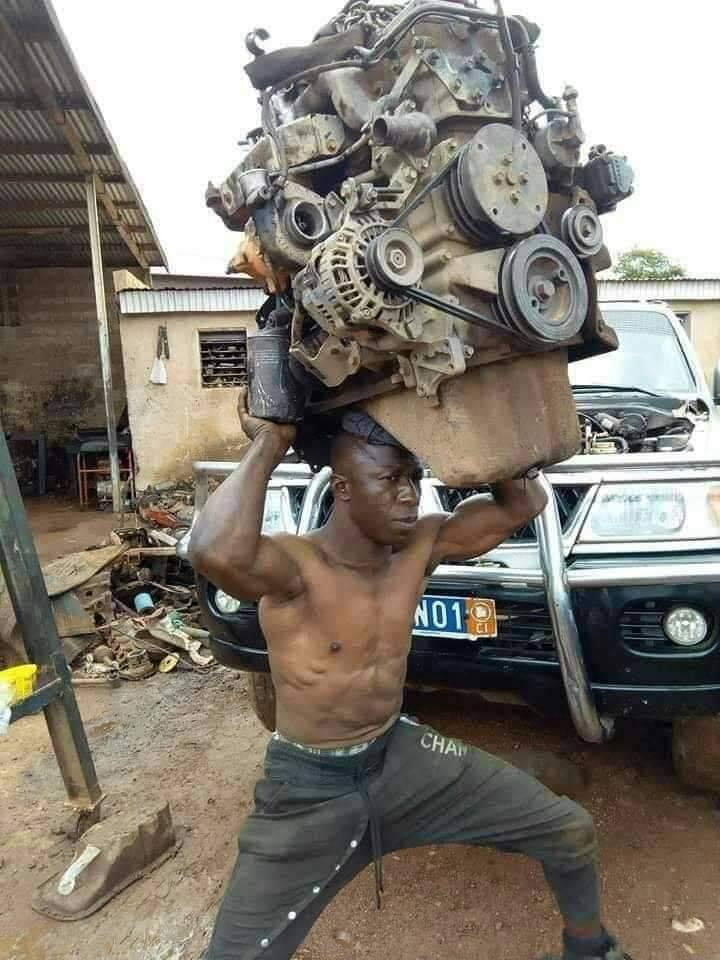
The image depicts a muscular man carrying a substantial engine block on his head and shoulders. He is outdoors, in what appears to be an informal automotive repair or salvage yard. The background is cluttered with vehicle parts, scrap metal, and a building with corrugated metal walls. The man is wearing basic clothing: dark trousers with "CHAN" printed on the side, and is barefoot. His expression is largely obscured, but appears focused or strained. He’s in the process of walking while balancing the heavy load. The lighting is bright, creating strong shadows and highlighting the textures of the metal and the man’s body. A vehicle, likely a white SUV, is partially visible in the background. The overall impression is one of physical exertion, labor, and a resourcefulness within a potentially challenging environment.
Marxist Conflict Theory
This image is strongly amenable to a Marxist reading. It immediately evokes themes of class, labor, and exploitation.
- Labor & Alienation: The man’s physical burden isn’t simply of weight, but of labor. He is demonstrably performing physically demanding work, possibly to earn a meager wage. This aligns with Marx's concept of alienated labor – the worker is separated from the product of their labor, and the work itself lacks inherent meaning or fulfillment. He is reduced to a functional component in a system.
- Class Structure: The setting—a scrap yard or informal workshop—suggests a position within the periphery of the capitalist system. This man is likely performing the kind of essential but devalued labor that keeps other parts of the economy functioning. His physique, while impressive, doesn't necessarily signal privilege; it is shaped by the demands of his labor.
- Power Dynamics: The image implicitly points to the power dynamics at play. There is an unseen owner or recipient of this labor who benefits from the man's strength. This highlights the inherent imbalance of power in a capitalist system where the means of production are not equally distributed. The man is a tool, a source of profit for another.
- Commodity Fetishism: While subtle, the engine itself can be viewed through the lens of commodity fetishism. It appears as a valuable object, but the immense amount of labor involved in its creation, maintenance, and now, salvage, is obscured. We focus on the object, not the exploitative conditions that brought it into existence.
Foucauldian Genealogical Discourse Analysis
A Foucauldian reading can explore the disciplinary aspects of labor and how bodies are constituted through power relations.
- Power/Knowledge: The man’s body is not simply a biological entity, but a product of the knowledge and power that shape his work. The skills required to handle the engine, the understanding of mechanics, and even his physical conditioning are all forms of knowledge produced within a specific regime of labor.
- Discipline & Normalization: His physical strength isn’t merely a natural attribute, but a normalized expectation within this context of work. The body is disciplined and trained to perform this task, reinforcing the demands of the system. The ability to carry such a weight becomes a marker of ‘fitness’ or ‘ability’ within this specific field.
- Genealogy of Labor: We could trace the historical genealogy of this labor. What conditions and technologies led to the development of this type of work? How has the body been modified (through training, tools, etc.) to become adapted to it? This exposes how current practices are not natural or inevitable, but contingent on historical power relations.
- Panopticism (subtle): While not a direct application, the potential for constant monitoring within a workshop or yard (even if not physically present) could be seen as a subtle form of panoptic control. He's aware that his performance is potentially being observed and judged.
Postmodernism
A postmodern reading is less direct but still relevant:
- Deconstruction of "Work": The image disrupts the conventional notion of "work" as a clean, organized activity. It's raw, physical, and embedded in a chaotic environment. This deconstructs the idealized images of labor often presented in media.
- Fragmentation and Hybridity: The setting is a fragmented landscape of discarded parts and makeshift repairs. This speaks to the postmodern fascination with fragmentation and the blurring of boundaries.
- Hyperreality: The engine itself can be seen as a symbol of technological advancement, yet it's presented in a state of disassembly and disrepair, challenging the notion of progress and perfection.
- Ambiguity: The man’s expression is obscured, and the context of his work is vague. This ambiguity aligns with the postmodern rejection of grand narratives and fixed meanings.
Critical Theory
Critical theory can provide a broader perspective on the image.
- Domination and Emancipation: This image is a clear example of power imbalances and domination. The man is subjected to a physically demanding task, likely for economic gain. A critical theoretical analysis might ask: what conditions would be necessary to achieve emancipation from this form of exploitation?
- Ideology: The image challenges us to examine the ideologies that justify this type of labor. How are working-class bodies and labor valued (or devalued) in society? What narratives are used to normalize this type of exertion?
- The "Other": The image could also be viewed through the lens of representation. The man’s body is potentially "othered" – positioned as different from the viewer, and subject to scrutiny and judgment.
Queer Feminist Intersectional Analysis
This analysis isn't a central reading of the image, but could add nuance:
- Gendered Labor: While the man’s gender is apparent, it’s worth considering how physically demanding labor is often historically associated with masculinity. Examining the expectations and pressures placed on men to perform this type of work could be useful.
- Intersectionality: To understand the full context, we’d need information about the man’s race, ethnicity, and socioeconomic background. These intersecting identities would shape his experience of labor and power.
- Body as Site of Resistance/Control: The image highlights the body as a site of both control (through labor demands) and potential resistance (through physical strength and endurance).
I hope these analyses provide a nuanced and insightful interpretation of the image. Remember that these are just possible readings, and others are equally valid.
simple-description (llama3.2-vision)
This meme features a photo of a person, presumably a man, lifting a massive weight, likely a car or a heavy machine, above their head. The image is captioned "I just spent 3 hours making a 10 minute workout".
tesseract-ocr
a KGa LF) . ge ee i 1 j . 0 ® y) oe a; \ ‘ ~ ances y. ’ x \ “024 LG ‘ a _—— le Sa (| " ; h wera . wie = “y 4 \ Tg > (e f AT 3 »\ ice " " — ws i; ns he . y} = =e = S } = a "a ~ \ \ 4 <= 1, oe i 5 i i y a : Es ee ee Al . . a \) oe . = = i Sei Pe —5 x —s CORES) y EY dee oS | ——— FE Es “a ye oe a ented hl u FF aT i 7 Sit =e. oa