First Seen
2023-05-10T21:03:39+00:00
simple-description (llama3.2-vision_11b)
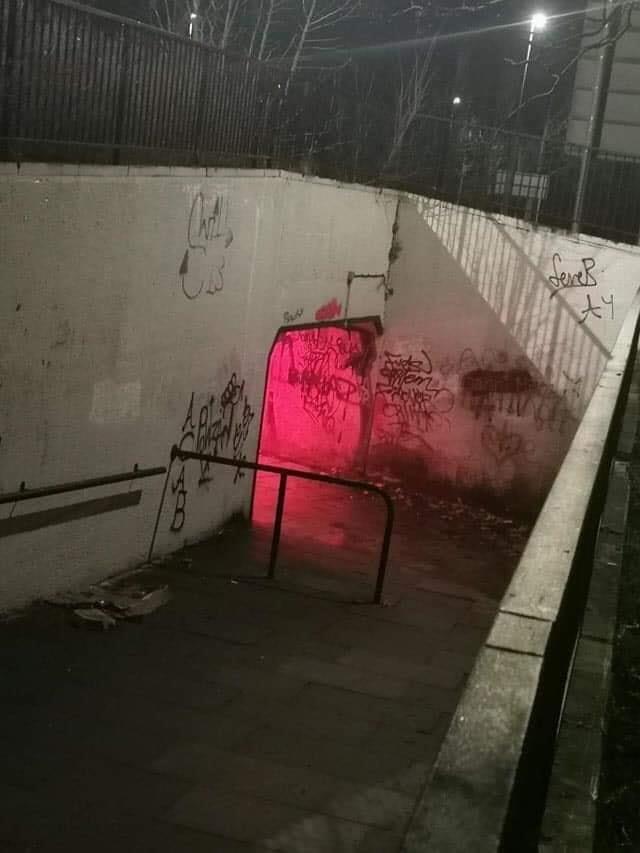
The meme is an image of a dark, eerie tunnel with a faint, pulsing glow emanating from the walls. The text "I can smell the desperation" is overlaid on the image, implying that the tunnel is a symbol of hopelessness and despair. The image is meant to evoke a sense of foreboding and anxiety, as if the viewer is being led into a dark and ominous place.
detailed-analysis (gemma3-27b-vision)
Okay, let's break down this image through the requested critical lenses.
Visual Description
The image depicts a concrete underpass or tunnel, likely beneath a road or railway line. The structure is utilitarian and somewhat stark, with rough, gray concrete walls covered in graffiti. The graffiti is extensive, varying in color and style. The underpass appears to be wet, possibly from recent rain, with scattered debris along the edges.
A bright, almost neon, pink/red light illuminates a central section of the tunnel, creating a dramatic contrast with the surrounding darkness. The light source is not directly visible, contributing to an unsettling, almost theatrical atmosphere. Black metal handrails run along the sides. The lighting creates long, harsh shadows, emphasizing the depth and claustrophobia of the space. The overall impression is one of urban decay, marginalization, and a slightly eerie, unsettling beauty. The framing is from a low angle, looking upwards within the tunnel, increasing the sense of enclosure.
Foucauldian Genealogical Discourse Analysis
This image provides fertile ground for a Foucauldian analysis. The underpass itself embodies heterotopia, a space that is simultaneously real and unreal, a space of otherness within the normalizing spaces of the city. It’s a site of transgression, a place where rules and norms are loosened or broken.
- Power/Knowledge: The graffiti represents a counter-discourse to the official narratives of the city. It's an attempt to claim space and voice in a landscape that often silences marginalized groups. The act of tagging is a manifestation of power – a claiming of ownership, even if illicit. The very presence of the underpass, designed to facilitate pedestrian movement under and away from the main flow of traffic, represents a spatial articulation of power – a segregation of bodies and experiences.
- Genealogy: Tracing the genealogy of the underpass reveals a history of urban planning, control, and the desire to organize space for efficient movement and social control. The graffiti, then, is a disruption of that order, a layering of alternative histories and meanings.
- Discipline and Panopticism: While not a direct panoptic space, the underpass can be seen as a site where surveillance occurs. The darkness, while seemingly offering anonymity, also creates a sense of being watched or exposed. The harsh lighting can be interpreted as a form of “illumination” – a bringing into view and thus, potential control – of those who utilize this space.
Critical Theory
From a broadly Critical Theory perspective, the image embodies many themes of alienation and social fragmentation.
- The Built Environment and Social Control: The underpass, as part of the broader urban landscape, can be seen as a manifestation of rationalized control. It’s a functional space designed to facilitate movement, but it lacks warmth, beauty, or a sense of community. This contributes to the sense of alienation experienced by those who inhabit or pass through it.
- Commodification of Space: The city, in general, is increasingly commodified. This underpass, even in its "decay," is part of that system. It’s a space between commercially valued areas, existing as a necessary but overlooked infrastructure component.
- The Spectacle: The bright pink light, while aesthetically striking, can be interpreted as a form of spectacle, diverting attention from the underlying social and economic issues that contribute to the underpass’s state. It's a superficial "brightness" masking deeper darkness.
Marxist Conflict Theory
A Marxist interpretation would see the underpass as a space reflecting class conflict and the inherent contradictions of capitalism.
- Spatial Segregation: The underpass represents a marginalized space, often inhabited by those on the fringes of society – the homeless, the dispossessed, those who cannot afford better access to the city. It’s a physical manifestation of social stratification.
- The Production of Space: The creation of the underpass is tied to the development of infrastructure driven by capitalist expansion. It's a space created for the needs of production and circulation, rather than for the well-being of individuals.
- Contestation and Resistance: The graffiti, in this context, can be seen as an act of resistance against the dominant order. It's a claiming of space by those who are excluded from the mainstream, a visual expression of discontent.
Postmodernism
The image resonates with key themes of Postmodernism.
- Deconstruction of Grand Narratives: The underpass itself rejects any notion of a unified, coherent urban vision. It's a fragmented, messy, and incomplete space. The graffiti further destabilizes any sense of order or meaning.
- Simulation and Hyperreality: The bright pink light creates an artificial, almost dreamlike atmosphere. It's a simulacrum – a copy without an original – that distorts reality and challenges our perceptions.
- Fragmentation and Loss of Meaning: The image embodies a sense of fragmentation and the loss of traditional values and beliefs. The graffiti, in its chaotic energy, represents a rejection of fixed meaning and a celebration of ambiguity.
Queer Feminist Intersectional Analysis
This lens is particularly powerful when considering the image.
- Spatialized Oppression: The underpass is likely a space where marginalized genders and sexualities experience heightened vulnerability and risk of harassment or violence. These spaces are often avoided or traversed with caution.
- Intersectionality: The underpass likely holds different meanings and risks based on the intersection of identities. A queer person of color may experience the space very differently than a white, cisgender man.
- Reclaiming Space: The graffiti, particularly if created by queer or feminist artists, can be seen as an act of reclaiming space and asserting visibility. It's a way of disrupting the dominant, often heteronormative and patriarchal, structures of the city.
- The “Other” and Marginalization: The underpass itself is a liminal space, existing outside the “normal” flow of the city. This can be interpreted as a metaphor for the experience of being “othered” or marginalized within society. The bright pink lighting, while visually striking, could be read as a deliberate act of disrupting the grayscale aesthetic of power, challenging norms of visibility and representation.
Let me know if you’d like me to elaborate on any of these points or explore additional perspectives!
simple-description (llama3.2-vision)
The meme is an image of a dark and abandoned subway tunnel. The text "I love this place" is scribbled on the wall in a childish, messy handwriting. The image is often used to express a sense of irony or sarcasm, implying that the speaker is not actually enjoying the eerie and possibly threatening environment.
tesseract-ocr
Pim: ss) ee emg i Mitel HT nN i ih a ai t thay | a) a At ieee 3 } Mi hie ea s r cy er = = ’ a | ha. 8 j ; \ a A i } YP , i set! zt gi Ares . _——e } ae ty f | 1) ae aa 2 f Ci he 3 “ = F | pi 4