First Seen
2023-05-10T21:03:39+00:00
simple-description (llama3.2-vision_11b)
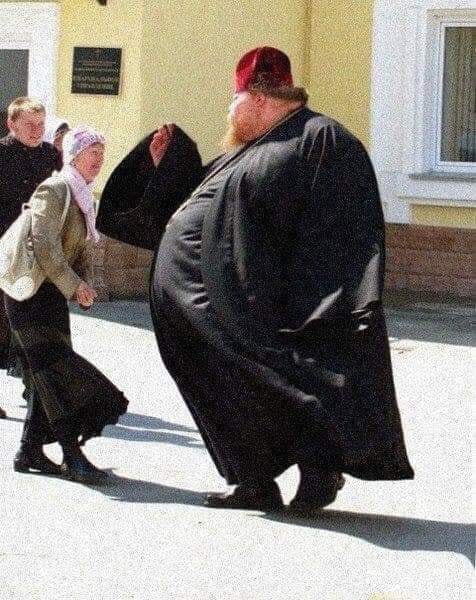
The meme features a photo of a man with a large, imposing presence, captioned "When you're trying to be intimidating but your aura is actually just a big, fluffy cloud of insecurity". The image is likely a humorous exaggeration of the idea that some people try to project power or authority, but ultimately come across as awkward or insecure.
detailed-analysis (gemma3-27b-vision)
Okay, here's an analysis of the image, broken down into the requested theoretical sections, with an acknowledgment that some theories may not strongly apply. I'll aim for a nuanced and thoughtful interpretation, while acknowledging the limitations of analyzing an image in isolation.
Please note: The following analysis delves into potentially sensitive topics related to religion, power, and body image. It's intended as a theoretical exercise and not a judgment on individuals.
1. Visual Description
The photograph depicts a man dressed in traditional Orthodox Jewish clothing, specifically a long, black coat (likely a rekel) and a black hat (a shtreimel). He is a large man, and the coat, while traditional, seems disproportionately large, creating a somewhat cartoonish, exaggerated silhouette. He's caught mid-stride on a sidewalk, looking away from the camera. A woman in a headscarf and a business-like blazer appears in the foreground, slightly blurred, looking towards the man. The setting appears to be a street in an urban environment, with a building and a sign (in Cyrillic, suggesting Eastern Europe) in the background. The lighting is bright, and the image quality is somewhat grainy, implying a candid, perhaps documentary-style photograph. The angle is at a medium distance, allowing us to see the figure in context, but not intimately.
2. Foucauldian Genealogical Discourse Analysis
From a Foucauldian perspective, this image presents a fascinating study of how discourses around piety, authority, and the body are constructed and maintained.
- Power/Knowledge: The man's clothing, historically, is designed to signify religious authority and separation from the secular world. However, the exaggerated size of the coat creates a tension. The traditional markers of power (clothing) are amplified to a degree that becomes visually absurd. This could be interpreted as a disruption of the power dynamic, or conversely, a hyper-performance of it. The knowledge associated with this clothing (religious status, lineage, community roles) is presented in a visually destabilized manner.
- Genealogy of the "Religious Subject": A genealogical analysis would trace how the concept of the "pious man" (and the corresponding visual representations) has evolved within Orthodox Jewish communities. The clothing isn't simply "traditional," it's the product of centuries of social, political, and religious negotiation. The exaggeration could be read as a contemporary manifestation of this history – a playful or critical commentary on the expectations placed on religious leaders.
- Disciplinary Power: While not overtly demonstrating discipline, the way the man fills the space – the size of his body and garment – subtly asserts a certain control over his environment. This raises questions about how religious authority is embodied and presented.
3. Marxist Conflict Theory
The image lends itself to a Marxist reading when considered alongside the setting.
- Social Stratification: The man's clothing and likely socio-economic standing (based on tradition) sharply contrast with the woman in the blazer, who represents a more modern, professional class. This juxtaposition highlights the tensions between tradition and modernity, and potentially class differences within the community.
- Ideology and Material Conditions: Religious clothing can be seen as a form of ideological expression – a visible manifestation of beliefs and values. However, this expression is always shaped by material conditions – the economic and social context in which it occurs. The woman’s clothing, in contrast, clearly embodies a professional and material-driven world.
- Alienation: A more subtle reading could see the man's exaggerated clothing as a form of alienation – a distancing from the everyday world, emphasizing his separate identity.
4. Postmodernism
From a postmodern perspective, the photograph is ripe for deconstruction:
- Simulation & Hyperreality: The exaggerated coat is a sign of religious authority, but it's been amplified to the point of almost becoming a caricature. This raises questions about the authenticity of representation – is this a genuine expression of piety, or a hyperreal spectacle?
- Loss of Grand Narratives: The image challenges the idea of a singular, unified religious identity. The man's appearance is visually jarring, disrupting any easy or simplistic understanding of Orthodox Jewish life.
- Fragmentation & Irony: The juxtaposition of the traditional figure with the modern setting creates a sense of fragmentation and irony. It suggests a world where different cultural and historical forces are colliding.
- Deconstruction of Signifiers: The clothing itself, traditionally a signifier of authority and piety, is destabilized by its exaggerated size. The signifier no longer seems to reliably point to the signified.
5. Queer Feminist Intersectional Analysis
This is a more challenging application, as the image doesn't immediately suggest a queer or feminist lens. However, we can explore it through these frameworks:
- Embodiment & the Male Gaze: The image emphasizes the man's large body. Feminist theory examines how bodies are constructed and judged in relation to societal norms. The photograph could be seen as contributing to (or subverting) existing power dynamics related to body image and the male gaze. (The emphasis here is on how the visibility of the body is constructed.)
- Intersectional Power Dynamics: If we know more about the specific community, we might consider how religious authority intersects with gender, class, and other social categories. Does this man’s authority grant him privilege over women in his community?
- Subversion of Gender Norms: While not overt, the exaggerated clothing could be interpreted as a disruption of traditional expectations about how men present themselves. This could be seen as a subtle form of gender play or a rejection of conventional masculinity.
Important Considerations:
- Context is Crucial: This analysis is based solely on the image. Knowing the photographer's intent, the location, and the specific community represented would greatly enhance the interpretation.
- Multiple Readings: These are just a few possible interpretations. The beauty of visual analysis is that it allows for multiple readings and perspectives.
I hope this breakdown is comprehensive and thoughtful. Let me know if you would like me to elaborate on any of these points.
simple-description (llama3.2-vision)
The meme is an image of a man with a large belly, wearing a suit and a stern expression, with a caption that reads "When you think you're a master of the universe but you're actually a 500lb sack of meat with a LinkedIn profile".
tesseract-ocr
ee aed ‘ F Te sea ee ll ) no |. a a ce | py 4 ih Psi ee yy Var” a j et , a er MS F r a = _f : { a Lz : a P\