First Seen
2023-05-10T21:03:39+00:00
simple-description (llama3.2-vision_11b)
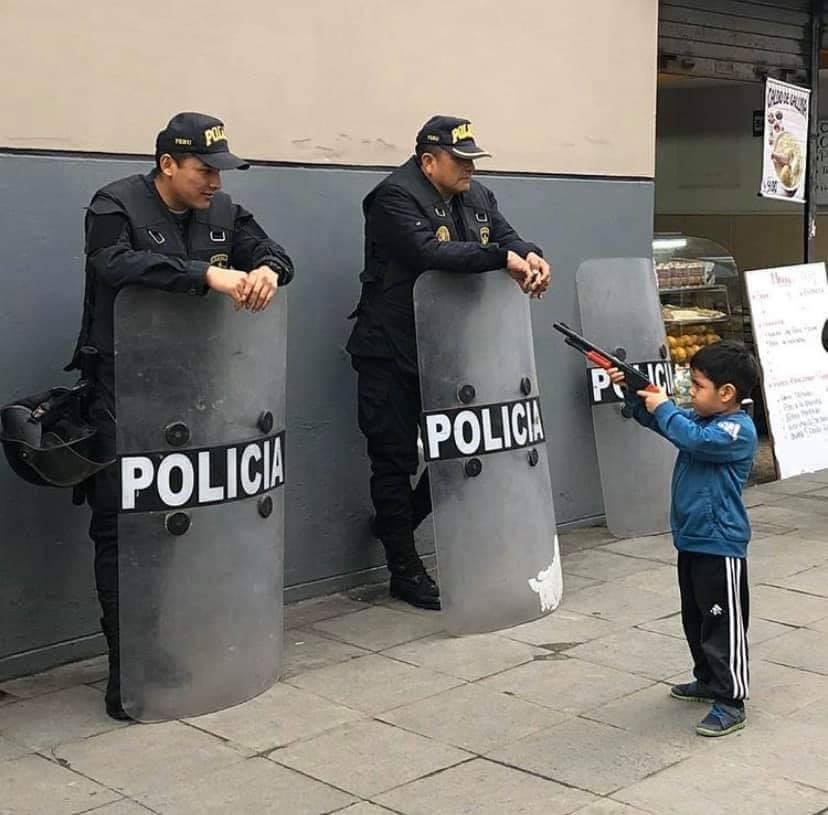
The meme is an image of a child holding a toy gun, with a caption that reads "I'm not a child, I'm a powerful aura." The image is meant to be humorous, as it juxtaposes the idea of a child with the concept of a powerful aura, implying that the child is somehow imbued with a powerful and intimidating presence. The caption is likely meant to be ironic or sarcastic, suggesting that the child is actually a force to be reckoned with.
detailed-analysis (gemma3-27b-vision)
Okay, here’s an analysis of the image, broken down into sections as requested. I will only include the sections that genuinely apply to the content of the photograph, rather than forcing fits.
Visual Description
The photograph depicts two Peruvian police officers standing behind large, cylindrical barriers labelled "POLICIA" in bold white letters. They are wearing full black uniforms with caps, appearing stoic and observant. They each lean against the barriers, one holding what appears to be a shotgun. A young boy is positioned in front of them, playfully "aiming" a toy gun (or hand gesture resembling one) at the officers. The scene takes place on a paved sidewalk in front of what seems to be a small shop or storefront, evidenced by a menu or flyer posted on the wall and a display window. The image has a candid, documentary feel, seemingly captured during a real-world event or protest. The composition highlights the stark contrast between the power and authority represented by the police and the innocence and playfulness of the child. The light is overcast and appears to be a dull grey, lending to the tension of the photo.
Foucauldian Genealogical Discourse Analysis
This image is ripe for a Foucauldian analysis. The police officers, standing behind the barriers marked "POLICIA," represent an embodiment of power/knowledge. The “POLICIA” label isn’t simply an identification marker, but a constant, material reinforcement of their authority, a discourse built into the physical landscape. The barriers themselves are crucial; they don’t just contain the police, they constitute their role as protectors and enforcers.
The child's play, however, disrupts this neat construction. By imitating the posture of the police – "aiming" a weapon – the child replicates the power dynamic. This isn't simply a naive act of imitation, but a demonstration of how power relations are learned, internalized, and performed from a young age. The child’s play draws attention to the fact that police authority is constructed and performed, not innate.
A genealogical approach would examine the history of policing in Peru, tracing the evolution of its practices, discourses, and the justifications used for its authority. It would investigate how the "POLICIA" as an institution has come to occupy this position of power, what norms and values it enforces, and what marginalized groups are subject to its control. The photo, therefore, becomes a snapshot of a complex web of historical power relations, materialized in this immediate scene.
Marxist Conflict Theory
From a Marxist perspective, this image illustrates the inherent class conflict and the role of the state (embodied by the police) in maintaining the existing power structure. The police, as representatives of the state, function to protect the interests of the ruling class and suppress dissent. The barriers symbolize the physical and ideological division between those in power and those who are marginalized or oppressed.
The child, in this context, can be seen as a symbol of the future generations who will either perpetuate or challenge this system. The child's "play" with a weapon, while seemingly innocent, foreshadows the potential for future conflict and the cycle of violence that is often embedded in class-based societies.
The background elements – the shop, the street – point to the everyday contexts in which class struggle unfolds. The police are not simply abstract figures of authority, but active participants in the economic and political dynamics of this specific locality. Their presence, particularly if taken during a protest or period of social unrest, is a demonstration of the state's willingness to use force to maintain the status quo.
Postmodernism
A postmodern reading of the image emphasizes the simulacra and the deconstruction of grand narratives. The police, as symbols of law and order, are not inherently "real" or objective. They are representations, images constructed through media, culture, and historical discourse. The "POLICIA" label on the barriers is a signifier devoid of a stable, original meaning; it is a floating signifier that evokes a range of associations and interpretations.
The child’s play further disrupts the established order by blurring the lines between reality and representation. The child is performing the role of a police officer, creating a parody of authority. This parody challenges the notion of a singular, legitimate source of power.
The image can also be interpreted as a commentary on the spectacle of power. The police are presented as figures of authority, but their actual actions and motivations remain opaque. This ambiguity creates a sense of distrust and skepticism towards institutions of power.
Queer Feminist Intersectional Analysis
While not the most dominant theme, intersectional lenses can be applied. The image, while appearing straightforward, silently reinforces a normative idea of power, authority, and what it means to be a protector. Traditional policing is overwhelmingly dominated by masculinity and, historically, has been used to control and oppress marginalized genders and sexualities.
The child's imitation of the police, while playful, can be read as an early internalization of these dominant norms. It reinforces the idea that strength and authority are associated with masculine figures and the use of force.
A queer feminist reading might ask: Where are the voices and perspectives of those who are most vulnerable to police violence? What alternative models of safety and security exist outside of traditional law enforcement? The image, in its silence, omits these crucial considerations. While a direct reading would not apply, this highlights the absences that can be interrogated from an intersectional point of view.
I hope this detailed breakdown is helpful! Let me know if you'd like any further clarification or elaboration on any of these sections.
simple-description (llama3.2-vision)
The meme is an image of a young boy holding a toy gun and pointing it at a group of police officers. The officers are standing with their arms crossed and appear to be unimpressed by the boy's threat. The text "I'm not a cop, I'm a kid with a toy gun" is often included in variations of this meme.
tesseract-ocr
eA - oth rae > aS )SC li : 4 | : 4 e = ( aa E z oY re SF 5 ee! ae) ae a - | = as =e ae SS Si e