First Seen
2024-06-03T20:44:14.506846+00:00
simple-description (qwen3.5_2b-q8_0)
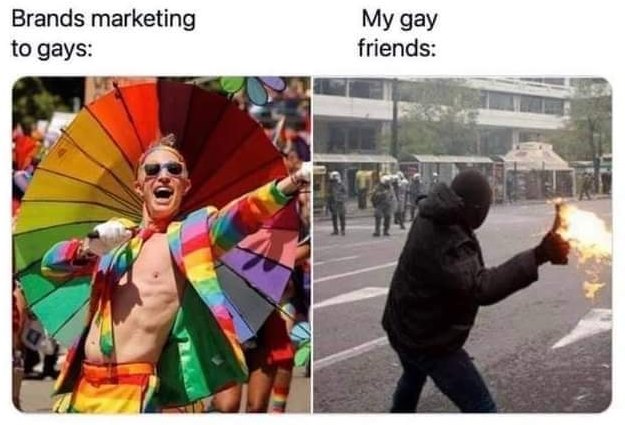
This meme uses the category of Pride to highlight the absurd contrast between the celebration of gay identity and the reality of hatred against it. On the left, a man dances enthusiastically in a vibrant rainbow costume with the text "Brands marketing to gays," representing the joyous acceptance of Pride. On the right, a person is angrily throwing a flare at riot police, labeled "My gay friends," representing the violent discrimination that often exists in real life. The joke lies in the juxtaposition of the ideal celebration with the ugly reality of hate crimes.
simple-description (llama3.2-vision_11b)
The meme is a humorous comparison between the way companies market to the LGBTQ+ community (specifically gay men) and how they might actually interact with their gay friends. The image shows a flamboyant, over-the-top "gay man" advertising a product, followed by a more subdued, edgy "gay friend" being a bit more... unpredictable. The text reads: "Brands marketing to gays: / My gay friends:".
detailed-analysis (gemma3-27b-vision)
Okay, let's break down this meme using the frameworks you've provided. It's important to note this meme is highly provocative and uses a stark contrast for comedic/critical effect. The analysis will reflect that.
Visual Description
The meme is a side-by-side comparison.
- Left Panel: A brightly colored image depicting a man in flamboyant rainbow-themed clothing (jacket, shorts) seemingly participating in a Pride parade. He's smiling and holding a large rainbow umbrella. The scene is full of color and suggests celebration.
- Right Panel: A more somber image showing a person in dark clothing throwing what appears to be a molotov cocktail during a protest/riot. There are other people present, as well as what appears to be police or security forces in the background. The image is desaturated, giving it a serious and urgent tone.
- Text: The text "Brands marketing to gays" is above the left image, and "My gay friends" is above the right image. This creates a clear juxtaposition.
Foucauldian Genealogical Discourse Analysis
This meme invites a Foucauldian reading by highlighting the construction of "gayness" as a category and the power dynamics at play in its representation.
- Discourse and Power: The left image exemplifies a specific discourse on gayness – one of consumerism, integration into mainstream culture, and performative celebration. Brands actively participate in this discourse, constructing "gayness" as a marketable identity. This discourse creates a subject, defining it, and therefore exerting power over it. The right image represents a different discourse – one of resistance, anger, and direct action. This is a rejection of the "acceptable" gayness promoted by brands.
- Genealogy: Tracing the "genealogy" of this image (how the idea of "gayness" has evolved) reveals a history of oppression, stigmatization, and subsequent attempts to co-opt and control that identity. The meme suggests that the current "rainbow capitalism" is a new form of control, replacing older forms of discrimination with a focus on purchasing power.
- Normalization & Discipline: The brand-focused "gayness" on the left can be seen as a means of normalization – making gayness palatable to the dominant culture. This normalization, while seemingly positive, can also be a form of discipline, encouraging conformity and discouraging radical challenges to the status quo.
Critical Theory
The meme clearly lends itself to a Critical Theory lens, particularly those concerned with ideology and domination.
- Ideology: The left image embodies a specific ideology – that acceptance and inclusion can be achieved through consumerism and market participation. This ideology obscures the underlying structural inequalities that continue to marginalize LGBTQ+ people. It presents a shallow solution to complex problems.
- Commodification of Identity: This meme highlights the commodification of LGBTQ+ identity. By turning rainbow imagery into a marketing tactic, brands are profiting from a community that has historically faced discrimination. This commodification diminishes the political and cultural significance of LGBTQ+ struggles.
- False Consciousness: The meme suggests that many LGBTQ+ individuals may be unaware of the ways in which they are being exploited by corporations. This could be interpreted as a form of "false consciousness" - believing that integration into the market system is true liberation when it's actually a form of control.
Marxist Conflict Theory
From a Marxist perspective, the meme speaks to the inherent contradictions of capitalism and class struggle.
- Exploitation: LGBTQ+ identity, like any other identity, becomes a source of profit for capitalist enterprises. Brands exploit the community's desire for recognition and acceptance to sell products, contributing to the accumulation of capital for the ruling class.
- Class Conflict: The meme implies a division within the LGBTQ+ community itself. The "marketable" gayness promoted by brands represents the interests of a more affluent segment of the community, while the direct action on the right represents the anger and frustration of those who are most marginalized and oppressed.
- Revolution vs. Co-optation: The riot suggests a desire for radical change – a rejection of the existing power structures. The brand marketing represents an attempt to co-opt that potential revolution, channeling it into consumerism and maintaining the status quo.
Postmodernism
A postmodern reading would focus on the deconstruction of meaning and the fluidity of identity.
- Hyperreality: The rainbow imagery of the left panel could be seen as part of a "hyperreality" – a simulation of reality that has become more real than the real itself. The constant bombardment of rainbow-themed advertising has created an artificial association between "gayness" and consumerism.
- Deconstruction of Identity: The meme challenges the notion of a singular, unified LGBTQ+ identity. It suggests that there are multiple, conflicting ways of being gay – from celebrating consumerism to engaging in direct action.
- Irony & Parody: The meme itself is an act of irony and parody. It juxtaposes two seemingly opposing images to expose the contradictions and absurdities of contemporary culture.
Queer Feminist Intersectional Analysis
This lens expands on the previous frameworks by considering the intersecting oppressions faced by LGBTQ+ individuals, particularly those who are also marginalized based on race, class, gender, and other factors.
- Intersectionality: The meme highlights the diversity of experiences within the LGBTQ+ community. The person throwing the Molotov cocktail may represent those who are disproportionately affected by systemic inequalities and who see direct action as the only way to achieve meaningful change.
- Critique of Assimilation: The meme implicitly critiques the pressure on LGBTQ+ individuals to assimilate into mainstream culture in order to gain acceptance. This assimilation can often come at the expense of radical political action and the solidarity of marginalized communities.
- Radical Resistance: The riot represents a form of radical resistance – a refusal to accept the limitations imposed by a patriarchal, capitalist, and heteronormative society. This resistance is particularly important for those who are most marginalized and oppressed.
In conclusion: This meme is a powerful, provocative statement about the commodification of LGBTQ+ identity, the contradictions of contemporary culture, and the diversity of experiences within the LGBTQ+ community. It invites a complex analysis using multiple theoretical frameworks. It's important to acknowledge that the meme is simplified and can be interpreted in various ways, but it raises important questions about the relationship between identity, politics, and capitalism.
tesseract-ocr
Brands marketing My gay to gays: friends: SW i ae —— are P a ao eal! la ‘ me: tL re (OO TR 7 aor ial =. nf P “iN i, ok ys oA Es A epee b So ‘i b yr , > y , “ > yr AU % . ; a7” ds a 4
simple-description (llama3.2-vision)
This meme is a split-image comparison between two scenarios. The left side shows a person celebrating or being joyful, likely at a Pride parade or LGBTQ+ event. The right side depicts a chaotic, intense scene with a person running away from flames or a riot. The text "Brands marketing to gays" is above the left image, and "My gay friends" is above the right image.