First Seen
2023-05-10T21:03:39+00:00
simple-description (llama3.2-vision_11b)
The meme is a humorous representation of the Pride flag, a symbol of LGBTQ+ identity and inclusivity. The image is a playful take on the traditional Pride flag, with a colorful and whimsical design that adds a touch of fun and personality to the iconic symbol. The text "Pride" is often overlaid on top of the flag, but in this case, it's replaced with "Pride: now with 100% more rainbow" - a tongue-in-cheek reference to the flag's iconic colors and the idea that it's now even more vibrant and celebratory.
detailed-analysis (gemma3-27b-vision)
Here's an analysis of the image, broken down into relevant sections as you requested. It's important to note that applying all of these frameworks can become somewhat complex and interpretive, so I'll aim for a nuanced and appropriate level of detail.
Visual Description
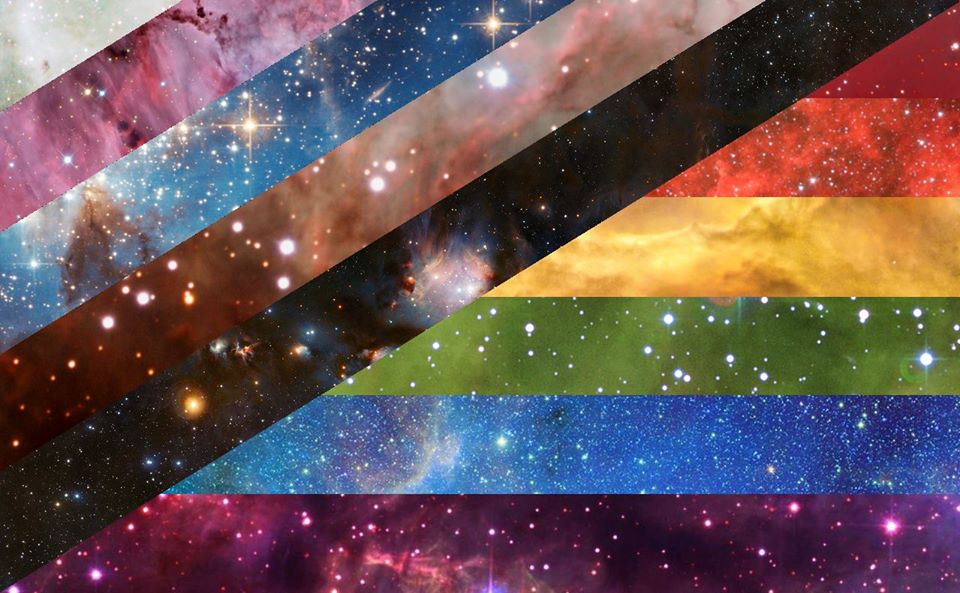
The image depicts a modified Pride flag. It follows the traditional six-stripe rainbow pattern, but each stripe isn’t a solid color. Instead, each band is filled with a detailed, high-resolution image of nebulae and cosmic dust clouds taken from space. The colors approximate those of the traditional Pride flag, moving from red to orange, yellow, green, blue, and violet. The overall effect is ethereal, expansive, and visually striking. The use of the nebulae imagery evokes a sense of vastness, timelessness, and the beauty of the universe. The speckled appearance is due to the stars in the images.
Queer Feminist Intersectional Analysis
This image powerfully embodies a queer feminist, intersectional sensibility. The Pride flag itself is a symbol of LGBTQ+ resistance and celebration, historically tied to the fight for visibility, liberation, and equal rights. The intersectional part comes into play with the imagery layered onto the Pride flag.
- Expanding Boundaries of Identity: The vastness of the nebulae imagery can be understood as representing the expansive and fluid nature of gender and sexuality, pushing against narrow, binary definitions. The universe is not bound by limits.
- Challenging Normativity: Traditionally, representations of queerness have been limited by societal norms. The cosmic imagery subverts this, implying an existence beyond the confines of terrestrial norms and expectations.
- Interconnectedness: The nebulae are formed from the remnants of stars and the creation of new ones. This resonates with the idea that identities are not isolated, but rather constructed through social forces and connections.
- Cosmic Feminism: The feminized celestial imagery can be seen as linking queer liberation to a broader connection with nature, rejecting patriarchal domination and celebrating the feminine principle in the universe. The image can be read as a deconstruction of the dominant "masculine" order, re-imagining power dynamics on a cosmic scale.
Postmodernism
The image strongly aligns with certain themes of postmodernism:
- Deconstruction: By visually dismantling the simple, flat colors of the traditional Pride flag and replacing them with complex, layered images, the artwork can be seen as deconstructing the idea of fixed, essentialist notions of identity. The nebulae challenge the idea of a singular, pure, unchanging meaning.
- Simulacra and Hyperreality: The image presents a “simulacrum” of the Pride flag, a representation of a representation. It is not simply a Pride flag, but a layered, digitally constructed image of a Pride flag. It creates a sense of hyperreality, something more intense and complex than the original.
- Fragmentation: The nebulae are fragmented, chaotic, and unpredictable, reflecting a postmodern rejection of grand narratives and totalizing systems of meaning. The image emphasizes the individual parts rather than a unified whole.
- Playfulness and Irony: The image can be considered playful with an ironic edge, taking a symbol of a social movement and transforming it into something abstract and cosmic.
Foucauldian Genealogical Discourse Analysis
A Foucauldian approach would focus on the discourse surrounding sexuality, gender, and power, and how this image contributes to or challenges that discourse.
- Power/Knowledge: Michel Foucault argued that power and knowledge are intertwined. Historically, the discourse surrounding sexuality has been used to control and normalize certain behaviors, while marginalizing others. This image resists that control. By representing sexuality as vast, complex, and beautiful, the image challenges the power structures that seek to define and control it.
- Genealogy: A genealogical analysis would trace the historical evolution of the Pride flag as a symbol. It would consider how the flag emerged from specific historical struggles, and how it has been interpreted and reinterpreted over time. This image adds another layer to that genealogy, expanding the symbolism of the flag. It presents a new way of understanding what it means to be queer or transgender, and it challenges us to think critically about the history of the LGBTQ+ movement.
- Discursive Shift: The replacement of simple colors with cosmic imagery can be understood as a discursive shift. It moves the conversation away from narrowly defined categories of identity and toward a more expansive, fluid, and interconnected understanding of sexuality.
Important Note: Applying frameworks can be subjective. These are interpretations based on the visual information and the theoretical lenses provided.
simple-description (llama3.2-vision)
The meme is a screenshot of the "Asexuality Flag" with the colors of the flag (black, gray, white, pink, blue, purple) overlapping in a way that resembles a "no" symbol. The text "no" is written above the flag.
tesseract-ocr
Godg 6 ee: a ‘i Rae ih B > - ee oie ie > " : , Le oe oe a a... (5 og Y eee Se a. pfs ee , a al : . ie rr i *e : a 4 P —— aa ri ar ry ” — og ; “Ry a a ee " si Fi om ait we a ee ge ae , . oe “eo ae 5 rs se [ord a ' 4 9 Pee. eh eam * bomen ¢ F ra . Pag ye "Sa eT oe “a ze a, = a ee ee