First Seen
2024-06-01T22:11:20.722650+00:00
simple-description (qwen3.5_2b-q8_0)
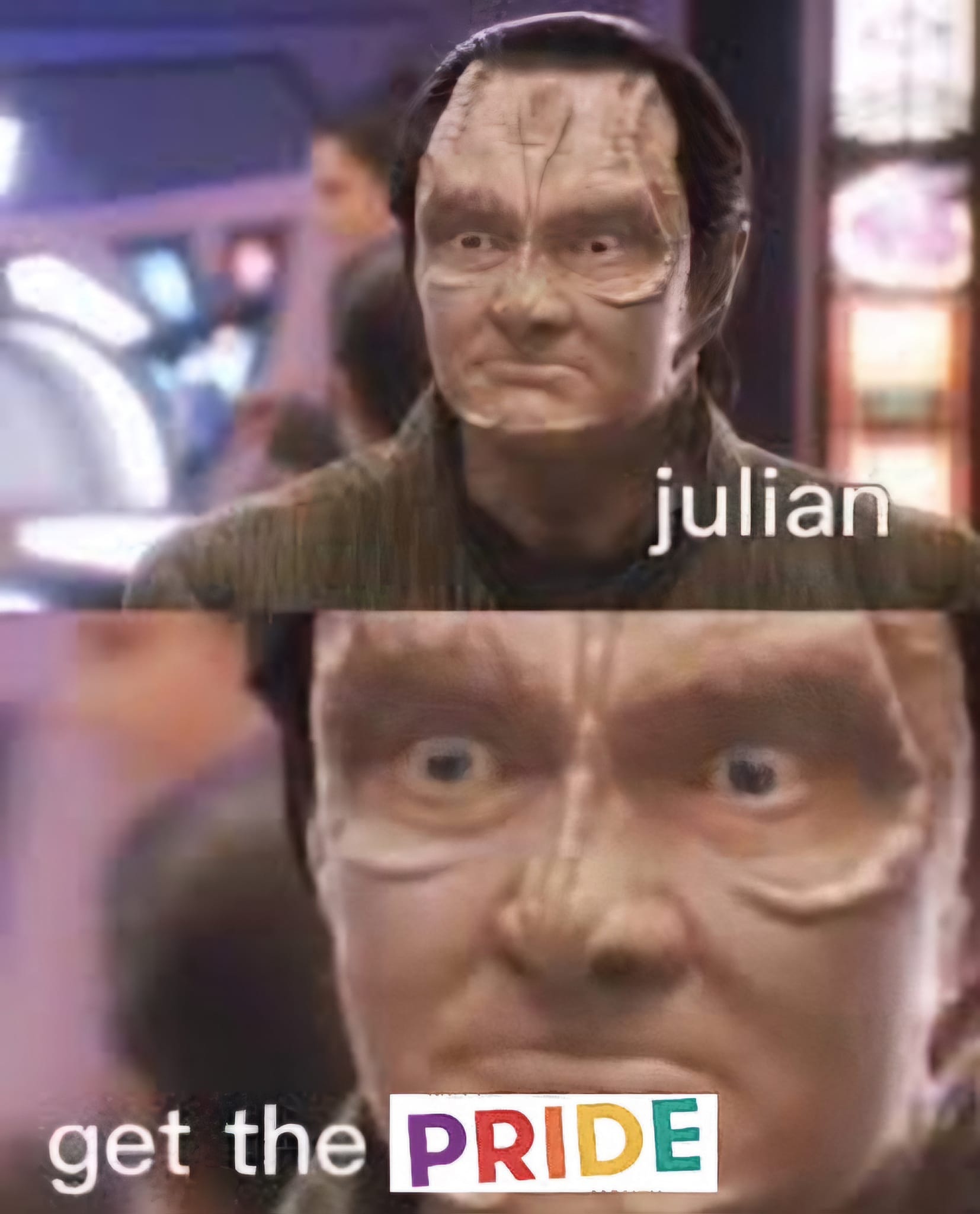
This meme features the character Julian from Star Trek, accompanied by the name "julian" at the top. Below, a close-up of his face is paired with the text "get the PRIDE," playfully suggesting that a person named Julian is supposed to actively get involved with the LGBTQ+ community.
simple-description (llama3.2-vision_11b)
The meme is a humorous take on the Star Trek character Data, played by Brent Spiner, with a caption that says "get the pride". The image shows Data's face with a confused expression, implying that he doesn't understand what "get the pride" means, and the word "pride" is likely referring to the LGBTQ+ community's Pride celebration.
detailed-analysis (gemma3-27b-vision)
Okay, let's break down this image, applying the requested theoretical lenses where applicable. It's a meme featuring a digitally altered image of Julian, a character from the television show Star Trek: Voyager, and the text "get the PRIDE." It’s ripe for analysis.
Visual Description
The image is a two-panel meme. The top panel features a close-up of Julian Bashir, a Star Trek character, looking stern and slightly distressed. The bottom panel presents a digitally manipulated image of the same character, appearing to be excessively smooth, almost doll-like, with the same stern expression and prominent eyes. The text "get the PRIDE" is superimposed at the bottom, in a bold, colorful font emphasizing the word "PRIDE." The background suggests a busy environment on the USS Voyager. The manipulation of the image, particularly the smoothing and the overall aesthetic, is striking. The stark contrast between the “normal” and altered portrait is key.
Foucauldian Genealogical Discourse Analysis
This image is interesting when approached through a Foucauldian lens because it highlights the construction of masculinity and beauty standards. Foucault’s work on power/knowledge relationships and discourse can be used to explore how the image plays with the historical formation of these categories.
- Discourse on Masculinity: The first image of Julian represents a fairly conventional depiction of a male character in science fiction, not overtly hypermasculine, but definitely embodying certain recognizable traits (stern expression, etc.). The altered image, though, presents a challenge to that discourse. The digitally smoothed, almost doll-like skin, and exaggerated features disrupt expectations of a masculine presentation. It challenges the “naturalness” of masculine features, suggesting they are produced through cultural and technological practices.
- Power and Normalization: The alteration itself, and its presentation as a desired state ("get the PRIDE") implies a form of power operating through normalization. Someone, somewhere, has decided that this altered aesthetic is preferable, and is attempting to impose it (humorously, in this meme) as a standard. The phrase "get the PRIDE" suggests that conformity to this altered aesthetic is somehow connected to self-worth or affirmation.
- Genealogy of Beauty: The smoothed skin and exaggerated features could be seen as linked to the genealogy of beauty standards in digital culture (e.g., filters, digital editing, the pursuit of "flawless" skin). The image could be read as a commentary on how digital technology is reshaping our understanding and pursuit of beauty.
Queer Feminist Intersectional Analysis
This meme’s potential for intersectional analysis is significant. The image, with its alteration of a male character's appearance towards a more conventionally "feminine" or aesthetically smoothed-out look, raises questions about gender performance and societal expectations.
- Challenging Masculine Norms: The digitally altered image deconstructs traditional representations of masculinity. The smoothing of features, removal of imperfections, and shift toward a more doll-like aesthetic can be read as a disruption of the rugged, stoic male archetype. It prompts questions about what is considered "attractive" and "desirable" in male bodies.
- Gender Performance and Drag: The image can be likened to a form of digital drag, in which gender is actively performed and destabilized. The altered image is not necessarily becoming feminine, but rather, playing with the signifiers of femininity and masculinity to create a complex and ambiguous performance.
- Intersectional Power Dynamics: The meme also implicates the larger dynamics surrounding beauty standards. While seemingly focused on male aesthetics, it connects to the broader ways in which bodies (across all genders) are judged, policed, and modified to conform to oppressive societal norms.
- Pride and Identity: The inclusion of the word "PRIDE" invites an interpretation linked to LGBTQ+ identities. The meme could be read as a satirical commentary on the ways in which individuals within the queer community (and beyond) engage with self-presentation and the pursuit of self-affirmation. "Get the PRIDE" can then be read as an invitation to embrace one's own unique identity, even if it challenges conventional norms.
I’ve focused my analysis on the areas where the image most clearly lends itself to theoretical framing. Let me know if you'd like me to elaborate on any of these points, or explore other perspectives.
tesseract-ocr
a mo os) > we Mle i ae fe[-\amaays |
simple-description (llama3.2-vision)
This meme is a humorous image featuring the character Data from the TV show Star Trek: The Next Generation. The image shows Data's face with a confused expression, and the text "I'm sorry, captain. I am experiencing an emotional anomaly." is overlaid with the words "I am experiencing a gay anomaly" and "I am experiencing a lesbian anomaly". The image is captioned "I am experiencing a gay anomaly" and "I am experiencing a lesbian anomaly".