First Seen
2024-06-27T21:36:48.528050+00:00
simple-description (qwen3.5_2b-q8_0)
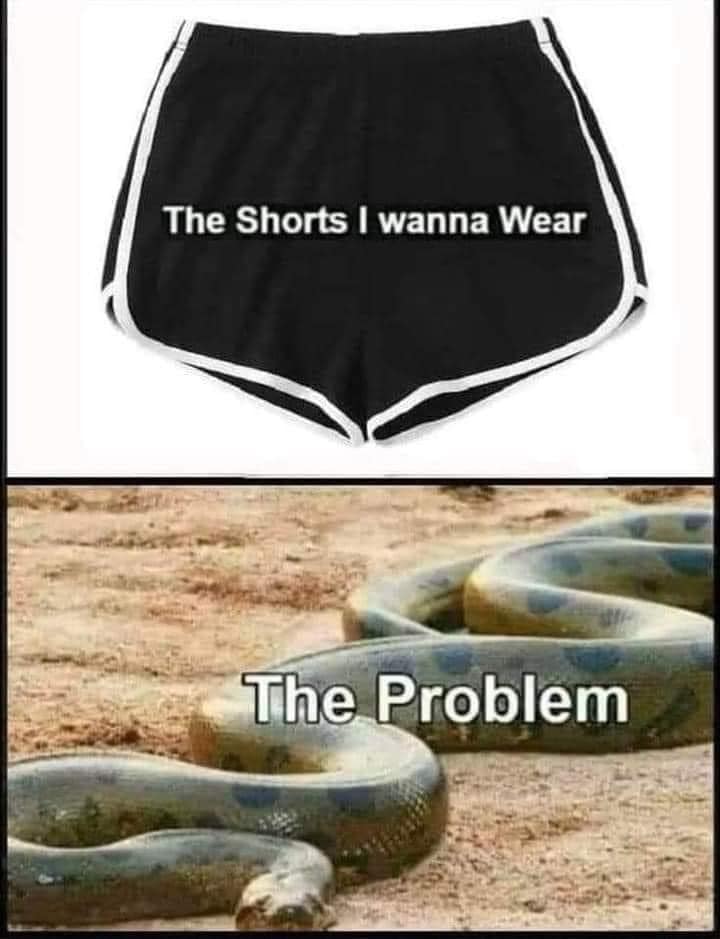
The top image features black track shorts with white stripes, captioned "The Shorts I wanna Wear," symbolizing a desire to express oneself or show off. The bottom image features a large green snake on the ground, captioned "The Problem," representing the frustrating obstacle that often blocks plans or makes life difficult.
simple-description (llama3.2-vision_11b)
This meme is a humorous take on the concept of pride and how it can be a source of conflict. The image shows a pair of shorts with the phrase "I want to wear these" next to a picture of a snake, implying that the person's desire to wear the shorts is being threatened by a snake, symbolizing the idea that one's pride can be vulnerable to attack. The phrase "I want to wear these" is juxtaposed with "I don't want to wear these" in a humorous way, highlighting the irony of the situation.
detailed-analysis (gemma3-27b-vision)
Okay, let's break down this meme through several theoretical lenses. It's a surprisingly rich piece of visual communication!
Visual Description
The meme is a two-panel format.
-
Top Panel: A pair of black running shorts with white stripes down the sides is presented. Text overlayed reads "The Shorts I Wanna Wear." The presentation is simple and direct, focused entirely on the garment itself.
-
Bottom Panel: A very large, coiled anaconda is shown. The snake takes up nearly the entire frame. Text overlayed reads "The Problem". The serpent is in a somewhat relaxed, yet still imposing pose.
The contrast between the seemingly harmless (even aspirational) item of clothing and the threatening, powerful image of the snake immediately suggests a metaphorical tension.
Foucauldian Genealogical Discourse Analysis
Michel Foucault's work emphasizes how power operates through discourse – the ways we talk about things. Analyzing this meme through a Foucauldian lens, we can see the following:
-
Discipline & the Body: The shorts represent a particular ideal of the body – athletic, fit, perhaps even sexualized (depending on context and wearer). This body is constructed through discourses of health, fitness, fashion, and even surveillance. The shorts themselves become a site where these discourses materialize.
-
The "Problem" as Disciplinary Power: The anaconda doesn't literally prevent the wearer from wearing shorts. Instead, the snake acts as a metaphor for anxieties and forces that attempt to regulate and control the body. This could represent body shaming, societal expectations about appearance, or even internalized feelings of inadequacy. The "problem" is not external, but a network of power relations that shapes self-perception.
-
Genealogy of Anxieties: We could trace the historical emergence of these anxieties related to body image. What discourses have historically shaped ideas about what bodies should look like? How have these discourses shifted over time? The anaconda becomes a symbol of the accumulated weight of these disciplinary forces.
Queer Feminist Intersectional Analysis
This meme gains significant layers of meaning when viewed through this lens:
-
Body Policing & The "Ideal" Body: The shorts, again, represent a desired aesthetic, but that aesthetic is deeply gendered and often unrealistic. The anaconda becomes a metaphor for the pressures placed on all bodies to conform to narrow standards of beauty, particularly those that prioritize thinness, fitness, or a specific body shape.
-
Intersectional Oppression: The "problem" isn't just about body image for all women. Different bodies face different levels of scrutiny and oppression. Black, Indigenous, Trans, Disabled, and fat bodies are held to different standards and often face greater levels of criticism and exclusion. The snake becomes symbolic of this intersecting network of power dynamics.
-
Reclaiming the Body: The desire to wear shorts, despite the anxieties represented by the snake, can be interpreted as an act of resistance. It's a declaration that one's body is their own, and that they will not be controlled by external pressures. The meme can thus be seen as a small act of self-affirmation, even if it acknowledges the struggle.
-
Queer Resistance: Queer bodies often inherently challenge normative ideas of beauty and gender. The meme resonates particularly strongly within queer communities, where the struggle for body acceptance is often acute. The snake might also represent internalized homophobia or transphobia, which can contribute to body image issues.
Let me know if you'd like me to elaborate on any of these points or analyze the meme through other theoretical frameworks!
simple-description (llama3.2-vision)
This meme is a play on the song "I'm a Slave 4 U" by Britney Spears, but with the lyrics changed to "I'm a slave 4 u, I'm a slave 4 u, I'm a slave 4 u, oh, oh, oh". The image is a picture of a snake with the words "I'm a slave 4 u" rewritten as "I'm a snake 4 u" and the lyrics "I'm a slave 4 u" rewritten as "I'm a snake 4 u" and the lyrics "I'm a slave 4 u" rewritten as "I'm a snake 4 u".