First Seen
2023-05-10T20:59:58+00:00
simple-description (llama3.2-vision_11b)
The meme is a picture of a quantum computer with a tangled mess of blue and white wires. The text "quantum computer: 0 errors, 100% uptime, always on time" is overlaid on the image. The joke is that the computer is being overly optimistic about its performance, implying that it's always on time and never makes errors, which is unlikely for a complex system like a quantum computer.
detailed-analysis (gemma3-27b-vision)
Okay, let's break down this image through several theoretical lenses.
Visual Description
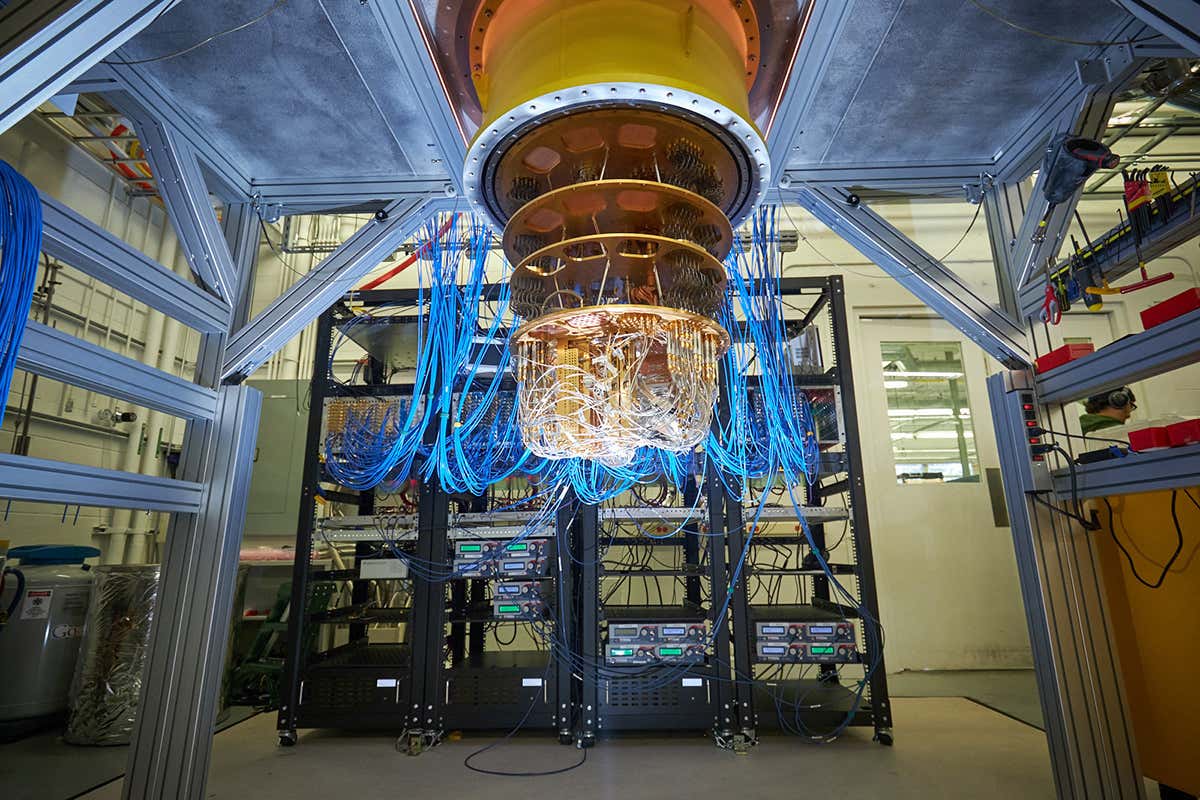
The image depicts a complex and highly technological interior. Dominating the scene is a spherical structure made of a lattice-like golden material, suspended from a cylindrical hub connected to the ceiling. Beneath the sphere is a series of black server racks, densely packed with electronic equipment displaying various lights and indicators. A vibrant network of bright blue cabling cascades down from the sphere and connects to the server racks, creating a visually striking contrast.
The scene is contained within a metallic framework, which forms a sort of cage or enclosure. The space appears to be an industrial or laboratory setting. The floor is a pale grey, and the background suggests a larger building with windows and additional equipment. The lighting is artificial and casts some dramatic shadows, highlighting the intricacy of the cabling and the structure itself. The overall impression is one of high-tech sophistication and immense computational power.
Foucauldian Genealogical Discourse Analysis
This image powerfully speaks to the deployment of power/knowledge as described by Michel Foucault. The structure itself can be seen as an embodiment of a discourse on computation, scientific inquiry, and control. Its complexity isn’t merely about functionality, but about establishing a specialized knowledge base, effectively barring access to understanding for those outside the scientific and technical fields.
- Discipline & Surveillance: The dense network of cables and the enclosure around the structure can be interpreted as a panoptic arrangement. Though not visually visible, data is likely being collected and processed, contributing to a system of knowledge and potential control. The very act of measuring and quantifying through this technology generates a norm against which other data is judged.
- Genealogy: Tracing the history of this technology—from early computing machines to the present—reveals how seemingly objective “truths” are constructed through specific historical and social forces. The image is not just a picture of a machine; it’s a snapshot of a continuing power dynamic shaped by those who design, control, and interpret the data it produces.
- Episteme: This image reflects a contemporary episteme—a system of thought—centered around data, algorithms, and the potential for prediction and control. The sphere, with all its cabling, becomes a symbol of this overarching system of knowing.
Critical Theory (specifically, relating to the technological sphere)
From a critical theory perspective (drawing on the Frankfurt School), this image embodies both the promise and the potential danger of instrumental rationality. The technology is designed for specific, measurable outcomes (scientific discovery, data processing). However, this focus on efficiency and control can overshadow broader ethical or social considerations.
- Technological Rationality: The image emphasizes the dominance of logic, calculation, and efficiency. It suggests a worldview where everything can be understood and controlled through technology.
- Commodification of Knowledge: The sphere and server racks represent a vast investment of capital and expertise. The knowledge generated by this technology is likely proprietary, owned by institutions or corporations, and used for specific (potentially profit-driven) purposes.
- Dehumanization: While not directly apparent in the image, the increasing reliance on such technology raises questions about the erosion of human agency and the potential for technology to dictate our lives. The complex system may function without a human component, or make human labor obsolete.
Marxist Conflict Theory
From a Marxist perspective, this image represents the concentrated ownership of the means of technological production.
- Class Struggle: The technology pictured is likely owned and controlled by a small elite (corporations, governments, research institutions), creating a significant power imbalance. Those who control the technology control the knowledge and, therefore, exert influence over society.
- Alienation: The complexity of the technology and the potential for automation can lead to worker alienation, as individuals become disconnected from the products of their labor.
- Capital Accumulation: The technology is a form of capital – an asset that can be used to generate further wealth. The image visually represents the ongoing process of capital accumulation, and the inherent inequality that comes with it.
Postmodernism
This image can be seen as emblematic of several core Postmodern themes:
- Simulacra & Simulation: The technology is engaged in processing information, creating representations of reality. The data produced may become more ‘real’ than the original subject being measured.
- Hyperreality: The sheer volume of data and the complexity of the systems may create a sense of hyperreality—a simulation that is more compelling than any “real” experience.
- Deconstruction of Grand Narratives: The image challenges any unified, objective view of knowledge. The technology produces fragmented data, open to multiple interpretations.
- Loss of Meaning: The complexity of the system can make it difficult to discern the ultimate purpose or meaning of the technology. It represents a world where information is abundant, but understanding is elusive.
Queer Feminist Intersectional Analysis (This is the most challenging application, as it's not immediately obvious in the image. The analysis requires some extrapolation.)
Applying a Queer Feminist Intersectional lens requires us to consider who is excluded from the development, control, and benefit of this technology.
- Dominant Masculinity in STEM: The field of technology has historically been dominated by men, particularly white men. This image, while not depicting individuals, represents a culture where women and non-binary individuals are underrepresented.
- Data Bias: The data processed by this system may reflect existing societal biases, leading to discriminatory outcomes. If the algorithms are trained on biased data, they will perpetuate and amplify those biases.
- Intersectionality of Exclusion: Marginalized groups (women of color, LGBTQ+ individuals, people with disabilities) are often doubly or triply marginalized in STEM fields. They may face barriers to access, lack of representation, and systemic discrimination.
- The "Black Box" & Opacity of Power: The complex nature of the technology mirrors the opacity of power structures. It can be difficult to understand how decisions are made or who is accountable. This opacity can be particularly harmful to marginalized groups, who may be disproportionately affected by the consequences of those decisions.
It’s important to remember that these interpretations aren't definitive. A single image can be analyzed from many different perspectives. These are merely potential avenues for exploration.
simple-description (llama3.2-vision)
The meme is an image of a computer server room with a massive stack of servers and cables, but the most prominent feature is a single server that's been "hacked" with a giant, glowing, green, "Hacked by Lulz" sign. The sign is a playful reference to the LulzSec hacking group, which was known for their high-profile hacks in the early 2010s.
tesseract-ocr
ye (eS \\\G7 ~ Wee) / 7 p “SS =e A - -f bf 5 \ z. e Co Ye eS wzZ "ae i <= \\ SS eer S| Fe i \\W im = LH A . << B SS : fi <p 4 SAS N | TT a rh 4 ae \i ve.) 1 =n Ss rg mi) SOs.) PL z sa j Panne, ST iiss — Ni j E tr Ie a va ea a 4 ac Nae i, pl hie yea A an SS —< i a ey Zi NN we i ewe poe _ Uae ma poe ak ism e bony 4) vw iy , ( eel) ||| pee eae WX) a yee Ze \\\ SZ Wie! a Se nn EZ el ee Het Uae ee ay} | 5 /|| | ~~ & z ode —— _ _ —s fs F