First Seen
2023-05-10T20:59:58+00:00
simple-description (llama3.2-vision_11b)
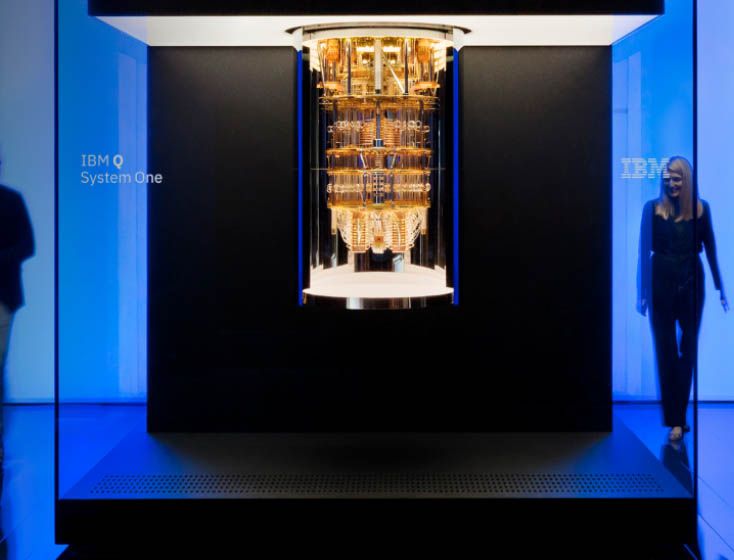
The meme features a photo of the IBM Quantum System One, a supercomputer that uses quantum mechanics to perform calculations. The image is captioned "When you're trying to solve a problem, but your quantum computer is just... existing". The meme is poking fun at the idea that a quantum computer can be so powerful that it can solve complex problems, but it's also just sitting there, not actually doing anything.
detailed-analysis (gemma3-27b-vision)
Okay, let's break down the image of the IBM Quantum System One using the requested theoretical frameworks.
Visual Description
The image depicts a striking installation of the IBM Quantum System One, a quantum computer. The machine itself is the focal point – a cylindrical structure with multiple tiers, composed of gold-colored metallic components. It appears to be suspended within a glass enclosure, set against a dark, likely black, background. The lighting is dramatic, emphasizing the machine's complexity and almost otherworldly appearance. The machine rests on a raised, dark platform and is surrounded by a clear glass enclosure. The entire scene is bathed in a strong blue light. A person is faintly seen on the right side of the image. There’s text visible on the left indicating “IBM Q System One.” The overall impression is one of sterile, futuristic technology presented as an almost sacred object.
Foucauldian Genealogical Discourse Analysis
Michel Foucault's genealogical approach allows us to examine how the IBM Quantum System One isn't simply a technological object, but a node within a historical and power-laden discourse around knowledge, computation, and control.
- Archaeology of Knowledge: The presentation of the Quantum System One within a glass enclosure recalls the historical evolution of displaying scientific artifacts – from cabinets of curiosities to museum exhibits. This isn't just about showing technology, but about establishing a specific regime of truth regarding quantum computing. It presents this technology as both mysterious and authoritative.
- Power/Knowledge: The image highlights the connection between power and knowledge. IBM (a powerful corporation) is positioning itself as the leader in this new field. The installation creates an aura of authority around quantum computing – suggesting that those who control this technology also control the future.
- Disciplinary Power: The very idea of quantum computing, and its potential applications (cryptography, advanced modeling) hint at possibilities of increased surveillance and control. The enclosure, while seemingly protective, also evokes a sense of containment – aligning with Foucault's notion of disciplinary power. The “sterile” and “futuristic” appearance also suggest scientific rationalism.
Critical Theory
The image can be analyzed through the lens of Critical Theory, specifically drawing on the Frankfurt School's concerns about technological rationality and the culture industry.
- Technological Rationality: The Quantum System One embodies a form of technological rationality – a belief that technology can solve all problems. However, this image obscures the social and ethical questions surrounding quantum computing. Who will benefit from this technology? What are the potential risks? The image's focus on the machine itself (its aesthetic and complexity) distracts from these crucial questions.
- Commodification of Knowledge: IBM presents this complex technology as a product to be marketed and consumed. The installation is designed to sell an idea – that quantum computing is the future, and IBM is leading the way. This aligns with the Critical Theory critique of how knowledge is increasingly commodified within capitalist systems.
- Spectacle & Alienation: The installation itself functions as a spectacle – a visually striking display intended to awe and impress. This spectacle contributes to alienation – distancing people from the actual implications and ethical concerns of quantum computing. It's a dazzling presentation that obscures the underlying social and power dynamics.
Marxist Conflict Theory
From a Marxist perspective, the image reveals the power dynamics inherent in the development and control of advanced technology.
- Means of Production: The IBM Quantum System One represents a significant investment in the “means of production” – the technological infrastructure that shapes economic and social power. IBM, as the owner and controller of this technology, holds a distinct advantage in the future economy.
- Class Conflict: The development and deployment of quantum computing will likely exacerbate existing class inequalities. Those with access to this technology (corporations, governments) will further consolidate their power, while others may be left behind. The image, with its emphasis on exclusivity and spectacle, reinforces this dynamic.
- Ideological Control: The presentation of the machine as a symbol of progress and innovation serves as a form of ideological control. It legitimizes the capitalist system by suggesting that technological advancement is inherently beneficial, even if it comes at the cost of social justice.
Postmodernism
The image can be read through a postmodern lens, particularly in terms of its manipulation of symbols, simulation, and the blurring of boundaries.
- Hyperreality: The installation creates a hyperreal environment – a simulation of reality that is more intense and compelling than reality itself. The dramatic lighting, glass enclosure, and sleek design create an aura of technological transcendence.
- Loss of Authenticity: The machine's presentation as a perfect, immaculate object obscures the messy, complex process of its creation. The focus on aesthetics overshadows the ethical and social implications of quantum computing.
- Fragmentation of Meaning: The image does not offer a clear, singular message. Instead, it invites multiple interpretations and reflects the postmodern condition of uncertainty and ambiguity.
Queer Feminist Intersectional Analysis
While not immediately obvious, a Queer Feminist Intersectional analysis can reveal power dynamics regarding who gets to participate in the creation and benefit from this technology.
- Exclusionary Practices: Historically, STEM fields (science, technology, engineering, and mathematics) have been dominated by white, cisgender men. The image doesn’t necessarily show this, but it can prompt a critical question: Who is not represented in the creation of this technology? What biases and perspectives are embedded in its design?
- Technological Determinism & Gender: The presentation of the machine as a neutral, objective force can reinforce a form of technological determinism. This ignores the ways in which technology is always shaped by social and gendered assumptions.
- Intersectionality: The benefits of quantum computing (and the risks) will not be distributed equally. Intersectional analysis demands that we consider how race, gender, class, and other social categories will intersect to shape access and experiences with this technology. (This is not explicitly depicted, but it’s a critical question raised by the image.)
I hope this detailed breakdown, organized by the requested theoretical frameworks, is helpful. Let me know if you’d like me to elaborate on any particular aspect.
simple-description (llama3.2-vision)
This meme is an image of the IBM Quantum System One, a large and complex computer system, with the text "I can explain it to my mom" written above it. The joke is that the system is so complex and technical that it's unlikely to be understood by someone without a strong background in computer science or physics. The image is likely accompanied by a caption or context that implies the speaker is trying to explain a complex concept to someone who doesn't understand it.
tesseract-ocr
er ” } s kt fil aos Santo be Tnnryes (ay pei. ial we Bhi ena a ne " epage sing en Gir ‘SL , 4 " j