First Seen
2023-05-10T21:03:40+00:00
simple-description (llama3.2-vision_11b)
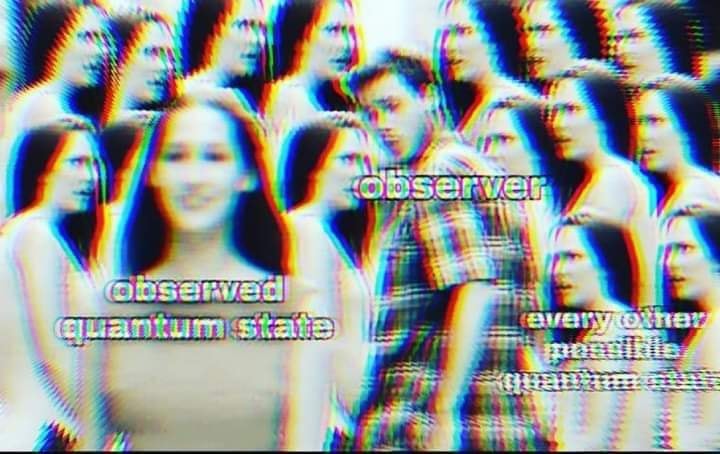
The meme is a play on the concept of the observer effect in quantum mechanics, where the act of observing a particle can change its behavior. The image shows a person looking at a cat, with the text "I'm watching you" and "You're watching me". The meme is poking fun at the idea that the observer is affecting the cat's behavior, just like in quantum mechanics, but in a humorous and relatable way.
detailed-analysis (gemma3-27b-vision)
Okay, let's break down this image using the requested theoretical lenses. It's a very layered image, so each section will delve into how those lenses can be applied.
Important Note: Interpretations are subjective, especially with art/visual media. I'll aim to present several possible readings based on the theories.
1. Visual Description
The image is a digitally distorted depiction of multiple faces, seemingly of women, overlaid and bleeding into each other. It appears to be a still from a video, with significant chromatic aberration (red/blue/green splitting of colors). The faces, while recognizable as human, are fractured and fragmented, making them somewhat unsettling. Text overlays the image, featuring phrases like "observer," "observed quantum state," and "every other possible quantum state." The text is also distorted, further enhancing the sense of instability and fragmentation. The colors are highly saturated, with a predominance of blues, reds, and greens. The aesthetic feels intentionally glitchy and reminiscent of early digital video or VHS degradation. It feels like a deliberate manipulation of a source image, not a natural degradation.
2. Postmodernism
This image is deeply rooted in postmodern aesthetics and concerns.
- Fragmentation and Simulacra: The fractured faces and distorted text embody a key postmodern concept – the breakdown of grand narratives and stable identities. The faces aren't real representations, but simulations or copies of copies. There's a sense that nothing is original, and everything is a constructed representation.
- Deconstruction of Meaning: The text phrases related to quantum states suggest a play with concepts of objectivity and observation. Postmodernism questions the possibility of "true" knowledge. The image implies that the act of observation alters reality (a nod to quantum physics, but used metaphorically to represent the subjectivity of all experience).
- Rejection of Metanarratives: There's a deliberate avoidance of a clear, singular message. It's an image about the process of perception and interpretation, rather than a statement about something.
- Aesthetic of Glitch/Distortion: The digital distortion itself is a postmodern trope, often used to disrupt conventional modes of representation and highlight the artificiality of media.
3. Foucauldian Genealogical Discourse Analysis
Applying Foucault's framework allows us to consider the power dynamics embedded within the image and the discourses it evokes.
- Power/Knowledge: The image can be seen as an exploration of how power operates through the construction of knowledge about subjectivity, observation, and identity. The phrase "observer/observed" immediately brings up the power dynamic inherent in looking vs. being looked at. Who is doing the observing, and what knowledge are they attempting to gain?
- Discursive Formation: The image's concern with "quantum state" and observation brings forth a particular discourse – that of scientific objectivity and the pursuit of knowledge. However, by distorting this discourse visually, the image questions the very foundations of that knowledge. It reveals how even supposedly "objective" systems of knowledge are constructed and contingent.
- Genealogy of Subjectivity: The fragmented faces speak to the construction of the subject. Foucault argues the "self" isn't a pre-existing entity but a product of discourse. The fragmentation could symbolize the ways in which societal forces and power structures shape our identities, breaking them down into fragmented parts.
- Surveillance and the Gaze: The repetition of faces and the implied observation/surveillance connect to Foucault's ideas of the panopticon. There's a sense of being watched, and a blurring of the line between the observer and the observed.
4. Queer Feminist Intersectional Analysis
This image offers fertile ground for a queer feminist intersectional reading.
- Deconstruction of the Female Gaze & Objectification: The repetition of (seemingly) female faces, combined with the distortion and fragmentation, can be interpreted as a critique of the male gaze and the objectification of women. However, the fragmentation disrupts a simple reading of objectification. It suggests a resistance to being neatly categorized or consumed by the gaze.
- Fluidity and Deconstruction of Identity: Queer theory challenges fixed identities and embraces fluidity. The fragmented faces embody this idea. They are not whole, stable representations of individuals, but rather fragmented expressions of multiple possibilities.
- Intersectionality & Multiplicity: The image suggests a multiplicity of experiences and perspectives. The blending of faces implies an interconnectedness and an acknowledgement of the complexity of individual identities. It could symbolize the ways in which various social categories (gender, race, class, sexuality) intersect and shape our experiences.
- Resistance and Disruption: The glitchy aesthetic can be read as a form of resistance—a disruption of conventional modes of representation and a refusal to conform to societal expectations.
5. Critical Theory
Applying Critical Theory, particularly a Frankfurt School lens, leads to a focus on the image's commentary on the effects of modernity and the media.
- Commodification of the Self: The repetitive presentation of faces could be seen as mirroring the commodification of identity in a consumer culture. Faces become images to be consumed, replicated, and distorted, losing their individuality.
- The Culture Industry & Mass Media: The image’s digital distortion and aesthetic echo the effects of mass media on our perception of reality. It suggests that media images are often fragmented, superficial, and designed to manipulate our emotions and beliefs.
- Alienation & Loss of Authenticity: The fragmentation of the faces and the glitchy aesthetic can be interpreted as representing the alienation and loss of authenticity that are characteristic of modern life.
- Critique of Technological Rationality: The digital distortion can be read as a critique of the uncritical embrace of technology and its effects on our lives.
6. Marxist Conflict Theory
While perhaps less direct than other lenses, a Marxist reading can be applied.
- Alienation from the Self: The fragmentation of faces can be understood as a metaphor for the alienation experienced by individuals under capitalist conditions, where labor is fragmented and individuals are separated from the products of their labor.
- Commodification of Identity: The image could be seen as critiquing the commodification of identity under capitalism, where individuals are reduced to their exchange value and their identities are shaped by consumer culture.
- Power Dynamics & Control: The act of "observation" implied in the image could be seen as a metaphor for the surveillance and control mechanisms that are inherent in capitalist systems.
Disclaimer: These are just interpretations. The beauty of art/visual media is that it's open to multiple readings. The specific meaning will depend on the viewer's own background, experiences, and theoretical framework.
simple-description (llama3.2-vision)
This meme is a play on the concept of a "scholar" or expert, but in a humorous way. The image shows a person with a thought bubble, but the text "I'm not arguing, I'm just explaining why I'm right" appears above them, implying that they're being obstinate. The meme is captioned "I'm a scholar, not a troll".
tesseract-ocr
FIFI Lo /: s > laws