First Seen
2023-05-10T20:59:59+00:00
simple-description (llama3.2-vision_11b)
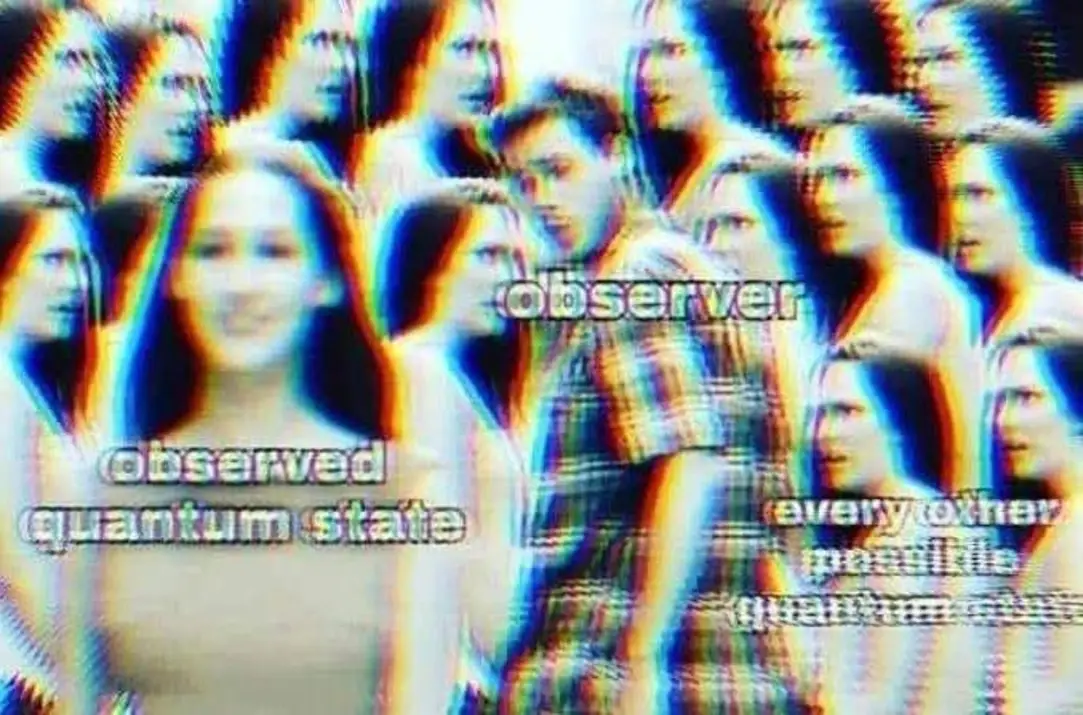
The meme is a play on the concept of the observer effect in quantum mechanics, where the act of observing a quantum system can change its behavior. The meme features a group of people with different labels, such as "observed" and "not observed", with the phrase "I'm not observing you" appearing in the image. The joke is that the person is trying to avoid being observed, but is actually being observed by the viewer, highlighting the absurdity of the concept.
detailed-analysis (gemma3-27b-vision)
Okay, let's break down this image using the requested theoretical lenses. It's a fascinating and densely layered piece, making for a rich analysis.
Visual Description
The image presents a heavily distorted and glitching composite of faces. Multiple instances of a single face (likely female, presenting a traditionally feminine aesthetic with long hair) are stacked and layered, all experiencing significant chromatic aberration (red, blue, and green color separations). This creates a "broken" or "fragmented" visual effect. Text fragments are superimposed over the faces, reading "observer," "observed quantum state," and "every other possible quantum state." The overall aesthetic strongly evokes early digital media, VHS artifacts, and signal degradation. The repetitive nature of the faces and text contributes to a sense of overwhelming information and visual noise.
Postmodernism
This image immediately resonates with postmodern aesthetics and sensibilities. The glitch effect and fragmentation directly challenge the idea of a stable, unified image or representation. Postmodernism questions the possibility of objective truth or meaning. Here, the "observed quantum state" explicitly references quantum physics, a realm where observation changes the reality observed – reinforcing the idea that meaning isn't inherent but created through the act of seeing. The repetition and layering of the faces could be seen as a commentary on the overwhelming flood of images and information in contemporary culture, where the "real" is constantly mediated and deconstructed. It questions the originality and authenticity of the image itself, as it's a constructed artifact, a simulation of reality. The instability of the image echoes postmodern anxieties about the breakdown of grand narratives and the loss of fixed identities.
Foucauldian Genealogical Discourse Analysis
Foucault's work focuses on power dynamics embedded in discourses. The text fragments and imagery evoke questions of surveillance, observation, and the power of the "observer." The repetition of "observed quantum state" is particularly compelling. Foucault argued that knowledge is not neutral, but is always tied to power. In this context, the very act of "observing" (implied by the text) is not a passive act, but one that shapes and defines the "observed" – mirroring the quantum principle mentioned. The image could be interpreted as a visual metaphor for the ways in which individuals are categorized, defined, and controlled through systems of observation and classification. The fragmented, glitching nature of the faces could symbolize the breakdown of fixed identities under the weight of these observational systems. We can ask: What discourse is constructing this observed state? What power relationships are at play in the act of observation?
Critical Theory
Within a critical theory framework (drawing from the Frankfurt School, for instance), this image can be seen as a critique of the media landscape and its effects on subjectivity. The glitch effect and overwhelming repetition could represent the bombardment of images and information that characterizes modern life, potentially leading to a sense of alienation and fragmentation. The image challenges the notion of a coherent and unified self, suggesting that individuals are increasingly fragmented and constructed by external forces (media, technology, surveillance). The image's commentary on the power of the "observer" to define the "observed" can be understood as a critique of the ways in which dominant ideologies shape our understanding of reality. It asks, who controls the gaze, and what are the implications of that control?
Queer Feminist Intersectional Analysis
This lens becomes particularly potent considering the image features a traditionally feminized face. The fragmentation and distortion of the face can be interpreted as a disruption of the patriarchal gaze. The image resists the objectification of the female body by refusing to present a stable, unified, or idealized representation. The glitch effect can be seen as a visual rejection of the demand for female "perfection" or "completeness." The repetition of faces could be read as a reclaiming of female agency, rejecting the idea that women are defined by a single identity or appearance.
Furthermore, the concepts of the observer and the observed resonate with the dynamics of power and representation that often affect marginalized groups. The image could be seen as a commentary on the ways in which marginalized individuals are constantly observed, categorized, and defined by dominant cultures. The glitching and fragmentation could symbolize the resistance to these categorizations and the assertion of self-definition. Intersectional concerns, while not explicitly represented, can be brought into play when considering how power and observation intersect with race, class, and other forms of identity.
Marxist Conflict Theory
Although less immediately apparent, a Marxist lens can be applied. The image can be interpreted as a visual representation of the alienation inherent in capitalist systems. The fragmentation and repetition can symbolize the dehumanizing effects of labor and the reduction of individuals to mere commodities. The glitch effect can be seen as a disruption of the seamless facade of consumer culture, revealing the underlying instability and contradictions. The "observer" could represent the capitalist system itself, constantly monitoring and controlling the "observed" (the individual). The overwhelming nature of the image can also be seen as a metaphor for the overwhelming nature of consumer culture and its constant bombardment of images and messages.
I hope this provides a thorough and nuanced analysis of the image using the requested theoretical frameworks. Please let me know if you'd like me to delve deeper into any specific aspect.
simple-description (llama3.2-vision)
The meme is an image of a person with a shocked expression, with a caption that reads "I can see you". The text is written in a bold, pixelated font and is placed in the center of the image. The meme is likely referencing the idea that even if someone is trying to be invisible or anonymous, they can still be seen or detected by others.
tesseract-ocr
, 7. i Pix 3 Ey ty