First Seen
2023-05-10T21:03:39+00:00
simple-description (llama3.2-vision_11b)
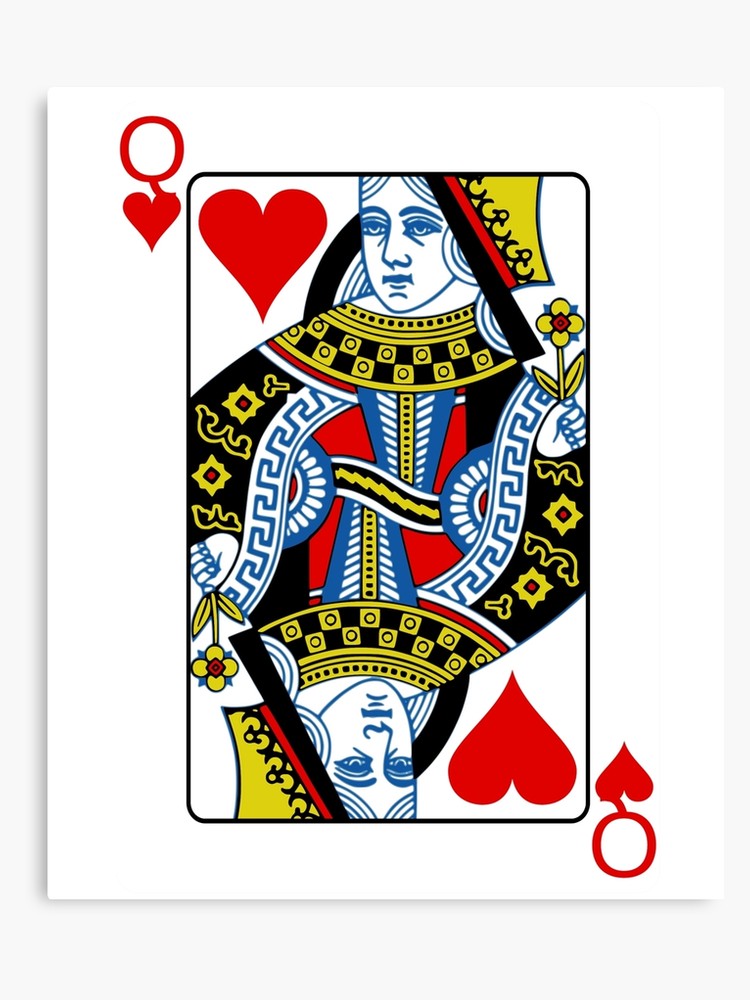
The meme features the Queen of Hearts, a playing card character, but it's not a straightforward image. The meme likely uses the Queen of Hearts as a symbol for a character who is angry, upset, or frustrated, often in a humorous or ironic way. The text "I'm not arguing, I'm just explaining why I'm right" may appear in the image, implying that the Queen of Hearts is being stubborn or obstinate.
detailed-analysis (gemma3-27b-vision)
Okay, let's analyze the image of the Queen of Hearts playing card through the lenses you've requested.
Visual Description
The image depicts the Queen of Hearts playing card. The card is framed by a white border. The Queen is depicted in profile, facing left. She has pale skin, dark hair pulled back, and appears to be wearing a detailed, ornate dress in black and blue, embellished with golden detailing and a Greek key pattern. A red heart is prominently featured on her crown and repeated as a motif on her dress. Her gaze is stern and her expression is somewhat austere. The card is bright, clean and high in resolution. There is a clear delineation between the image and the white background, creating a stark contrast.
Foucauldian Genealogical Discourse Analysis
This image, and playing cards in general, can be analyzed through a Foucauldian lens to understand how power operates within systems of representation.
- Discourse & Power/Knowledge: Playing cards are a discourse – a system of thought, language, and practice that constitutes knowledge and shapes understanding. The Queen of Hearts, as a figure, participates in a broader discourse of royalty, femininity, and hierarchy. The very categories of "suits" (hearts, diamonds, clubs, spades) represent specific conceptualizations of value and social ordering.
- Genealogy: A genealogical analysis would trace the historical development of playing cards from their origins (likely in China) to their adoption and evolution in Europe. The changing imagery of the Queens, specifically, reveals shifts in representations of women – from powerful figures, through periods of idealized fragility, to modern reinterpretations.
- Power/Knowledge & Normalization: The card normalizes certain ideas about queens, femininity, and the order of things. The Queen's image, even in a seemingly benign context, reinforces hierarchical structures. The card's very function in games relies on a system of rules and control, mirroring societal structures.
- Discipline & Surveillance: The card's role in games of chance and strategy relates to the Foucaultian concepts of discipline and surveillance. Players are subjected to the rules of the game, creating a form of self-regulation and control. The Queen, as a figure within this system, participates in this disciplinary power.
Critical Theory
Critical Theory, drawing from thinkers like the Frankfurt School, would analyze the card as a cultural artifact embodying and reinforcing ideologies.
- Ideology & Hegemony: The Queen of Hearts embodies a particular ideology centered around monarchy, power, and possibly romantic ideals (given the 'heart' suit). It may reinforce the hegemony of traditional hierarchies and social structures, presenting them as natural or inevitable.
- Commodification & Culture Industry: As a mass-produced item (playing cards), it is a product of the "culture industry." This means it's manufactured for consumption and contributes to the standardization of cultural forms. The design, while seemingly aesthetic, serves a commercial purpose.
- Alienation: While subtle, the card can be seen as representing alienation. The Queen is a symbol of power, but ultimately a passive object within a game, controlled by the player. This reflects the alienation of individuals from their own agency in capitalist systems.
Marxist Conflict Theory
Applying a Marxist lens reveals how the card participates in the perpetuation of class structures and power dynamics.
- Symbol of Authority: The Queen, as a monarchical figure, inherently represents a ruling class and a system of authority based on inherited privilege.
- Distraction & False Consciousness: The card, as part of a game, can be viewed as a form of distraction from material realities and class struggles. It offers a symbolic, rather than real, experience of power.
- Reinforcement of Hierarchy: Even in a game, the card participates in reinforcing hierarchical structures. The Queen's value within the game is predetermined, reflecting the fixed positions within a class-based society.
Queer Feminist Intersectional Analysis
This lens examines the image through the intersecting categories of gender, sexuality, and power.
- Gender Performance: The Queen's image relies on conventional gender performance – a regal, idealized femininity. This reinforces societal expectations and norms surrounding femininity.
- Power Dynamics & Objectification: The Queen, even as a figure of power, is ultimately an object within the game—something to be manipulated and controlled. This can be seen as a form of objectification that reinforces patriarchal power structures.
- Intersectionality: The card's meaning would change depending on the intersection of other identities (race, class, disability, etc.). A Black Queen of Hearts, for example, would carry additional layers of meaning related to racial representation and historical power dynamics.
- Subversion & Reclaiming: In contemporary contexts, the Queen of Hearts can be reclaimed and reinterpreted as a symbol of female agency and empowerment, subverting its traditional meaning.
Let me know if you would like me to elaborate on any specific aspect of this analysis or explore a different theoretical framework.
simple-description (llama3.2-vision)
The meme is an image of a playing card with the Queen of Hearts. The text "I can explain" appears in a speech bubble coming from the Queen, implying that she's about to provide a detailed explanation for something, but the reader knows she won't actually say anything.
tesseract-ocr
Sez 7k VEX. Sy ee , =V ho Se &