First Seen
2023-05-10T21:03:39+00:00
simple-description (llama3.2-vision_11b)
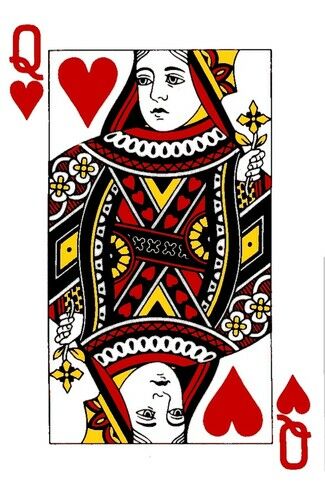
The meme is an image of the Queen of Hearts playing card, which is a classic symbol of love and romance. However, in this meme, the Queen of Hearts is often depicted with a sassy or sarcastic expression, implying that she's not as loving and caring as she seems. The meme often features text like "Queen of Hearts" or "Love is Dead" to emphasize the irony and humor in the situation.
detailed-analysis (gemma3-27b-vision)
Okay, let's break down this image of the Queen of Hearts playing card through several theoretical lenses.
Visual Description
The image depicts the Queen of Hearts playing card in a traditional style. The card features a full-length portrait of a woman dressed in ornate, black and red clothing. The background is white. She is positioned in profile facing left. Her attire includes a fitted bodice with a complex pattern, accented by gold details, and a large, fluted collar with a red accent. She wears a crown or elaborate headdress. Her expression is somewhat austere. The card design is highly symmetrical. She holds a flower in her right hand, a symbol commonly associated with love and passion. The corners of the card bear the letter 'Q' and a heart symbol. The color scheme is dominated by black, red, and gold, creating a strong visual contrast.
Foucauldian Genealogical Discourse Analysis
Foucault's approach, centered on discourse and power, allows us to examine how the Queen of Hearts card constructs understandings of womanhood, power, and love, rather than simply reflecting them.
- Discourse of Royalty: The card participates in a historical discourse of royalty, linking power, status, and visual iconography. The imagery (crown, opulent clothing) reinforces notions of inherent authority and difference. We can trace the evolution of royal iconography through playing cards, revealing how power has been represented and legitimized over time.
- Discourse of Femininity: The card positions the Queen within a discourse of femininity. The flower, although seeming delicate, is a symbol of both beauty and potentially dangerous passion. She’s depicted in profile, potentially signifying passivity or being ‘on display’. Her elaborate dress and adornment position her as an object of visual scrutiny and aesthetic judgment.
- Genealogy of the "Heart" Suit: The suit of Hearts itself has a historical genealogy. It links to concepts of emotion, affection, and the human core. The Queen, as a representative of this suit, is therefore constructed as the embodiment of these qualities, potentially as both nurturing and manipulative. Tracing the historical symbolism of hearts reveals the changing ways love and emotion have been understood and controlled.
- Power/Knowledge: The image demonstrates the Foucaultian relationship between power and knowledge. The card creates a knowledge about queens, femininity, and love, which in turn reinforces particular power dynamics. It isn’t simply a ‘neutral’ representation but actively participates in the production of social realities.
Critical Theory
Through the lens of Critical Theory (drawing upon thinkers like Adorno & Horkheimer, or the Frankfurt School), the Queen of Hearts card can be seen as a manifestation of societal structures and ideology.
- Ideology and Representation: The card reinforces specific ideologies about gender, power, and romance. It presents a highly stylized, idealized image of the Queen, obscuring the complexities and inequalities inherent in actual historical power structures. It contributes to the naturalization of hierarchical relationships.
- Commodification of Femininity: The Queen’s elaborate presentation—her dress, adornments, and aestheticized representation—can be interpreted as a form of commodification. She's an image for consumption, rather than a fully realized human subject. Her value is tied to her appearance and the aesthetic pleasure she provides.
- Domination and Control: The card participates in the broader system of domination by reinforcing patriarchal structures. While she is a "Queen," her power is visually confined to the aesthetic realm. Her agency is potentially diminished by her objectification.
Marxist Conflict Theory
From a Marxist perspective, the Queen of Hearts card represents class, power, and material relations.
- Symbol of Bourgeoisie: The Queen's opulence—her ornate clothing and regal bearing—can be seen as a symbol of the bourgeoisie, the ruling class in capitalist society. It visually reinforces the legitimacy of their wealth and power.
- Reinforcement of Hierarchy: The card reinforces the class hierarchy by presenting a clear division between the ruling class (the Queen) and the common people (the other cards). It naturalizes the idea of inherent social inequality.
- Symbol of Material Possession: The focus on material adornments (clothing, jewels) highlights the importance of material possessions in defining social status. This reinforces the materialistic values of capitalist society.
- Conflict and Control: The Queen’s position within the game of cards – her potential to win or lose – can be seen as a metaphor for class conflict. The Queen is a participant in a system of struggle for dominance.
Queer Feminist Intersectional Analysis
This approach recognizes the interconnectedness of gender, sexuality, race, class, and other social categories in shaping experiences of oppression and power.
- Performance of Gender: The Queen of Hearts is a carefully constructed performance of femininity. The card asks us to consider the ways in which gender is culturally constructed and enforced. She does not necessarily represent all feminine experiences.
- Deconstruction of Traditional Roles: The card can be analyzed in terms of its disruption or reinforcement of traditional gender roles. While seemingly upholding the status of a queen, the card also offers possibilities to reimagine what queenship could look like.
- Intersectionality of Power: The card’s meaning is not isolated. How would the meaning of the Queen of Hearts differ if a Black queen or a transgender queen were depicted? The image operates within a power structure that historically marginalizes many.
- Queering the Narrative: One might “queer” the narrative of the card by challenging conventional interpretations of love, romance, and power. Is the Queen’s power based on attraction or manipulation? Does she represent a monolithic “feminine” ideal, or a more complex, fluid representation of gender?
Hopefully, this breakdown offers a comprehensive analysis of the Queen of Hearts image through various theoretical lenses! Let me know if you’d like me to delve deeper into any of these areas.
simple-description (llama3.2-vision)
This meme is an image of a playing card, specifically the Queen of Hearts. The image is a simple, iconic representation of the queen, with a regal and stern expression. The text "I can smell the desperation" is written in a bold, playful font above the queen's head, implying a sense of irony or sarcasm.
tesseract-ocr
Q Ee ed Ol. ¥ Apel Z eg LX a YW