First Seen
2023-05-10T21:03:39+00:00
simple-description (llama3.2-vision_11b)
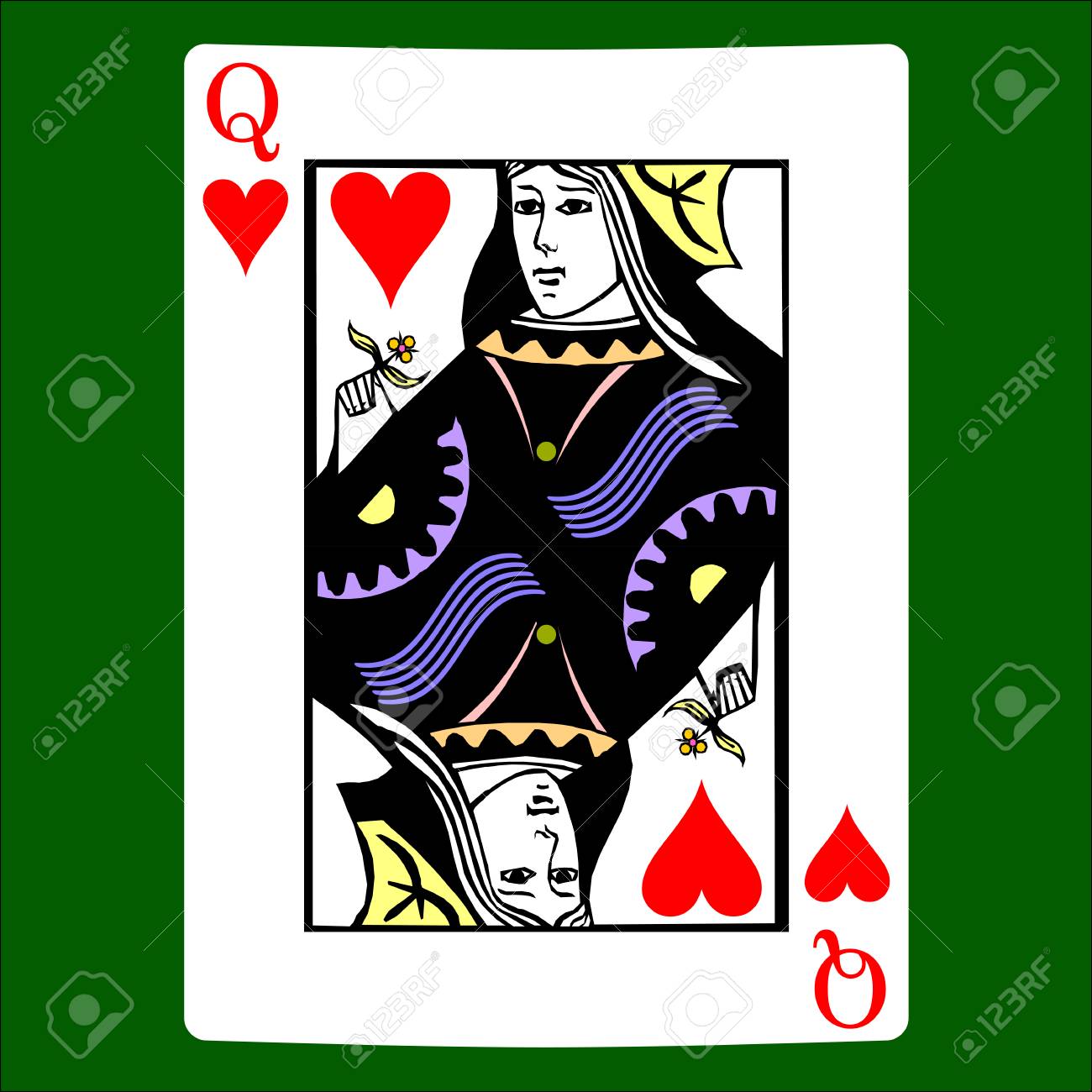
The meme is an image of the Queen of Hearts playing card, which is a classic symbol of love and romance. The image is likely captioned "Queen of Hearts" or "Love is in the Air" to poke fun at the idea that the Queen of Hearts is a symbol of love and romance, while also referencing the classic Disney movie "Alice in Wonderland" where the Queen of Hearts is a villainous character. The meme is likely used to express sarcasm or irony when talking about love or relationships.
detailed-analysis (gemma3-27b-vision)
Okay, here's an analysis of the image of the Queen of Hearts playing card, broken down into the requested sections. Please note that some of these lenses are more readily applicable than others, and the depth of analysis will vary.
Visual Description
The image shows a stylized depiction of the Queen of Hearts playing card. The card is rectangular with a white border and grey background. The queen is centrally positioned, depicted with a pale skin tone and black wavy hair beneath a small crown. She is dressed in a predominantly black and yellow outfit featuring a complex patterned bodice. The color scheme is limited, relying on black, white, yellow, and red. There are four red hearts in the bottom right corner and a single heart in the top left. Below the queen's image is a small, distorted face.
Foucauldian Genealogical Discourse Analysis
A Foucauldian approach would examine the discourse surrounding playing cards and particularly the Queen of Hearts, tracing its historical development and how it constructs understandings of power, gender, and societal roles.
- Discursive Formation: The "Queen" archetype itself is a discursive formation. Initially (originating in the 15th century), court cards represented nobility and status within a feudal system. Over time, this has been abstracted to symbolic representation of power, often tied to femininity. The Queen of Hearts, specifically, became associated with romance, passion, and sometimes, caprice or instability (think Alice in Wonderland).
- Power/Knowledge: The very act of assigning meaning to a card (e.g., "Queen" equates to authority, "Hearts" with emotion) is an exercise of power. This image, as a cultural artifact, embodies and reinforces those power structures.
- Genealogy of Emotion: The association of "Hearts" with emotions isn't inherent; it's a historical construct. Tracing the genealogy of this symbol reveals how certain feelings became linked with specific representations (shapes, colors, archetypes) and ultimately used as tools for social control.
Critical Theory
From a Critical Theory perspective, this image can be viewed as a product of its socio-historical context, potentially reinforcing dominant ideologies.
- Ideology: The Queen archetype, even in a stylized form, maintains a patriarchal view of power. While a "Queen" might hold authority, it’s often presented as femininity, inherently different from the traditionally masculine concept of a “King.” This reinforces the idea of a gendered power dynamic.
- Representation: The stylized representation is not neutral. It constructs a specific image of femininity and power—one that might be distant from lived experiences.
- Commodification: Playing cards themselves are commodities. Their design and imagery contribute to a culture of consumption and spectacle.
Marxist Conflict Theory
A Marxist lens examines power imbalances and class struggle.
- Symbolic Capital: Historically, court cards represented the aristocracy, embodying a specific form of symbolic capital—prestige and authority derived from lineage and social status.
- Representation of the Elite: The Queen of Hearts, while abstracted, still represents a figure of privilege and power. This can be seen as perpetuating the myth of a harmonious social hierarchy, obscuring the underlying conflicts of interest.
- Distraction: Like many forms of entertainment, playing cards (and the imagery within them) can be seen as a distraction from the realities of economic and social inequality.
Postmodernism
A Postmodern analysis would focus on deconstruction and challenging fixed meanings.
- Deconstruction of Archetypes: The stylized rendering of the Queen challenges the traditional representation of royalty. Its abstract nature blurs the boundaries between reality and representation.
- Play of Signifiers: The image can be seen as a play of signifiers—a collection of symbols (Queen, hearts, colors) without inherent meaning. Meaning is assigned through cultural context and individual interpretation.
- Simulation: The Queen of Hearts is a "simulation" of royalty. It is not a real Queen, but a symbolic representation, creating a hyperreality where the signifier precedes the signified.
Queer Feminist Intersectional Analysis
This lens would examine the image through the intersections of gender, sexuality, and power.
- Gender Performance: The Queen, as a figure, is a representation of gender performance. It’s a stylized, constructed image of femininity, embodying societal expectations and norms.
- Subversion of Power: Historically, women's power has been precarious. While the Queen archetype appears powerful, it's often a limited, symbolic power.
- Intersectional Critique: The image, in its traditional form, tends to center the experiences of heterosexual, cisgender women. An intersectional analysis would ask: whose narratives are absent? How would the image be different if it represented a queer or transgender queen? The distorted face at the bottom can be seen as representing how female bodies have historically been portrayed by the patriarchal gaze.
I hope this thorough breakdown provides a useful analysis of the image! Let me know if you'd like me to focus on a particular lens in more detail.
simple-description (llama3.2-vision)
The meme appears to be a playing card with a queen's face, but with a sarcastic or disappointed expression. The text "I'm not mad" is written above the queen's head, implying that she's actually quite upset about something. The image is likely a humorous take on the idea that someone can claim to be calm and collected, but is actually seething with anger or frustration.
tesseract-ocr
Q oT id = = ri x Vy NJ a if &% NS