First Seen
2023-05-10T21:03:39+00:00
simple-description (llama3.2-vision_11b)
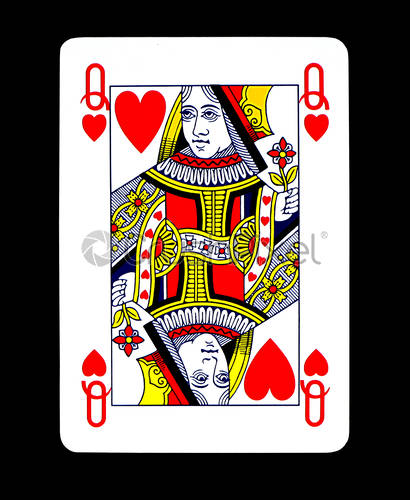
The meme is a still image of the Queen of Hearts playing card. The Queen of Hearts is a popular character in the "Alice's Adventures in Wonderland" by Lewis Carroll.
detailed-analysis (gemma3-27b-vision)
Okay, here's an analysis of the image of the Queen of Hearts playing card, broken down into the requested theoretical frameworks. Not all frameworks will be strongly applicable, and I'll explain when that's the case.
Visual Description
The image depicts a standard playing card: the Queen of Hearts. The card has a white background with a thin black border. The central figure is a stylized depiction of a woman, traditionally considered the "Queen." She is illustrated in profile, facing left. She wears an elaborate, dark blue and red gown with gold accents and a high, ornate collar. Her hair is blonde and curls around her head, adorned with a small, jeweled crown or tiara. She holds a single red heart-shaped flower in her right hand.
The corners of the card each feature a red heart symbol, and the upper left and lower right corners of the card display the letter 'Q' (for Queen) in a red stylized font. In the upper right and lower left corners are a red heart symbol. The style of the illustration is somewhat classic and reminiscent of vintage playing card designs, with bold lines and flat color application.
Foucauldian Genealogical Discourse Analysis
The Queen of Hearts card presents an interesting case for a Foucauldian analysis. We can examine the "discourse" surrounding power, femininity, and the construction of the "queen" as a figure.
- Archaeology of Knowledge: A historical archaeology might reveal how the figure of the Queen in playing cards emerged alongside specific social and political structures. The figure isn't neutral. It emerges during a period of established monarchies. It subtly reinforces a hierarchical system, even in a leisure activity.
- Power/Knowledge: The card embodies power/knowledge. The "queen" carries the symbolic weight of authority and control, but this is a representation of power, not actual power. The knowledge embedded in this card isn't about factual information, but about social roles and expectations. It reinforces the idea of a "queen" as a figure who is both beautiful and commanding.
- Disciplinary Practices: Playing cards themselves can be seen as a subtle form of discipline. They establish rules, hierarchies (e.g., Aces, Kings, Queens, Jacks), and a system of competition. Even the Queen, as a ranked character, is embedded in this disciplinary system.
Critical Theory
Critical theory seeks to understand how power structures operate and how they create and perpetuate social inequalities. The Queen of Hearts, though a seemingly innocent image, can be read through this lens.
- Ideology: The image subtly reinforces ideologies around gender and power. The Queen is depicted as aesthetically pleasing, embodying conventional beauty standards, and is placed within a hierarchical system (of cards). This can be seen as reinforcing patriarchal power structures by presenting authority as embodied in a traditionally feminine figure, but one still bound by the constraints of the game's rules.
- Commodification: The image can be seen as a commodified representation of femininity, a beautiful figure designed for entertainment and consumption. The focus on appearance and status reinforces the idea of women as objects of gaze and value being assigned based on superficial attributes.
- Representation & Othering: Traditionally, the Queen of Hearts has been depicted in the Western canon as an archetype of beauty and status. This can contribute to the "othering" of those who do not fit these narrow definitions of femininity or power, reinforcing dominant cultural norms and excluding alternative forms of expression.
Marxist Conflict Theory
Through a Marxist lens, we can examine how the image reflects class and economic relations.
- Superstructure: The card and its associated game can be seen as part of the superstructure, elements of society that are built upon the economic base. The game itself is a leisure activity enjoyed by those with disposable income and time.
- Symbolic Capital: The "Queen" represents symbolic capital—prestige and status within the game. This status is not economic wealth but still has value in the social context of the game.
- Class Representation: The ornate details of the queen’s dress and crown can be interpreted as a representation of the ruling class's luxury and extravagance, subtly reinforcing class distinctions.
Postmodernism
Postmodern thought questions grand narratives and fixed meanings.
- Deconstruction of Symbols: Postmodernism would examine the ambiguity of the Queen as a symbol. The “Queen” doesn’t have a singular, fixed meaning. It's subject to interpretation and varies according to context (playing cards, historical figures, modern interpretations).
- Simulacra and Simulation: The image is a simulacrum, a copy without an original. The "queen" in the card is not a real queen but a representation of the concept of a queen. It's a simulation of power and authority.
- Playfulness & Irony: Postmodernism acknowledges the playful and ironic nature of the card. It subverts the traditional seriousness associated with royalty and turns it into a form of entertainment.
Queer Feminist Intersectional Analysis
This lens considers how gender, sexuality, and other social categories intersect to create unique experiences of oppression and privilege.
- Reclaiming Femininity: The Queen of Hearts, as a traditionally feminine figure, can be reclaimed as a symbol of female power, even if it is within the constraints of the game.
- Challenging Gender Norms: By queering the image of the Queen, we can challenge traditional notions of femininity and explore alternative expressions of gender and sexuality. Imagine a reimagining of the Queen of Hearts as non-binary, transgender, or defying conventional beauty standards.
- Intersectional Power Dynamics: The image reinforces the historical marginalization of women and people of color, who were often excluded from positions of power and authority. By acknowledging these power dynamics, we can work towards creating a more equitable and inclusive society.
I hope this comprehensive analysis is helpful! Let me know if you’d like me to delve further into any of these frameworks.
simple-description (llama3.2-vision)
The meme is a screenshot of a playing card, specifically the Queen of Hearts. The image is a photo of the card, which features a regal-looking queen with a red dress and a crown. The text "Queen of Hearts" appears in bold, red letters at the top of the card, and the phrase "I'm not arguing, I'm just explaining why I'm right" is written in a smaller, curved line above the queen's head.
tesseract-ocr
f 8 ee, ; am 0 k Tas