First Seen
2023-05-10T21:03:39+00:00
simple-description (llama3.2-vision_11b)
The meme is an image of the Queen of Hearts playing card with a caption "I'm not arguing, I'm just explaining why I'm right". The meme is used to convey that someone is not being confrontational, but rather passionately explaining their point of view.
detailed-analysis (gemma3-27b-vision)
Okay, let's break down this image of stylized playing cards (Queens of Spades and Hearts) through various theoretical lenses.
Visual Description
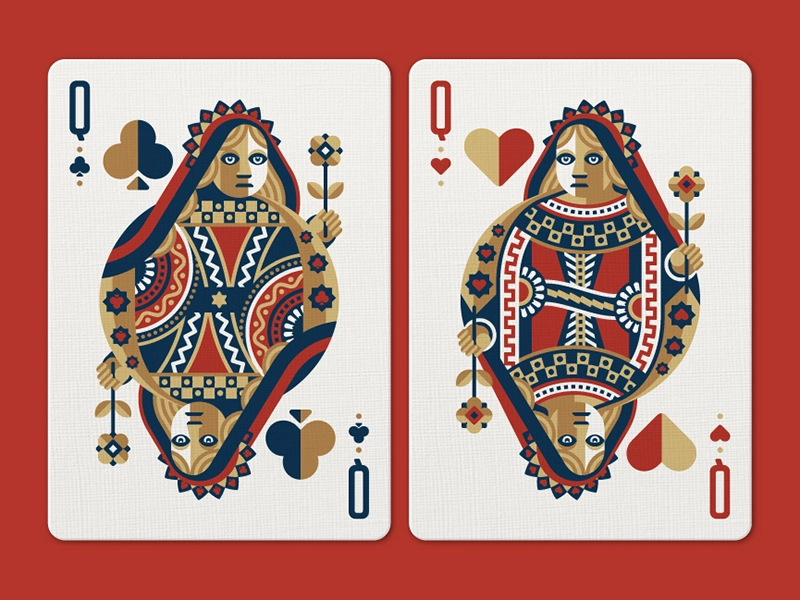
The image presents two stylized playing cards: the Queen of Spades and the Queen of Hearts. Both cards share a consistent aesthetic. They are designed with a mid-century modern, almost art deco, flair, using a limited color palette of black, gold, red, and a pale off-white/beige.
The Queens are depicted as figures with strong geometric shapes defining their forms. They are adorned with elaborate patterns within their garments, suggesting ornamentation and cultural references (potentially Mesoamerican or Southwest Native American). Their faces are stylized and symmetrical, with large, almond-shaped eyes. They hold a stylized flower or plant stem. The cards feature classic playing card suit symbols (spades and hearts) in the corners, however they appear very small. The design prioritizes visual patterns and shape over realistic representation. The backgrounds of the cards are textured with a halftone pattern.
Foucauldian Genealogical Discourse Analysis
This image can be analyzed through Foucault’s lens, examining the discourse surrounding the Queen as a playing card figure and the power/knowledge dynamics inherent in its representation.
- Genealogy of the Queen: The playing card Queen isn’t born from objective necessity. Instead, its appearance and significance are historically constructed. Tracing its genealogy—from medieval Tarot cards to the standardized English playing card deck—reveals how representations of female power are always linked to specific social structures and cultural norms. The very notion of a “Queen” relies on established hierarchies and ideas about female rule, even within a game.
- Disciplinary Power: The image doesn’t explicitly display disciplinary power, but it implies a regulation of representation. The style of the representation itself becomes a way of defining what a "Queen" should look like. The geometrical simplification and cultural patterns (we'll return to these in Intersectional Analysis) create a normalization—a specific way of viewing female authority.
- Power/Knowledge: The design of the card is not neutral. It produces knowledge. The patterns, the style, and the very choice to represent the Queen in this way constructs meaning about power, femininity, and authority. The image doesn’t simply show a queen; it creates a specific understanding of her.
- Disruption: The abstracted geometric style disrupts the historical traditions of court card imagery, which often depicts highly detailed regal portraits. This disruption can be seen as a form of resistance, or at least a questioning of the established imagery of power.
Critical Theory
Critical Theory, particularly from the Frankfurt School, focuses on examining how culture perpetuates power imbalances and ideological control.
- Culture Industry: These stylized cards could be seen as products of a "culture industry" (Adorno and Horkheimer). They aren't inherently revolutionary, but they reflect and reinforce prevailing aesthetic and power structures. By reimagining a familiar symbol (the Queen) within a visually appealing design, they contribute to a system of cultural consumption.
- Commodification of Symbols: The cards transform the historical symbol of a queen (with all its complex associations of power, gender, and history) into a consumer good. This commodification arguably diminishes the symbol’s political and historical weight.
- Ideological Critique: The image subtly reproduces the idea of power being visualized and aestheticized. The design is pleasing to the eye, creating an association between authority and beauty, thus masking the often-brutal realities of power dynamics.
Queer Feminist Intersectional Analysis
This lens examines how these images intersect with power, gender, sexuality, race, and class.
- Re-appropriation of Symbols: The stylized representation challenges the traditional, often hyper-sexualized or passively regal, depictions of Queens in playing card imagery. This can be seen as a reclaiming of female symbolism.
- Cultural Borrowing & Power Dynamics: The geometric patterns and design elements clearly borrow from Indigenous American art styles. This raises questions about cultural appropriation and the power dynamics inherent in borrowing from marginalized cultures. Who benefits from this aesthetic borrowing? Is it done with respect and acknowledgement, or is it simply an aesthetic trend?
- Deconstruction of Gender Roles: By stripping away realistic representation and focusing on stylized shapes, the image complicates traditional notions of femininity and gender. The Queen isn't defined by physical characteristics, but by abstract forms.
- Intersectionality: The image requires acknowledgement of multiple oppressions. The use of Indigenous visual language within a context of Western cultural production is a key point of intersectional analysis, raising questions about the exploitation and commodification of culture.
Let me know if you'd like me to elaborate on any of these analyses, or explore other theoretical frameworks.
simple-description (llama3.2-vision)
The meme is a humorous image of a playing card with the Queen of Hearts character. The image is a split-screen comparison, with the Queen of Hearts on the left and the Queen of Spades on the right, but the Queen of Spades has been modified to have a more seductive and provocative appearance. The text "I'm not a seductive queen, I'm just a queen" is written above the image.
tesseract-ocr
by’ : PN * Ave. | sea oo kN 7 eo ‘ ORG | eo