First Seen
2025-05-25T23:37:59.419138+00:00
simple-description (qwen3.5_2b-q8_0)
Here is the description for a blind user based on the context of "Queer - Anxiety":
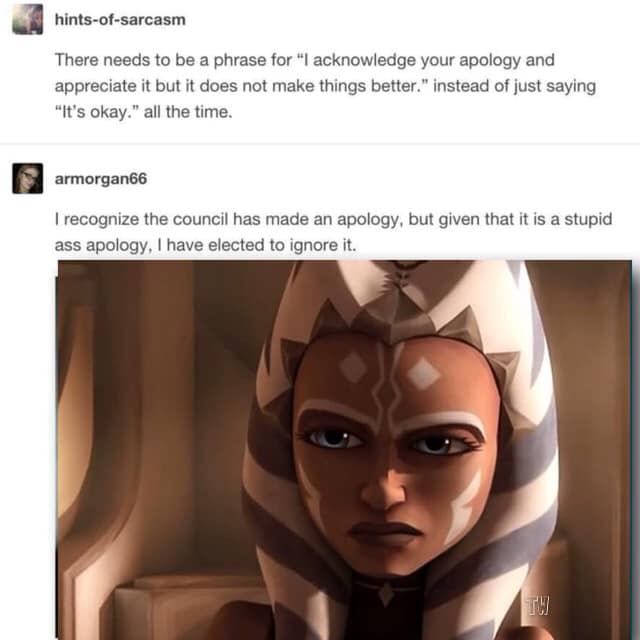
The image features Ahsoka Tano from Star Wars with a serious, unimpressed expression, acting as if she is filtering out a social situation. The text below displays a sarcastic complaint about the phrase "It's okay" and the Council's official apology. Ahsoka chooses to ignore the apology because it is "stupid ass" and cannot fix the situation, symbolizing her indifference to social rejection or bad news. In this "Queer" context, the character acts as a filter for insults, refusing to engage with apologies that are considered insulting to her status.
detailed-analysis (gemma3_27b-it-q8_0)
Okay, let's break down this meme through the lens of the “Queer - Anxiety” category, incorporating relevant theoretical frameworks where applicable.
Visual Description
The meme features a still image of Ahsoka Tano, a character from the Star Wars: The Clone Wars animated series. Ahsoka is depicted with a deeply skeptical, almost distrustful expression. Her eyes are narrowed, her head is slightly tilted, and her facial muscles convey a sense of resolute disagreement. The image focuses on her face and upper torso. The dark background and slightly somber lighting add to the overall mood of distrust and guardedness. This is a character who, throughout the series, has repeatedly been betrayed or let down by those in power, reinforcing her skeptical expression.
Queer Feminist Intersectional Analysis
This is where the meme’s power really resonates within the “Queer - Anxiety” context. The core sentiment – acknowledging an apology without it actually changing anything – speaks directly to the experiences of marginalized groups, especially queer individuals, and those with anxiety.
- Repeated Harm & Performativity: Queer people (and those experiencing anxiety) are often subjected to repeated microaggressions, invalidations, or outright harmful acts, followed by superficial apologies. These apologies may be offered to appear progressive or understanding, but lack any substantive change in behavior or systemic structures. It becomes a performance of remorse, rather than genuine accountability. The phrase "I recognize the apology, but it's a stupid ass apology" highlights the frustration of recognizing the performative aspect.
- Emotional Labor & Boundaries: Accepting an apology that isn’t followed by action often requires significant emotional labor. It can mean repeatedly explaining why the apology isn’t enough, negotiating for better behavior, and carrying the burden of educating others. Ahsoka's expression represents the decision to not engage in that emotional labor – to protect one's own energy and boundaries. This is a key coping mechanism for people dealing with anxiety and constant microaggressions.
- Anxiety as a Response to Systemic Oppression: Anxiety isn't always an internal, individual issue; it’s often a rational response to living in a world filled with systemic oppression and potential harm. For queer individuals, who face discrimination, violence, and constant invalidation, anxiety is a very real and understandable outcome. Expecting them to simply accept apologies without concrete change is asking them to suppress a perfectly valid emotional response to a hostile environment.
- Intersectionality The meme speaks to the exhaustion of being a part of an intersectional experience where one's apology may not hold weight.
Postmodernism
This meme subtly plays with postmodern concepts, specifically concerning truth and representation.
- Deconstructing Apology: The meme deconstructs the traditional notion of an apology as a sincere expression of remorse and a commitment to change. It exposes the apology as potentially a linguistic construct, divorced from genuine feeling or intention.
- The Skepticism of Grand Narratives: Postmodernism questions "grand narratives" – overarching stories that claim to offer universal truth. The expectation that an apology should automatically lead to feeling "okay" is a mini-narrative. The meme rejects this, suggesting that such narratives don't always apply, particularly when power imbalances are at play.
Foucauldian Genealogical Discourse Analysis
Michel Foucault’s work on power and discourse is relevant here.
- Power Dynamics Embedded in Language: Foucault argued that power isn’t simply top-down, but is dispersed throughout society and operates through discourse. The way we talk about apologies, forgiveness, and reconciliation is itself shaped by power relations.
- "It's Okay" as a Disciplinary Tool: The constant pressure to say “It's okay” (even when it isn’t okay) can be seen as a disciplinary mechanism. It encourages self-regulation, discourages challenging harmful behavior, and reinforces the status quo. Ahsoka's refusal to play that game is a rejection of that disciplinary power.
- Genealogy of Apology A genealogical analysis might examine how the concept of apology has evolved, and how its meaning has been shaped by social and political forces, particularly in relation to harm and redress. The meme suggests that the current iteration of the "apology" (as a performative act) is insufficient and potentially oppressive.
In Conclusion
The meme’s potency comes from its ability to encapsulate the exhaustion, skepticism, and boundary-setting that many queer individuals and those with anxiety experience. It's a defiant statement against the expectation to readily forgive and move on when genuine accountability and change are lacking. Ahsoka's expression perfectly embodies the sentiment of prioritizing self-preservation and refusing to participate in systems that demand emotional labor without offering meaningful redress. It's a meme that validates the right to not be okay with a superficial apology.
simple-description (llama3.2-vision_11b)
The meme is a screenshot of a Reddit comment where a user is expressing frustration with the phrase "I'm sorry" being used as a blanket apology. The user is saying that simply saying "I'm sorry" doesn't make up for the harm caused, and that a more thoughtful apology is needed. The image is a screenshot of a character from the TV show "Star Wars: The Clone Wars" with a caption "I'm sorry" written above it, but the character's expression is a mix of anger and disappointment, implying that the phrase "I'm sorry" is not enough to make up for the harm caused.
detailed-analysis (gemma3-27b-vision)
Okay, let's break down this meme/post using the frameworks you've requested. It's important to note that applying these complex theories to internet memes is often interpretive and can yield multiple valid readings.
Visual Description
The image depicts Ahsoka Tano, a character from the Star Wars: The Clone Wars and Rebels animated series. She's rendered in a distinctly stylized, cartoon/animation aesthetic. Her expression is crucial: it is one of fierce, skeptical disapproval. Her eyebrows are furrowed, her eyes are narrowed, and her mouth is set in a tight line. The lighting focuses on her face, emphasizing this expression. Her Togruta lekku (head-tails) are prominently visible, and her attire appears to be from her Jedi training period. The overall composition places her as a dominant figure in the frame, and she’s clearly rejecting something. The image is overlaid with text from two Twitter users – one requesting a new phrase to convey acknowledgement of an apology without implying it resolves anything, and the other claiming to actively ignore a "stupid ass apology."
Foucauldian Genealogical Discourse Analysis
This post touches on the discourse surrounding apologies and how power operates within that discourse. Michel Foucault would be interested in the history of the concept of apology – how its meaning has been constructed, shifted, and used as a tool.
- Power/Knowledge: The original Twitter user identifies a gap in language, a lack of a phrase to properly articulate the feeling of acknowledging an apology without automatically relinquishing agency or implying forgiveness. This indicates a power imbalance. The usual response ("It's okay") often feels demanded by the apologizer, subtly obligating the wronged party to offer absolution. The demand for a new phrase is an attempt to reclaim agency over the discourse.
- Genealogy: The idea of “being okay” as a mandated response has a genealogical history. It's tied to norms of politeness, conflict avoidance, and maintaining social harmony. But this harmony often comes at the cost of addressing underlying issues or the emotional needs of the wronged party.
- Discipline & Normalization: The expectation to say "it's okay" functions as a form of social discipline, normalizing the quick dismissal of harm. Ahsoka’s expression visually rebels against this normalization. It embodies the refusal to be disciplined into a premature, superficial forgiveness.
- Discourse and Subjectivity: The request for a new phrase suggests that existing language isn’t sufficient to articulate a complex emotional and political position. Ahsoka's image reinforces this position, signaling a rejection of easy resolutions and an assertion of individual boundaries.
Critical Theory
Applying a broadly Critical Theory lens (drawing from thinkers like Adorno and Horkheimer), this post critiques the instrumental rationality often embedded in the performance of apologies.
- False Reconciliation: The “it's okay” response can be seen as a performative act meant to restore a superficial sense of order. It prioritizes maintaining the system (smooth social interactions) over genuinely addressing the harm caused. Ahsoka’s defiant expression suggests a rejection of this false reconciliation.
- Critique of Domination: The Twitter users critique the power dynamic inherent in the apology exchange. The apologizer often seeks absolution, and the wronged party is expected to provide it. This reflects broader patterns of domination where one party seeks to reassert control by eliciting forgiveness.
- Alienation: The lack of nuanced language to express acknowledgement without forgiveness indicates a broader alienation from authentic emotional expression. The rigid social scripts surrounding apologies prevent genuine connection.
Marxist Conflict Theory
From a Marxist perspective, this post can be viewed through the lens of class struggle and ideology.
- Power Dynamics & Exploitation: The apology exchange can be seen as a microcosm of broader power imbalances. The apologizer seeks to “resolve” the conflict in a way that benefits them (re-establishing harmonious relations), potentially at the expense of acknowledging the real harm caused. The wronged party, by refusing to simply say "it's okay," is resisting this exploitation.
- Ideology & False Consciousness: The expectation to say "it's okay" can be seen as an ideological construct that serves to maintain the status quo. It encourages individuals to prioritize social harmony over addressing systemic injustices. Ahsoka’s rejection of this norm represents a form of resistance to this false consciousness.
- Conflict as Catalysis for Change: Ahsoka’s visual message suggests that genuine resolution requires more than a superficial apology; it demands acknowledgement, accountability, and potentially, a fundamental shift in power dynamics. This aligns with the Marxist belief that conflict is a necessary catalyst for social change.
Postmodernism
A Postmodern reading would focus on the deconstruction of meaning and the rejection of grand narratives.
- Deconstructing "Forgiveness": The post challenges the very concept of "forgiveness" as a simple, universally applicable solution. It suggests that forgiveness is a complex, subjective experience that cannot be reduced to a single phrase.
- Rejection of Meta-Narratives: The post implies that the traditional narrative of apology-forgiveness-reconciliation is a constructed, limiting framework. It rejects the idea that there is a single, "correct" way to respond to harm.
- Subjectivity and Fragmentation: The emphasis on individual experience (the need for a nuanced phrase to express how one feels) aligns with the postmodern emphasis on subjectivity and the fragmentation of meaning. There is no universal truth or objective standard for emotional responses.
- Playfulness with Language: The very request for a new phrase demonstrates a self-awareness of the limitations of language and a desire to subvert existing linguistic norms.
Queer Feminist Intersectional Analysis
This is where it gets more layered and perhaps more fitting, as Ahsoka Tano is a strong, independent character who defies traditional gender roles in the Star Wars universe.
- Challenging Power Dynamics: The rejection of the “it’s okay” response is an act of asserting boundaries and refusing to be silenced or minimized. This resonates with feminist critiques of patriarchal power dynamics, where women are often expected to prioritize maintaining harmony over expressing their own needs and emotions.
- Intersectional Resistance: Ahsoka’s visual expression isn’t just about rejecting an apology; it's about refusing to be subsumed by the expectations of a system that might have harmed her or others. This can be connected to intersectional resistance, as a refusal to accept the status quo for oneself or others.
- Emotional Labor: The expectation to offer forgiveness, even when not genuinely felt, is a form of emotional labor disproportionately placed on marginalized groups. The user’s plea for nuanced language is a recognition of this burden.
- Agency and Self-Determination: The user and Ahsoka in the image both claim agency, rejecting external expectations in favor of authentic self-expression and self-determination. This aligns with queer feminist ideals of challenging norms and prioritizing individual experiences.
In conclusion: This meme is surprisingly rich with layers of meaning. It's not just a lighthearted observation; it's a subtle critique of power dynamics, social expectations, and the limitations of language. It’s a small act of resistance embodied in an image of a strong female character, and it opens up a conversation about how we respond to harm and strive for genuine connection.
simple-description (llama3.2-vision)
The meme features a screenshot from the animated TV series Star Wars: The Clone Wars, specifically a scene with character Ahsoka Tano. The image is captioned with a humorous quote from the show, highlighting the character's frustration with being forced to apologize for something that isn't her fault.