First Seen
2023-05-10T21:03:39+00:00
simple-description (llama3.2-vision_11b)
The meme features a character from the video game "Mass Effect" with a caption that pokes fun at the idea of someone being so anxious about a social interaction that they become overly attached to a small, mundane object (in this case, a donut). The character's expression and the text "I love you" imply a deep emotional connection, but the context is actually about anxiety, implying that the person is so anxious about being rejected that they become overly clingy.
detailed-analysis (gemma3-27b-vision)
Okay, let's break down this meme using the requested theoretical lenses. It's a surprisingly complex image for a simple joke!
Visual Description
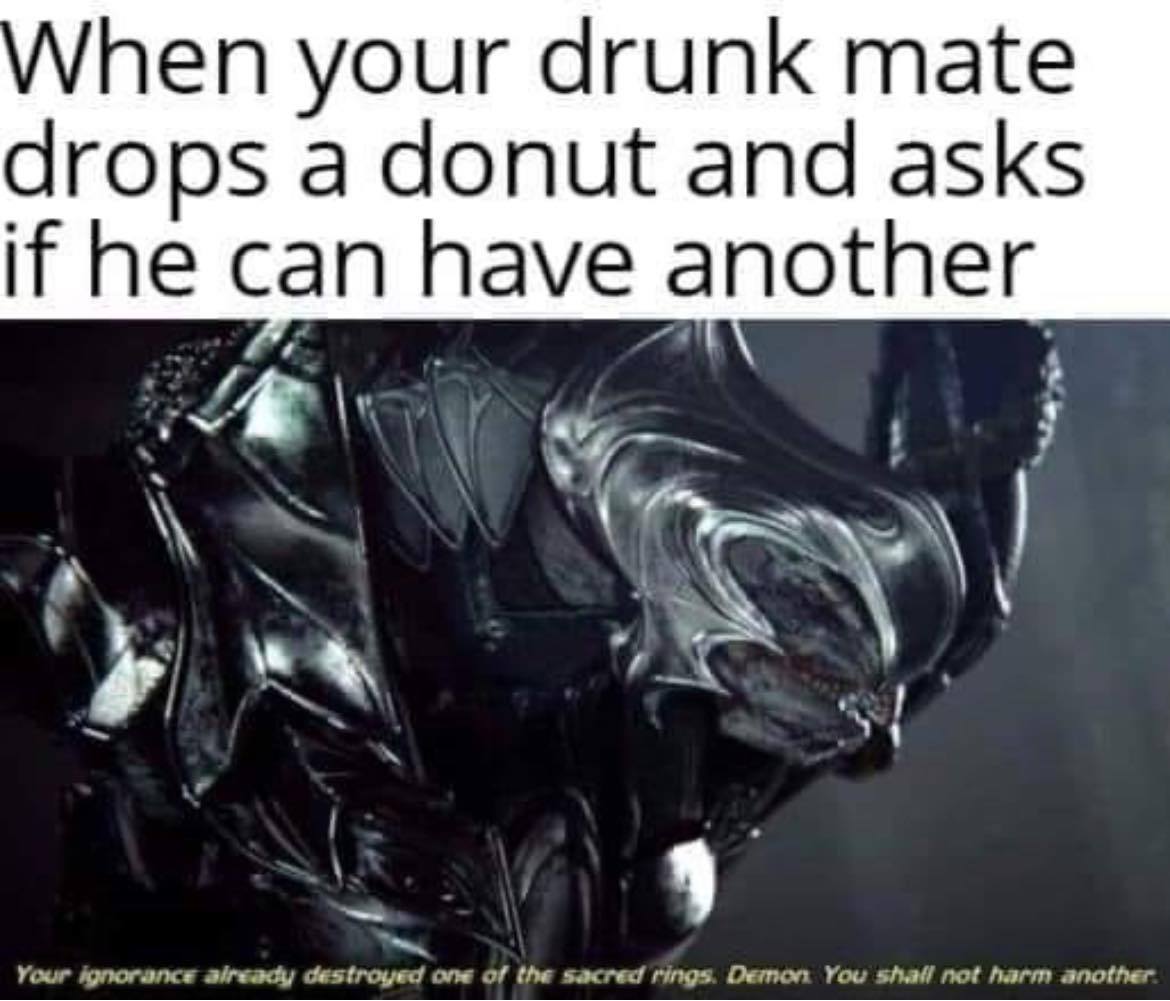
The meme features a dark, highly-detailed rendering of a monstrous, demonic figure. It's a very stylized, intricate creature with multiple limbs, appearing as if composed of segmented plates or armor. The creature has a vaguely humanoid head with glowing, intensely focused eyes. The lighting is dramatic, highlighting the textures and emphasizing the imposing, threatening nature of the being. Text overlays the image: "When your drunk mate drops a donut and asks if he can have another." Below the image is further text: "Your ignorance already destroyed one of the sacred rings. Demon. You shall not harm another."
Foucauldian Genealogical Discourse Analysis
This meme engages with the discourse of "friendship" and the power dynamics embedded within it. Foucault would ask how the expectation of providing another donut to a "drunk mate" came to be understood as normative (or at least expected). The image, a terrifying demon, represents the consequence (or the internal reaction) to the perceived entitlement implied by the request.
The "sacred rings" text hints at a moral framework that has been broken. The act of asking for another donut, given the fallen one, can be seen as a miniature enactment of societal demands and the expectation of continual supply/gratification. The demon isn't punishing a simple act, but the logic underlying it – a logic of endless consumption and disregard for consequences. The statement “you shall not harm another” is a re-establishment of moral boundaries in response to that logic.
We can trace the genealogy of this expectation to broader societal discourses around hospitality, obligation, and the "mate" archetype (often tied to a tolerance of minor transgressions). The demon is a symbolic manifestation of the suppressed anxieties and frustrations with these unacknowledged expectations.
Critical Theory
From a critical theory perspective (heavily influenced by the Frankfurt School), this meme points to the commodification of social relationships. The donut, seemingly trivial, represents the broader system of exchange and consumption that permeates modern life. The "drunk mate's" request isn't about genuine need, but a continuation of a cycle of demand and supply.
The demon, as a representation of suppressed anger/judgment, signifies the alienation and fragmentation inherent in a capitalist society where relationships can become transactional. The meme implies that beneath the surface of casual friendship, there lurks a resentment towards the constant expectation of providing—a resentment that manifests as a monstrous, otherworldly force. The focus on the "ignornace" is key. If only the drunk mate realized his entitlement, then the consequence could be avoided.
Marxist Conflict Theory
Applying Marxist conflict theory, the donut can be seen as a resource. The "drunk mate" represents a class seeking to continually extract resources (donuts) without acknowledging any limits or consequences. The demon is the symbolic representation of the forces of production/restraint pushing back against this unsustainable demand.
The joke highlights the inherent conflict in a system where resources are finite, and demands are often limitless. The fallen donut is a metaphor for wasted resources (time, effort, the donut itself). The "ignornace" is a lack of class consciousness; not understanding the resource depletion in play. This could also be taken as a social commentary on the current consumer based world, in which we continue to demand products with no regard for the sustainability of the resources needed to create them.
Postmodernism
A postmodern reading would emphasize the irony and playfulness of the meme. The juxtaposition of the trivial (a dropped donut) with the grandiose (a terrifying demon) deliberately destabilizes meaning. The meme isn't making a serious argument; it’s commenting on the absurdity of everyday interactions.
The deconstruction of the expected response (sympathy for a clumsy friend) and the replacement with a demonic reprimand challenges conventional norms. The meme embraces fragmentation and parody, rejecting grand narratives about friendship or obligation. It acknowledges that meaning is fluid and context-dependent.
Queer Feminist Intersectional Analysis
While a direct application to this meme is somewhat strained, we can find some potential intersections. The "drunk mate" archetype is traditionally masculine, and the response (the demon) could be read as a rejection of entitled, potentially problematic, behavior. The demon is a reclamation of power – a refusal to passively accommodate the demands of a privileged individual.
The meme could be seen as a subtle commentary on the emotional labor often expected of women (or marginalized groups) in interpersonal relationships – the expectation of constantly accommodating the needs and flaws of others. The demon is a symbolic expression of the breaking point – the refusal to continue providing support for someone who doesn't recognize or respect boundaries.
It's important to remember that these are interpretations, and the meaning of a meme is often subjective. However, applying these theoretical frameworks can reveal surprising layers of complexity in what initially appears to be a simple joke.
simple-description (llama3.2-vision)
This meme is a humorous take on a common social interaction. The image shows a character from the "Mass Effect" video game series, Commander Shepard, with a caption that reads "When your friend asks to borrow your last donut and you've just eaten it". The meme is a lighthearted way to poke fun at the frustration of sharing or lending something you've already enjoyed yourself.
tesseract-ocr
hen your drunk mate drops a donut and asks if he can have another oc it: 7 = F TA Wn oes a POTS BAS “SS ol , te FX wi K 4