First Seen
2024-04-06T18:50:15+00:00
simple-description (qwen3.5_2b-q8_0)
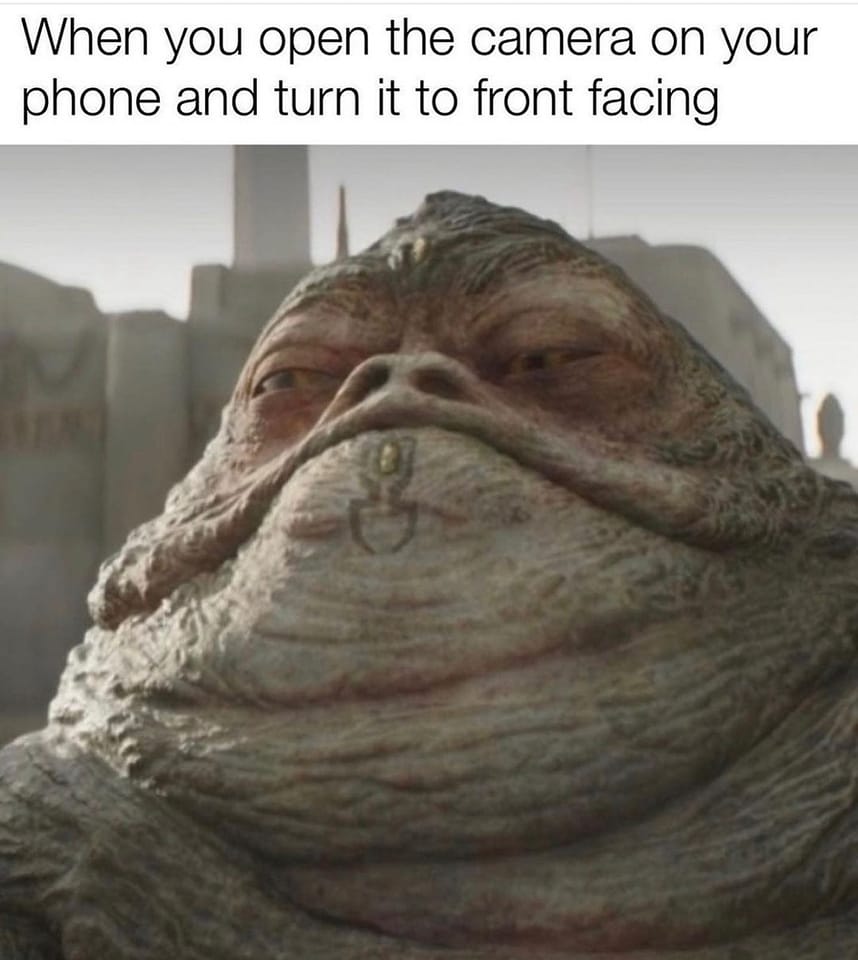
This image depicts Jabba the Hutt staring directly into the camera lens, a gesture that evokes a strong feeling of being intensely scrutinized or audited. In the context of queer anxiety, it represents the uncomfortable sensation of feeling judged about your appearance or identity while you are fully seen. The text, "When you open the camera on your phone and turn it to front facing," highlights the anxiety of being judged on your features while you are looking directly into the lens.
simple-description (llama3.2-vision_11b)
The meme is a humorous take on the anxiety of being in a new or unfamiliar social situation, particularly for individuals who identify as queer. The image depicts a character from the Star Wars franchise, Jabba the Hutt, with a caption that reads "when you open your camera app and realize you're on the wrong mode". This is a relatable moment for many, especially those who have experienced anxiety in social situations, where they may feel like they're being "exposed" or "outed" in a way that feels uncomfortable or threatening.
detailed-analysis (gemma3-27b-vision)
Okay, here's an analysis of the meme, broken down into the requested sections, with explanations of how those theoretical frameworks might apply. I'll indicate where a framework doesn't particularly fit.
Visual Description
The meme features Jabba the Hutt from Star Wars. He is depicted in a close-up, with a slightly downward angle. His expression is one of smug self-satisfaction, or perhaps bored superiority. The focus is on his wrinkled, fleshy face, with his mouth slightly open. The background appears to be a blurred depiction of his palace or surroundings, suggesting a space of power and indulgence. The text overlay reads: "When you open the camera on your phone and turn it to front facing." The joke relies on the implied self-centeredness and vanity of taking a "selfie" - the Hutt's expression is seen as analogous to the feeling of those who choose the front-facing camera.
Foucauldian Genealogical Discourse Analysis
This meme lends itself well to a Foucauldian analysis.
- Discourse of Self-Representation: The meme participates in a discourse around self-presentation and the technologies that enable it. The front-facing camera has produced a specific way of being and relating to others – one centered around curated self-images. Before the prevalence of front-facing cameras, self-portraits required more effort and were less ubiquitous.
- Power/Knowledge: The meme subtly hints at the power dynamics inherent in self-representation. Jabba the Hutt, as a symbol of power and control, embodies the ability to dictate how one is seen. The act of using a front-facing camera can be seen as an assertion of power over one's own image, but also a surrender to the visibility demanded by the digital sphere. The meme can be seen as revealing the power behind our ability to create and present our "selves".
- Genealogy of the Selfie: Tracing the historical development of self-portraiture, from paintings to photographs to digital selfies, reveals a changing understanding of the self and the desire for representation. The meme implicitly acknowledges this genealogy by associating it with a well-known, visually striking figure.
Critical Theory
The meme allows for a critical analysis centered on the concept of the spectacle.
- The Spectacle and the Self: Jabba the Hutt, as a figure accustomed to being looked at and projecting an image of authority, mirrors the dynamic created by self-presentation on social media. The selfie becomes part of the "spectacle" - a cultural environment where images are valued for their appearance rather than their substance. The meme suggests that even something as mundane as switching to the front-facing camera is implicated in this spectacle.
- Alienation: While less prominent, the meme can hint at alienation. By focusing on the surface (the selfie) rather than deeper connections, it suggests a potential disconnect from genuine experience. The Hutt’s detached, almost predatory expression embodies this kind of alienation.
Marxist Conflict Theory
While not the most natural fit, Marxist analysis can be applied, though it's somewhat strained.
- Consumption and Image: The meme can be read as commenting on the commodification of the self. In a capitalist system, even our identities become something to be "sold" or presented for approval (likes, views). The front-facing camera facilitates this process.
- Power and Control: Jabba the Hutt, as a figure of immense wealth and power, can represent the ruling class. The meme subtly suggests a parallel between his controlling gaze and the surveillance inherent in social media – the constant pressure to present a desirable image and be viewed by others.
Postmodernism
The meme strongly aligns with postmodern themes.
- Irony and Playfulness: The meme relies on ironic juxtaposition – associating the grandiose Jabba the Hutt with the mundane act of taking a selfie. This is characteristic of postmodern humor.
- Simulacra and Simulation: The selfie, as a constructed representation of the self, is a prime example of a simulacrum – a copy without an original. The meme highlights the artificiality of online personas.
- Deconstruction of Meaning: By subverting the traditional association of Jabba the Hutt with power and danger, the meme deconstructs his meaning and re-appropriates him for a new purpose.
Queer Feminist Intersectional Analysis
This framework is the least immediately applicable, but some connections can be drawn.
- The Male Gaze and Self-Objectification: While the meme doesn't explicitly focus on gender, it touches on the issue of self-representation. The front-facing camera can be linked to the idea of the “male gaze” – the tendency to view others from a heterosexual male perspective. The act of taking a selfie, especially with an emphasis on appearance, can contribute to self-objectification.
- Power Dynamics: Jabba the Hutt’s historically problematic portrayal of a powerful and controlling male figure is interesting. The meme indirectly acknowledges the power dynamics within society. However, the meme doesn't inherently address intersectionality or the experiences of marginalized groups.
Let me know if you'd like me to elaborate on any of these points or explore different angles!
simple-description (llama3.2-vision)
This meme is a humorous image of a character from the Star Wars franchise, specifically Jabba the Hutt, with a caption that pokes fun at the frustration of taking selfies. The text at the top of the image reads: "When you open the camera app and it's still on selfie mode". The meme is likely to resonate with people who have experienced the frustration of accidentally taking a selfie when they meant to take a photo of something else.
tesseract-ocr
When you open the camera on your phone and turn it to front facing ; Lae - Zz yf. 4 ra