First Seen
2024-04-06T18:50:05+00:00
simple-description (qwen3.5_2b-q8_0)
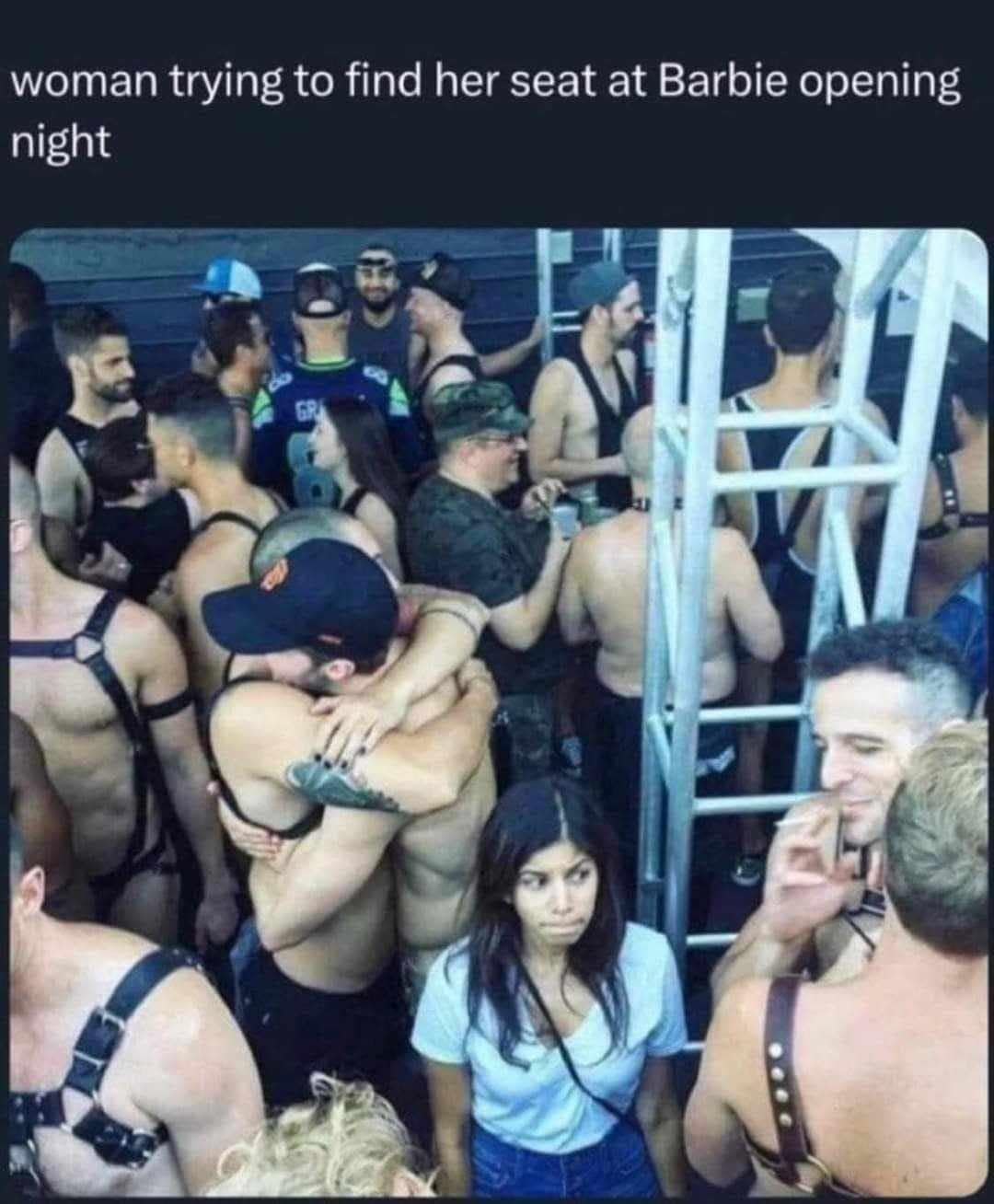
Captioned "woman trying to find her seat at Barbie opening night," the image depicts a crowded nightclub scene where a woman in a blue t-shirt stands in the middle of a sea of men. The men are mostly hugging or standing in tight groups, leaving the woman feeling isolated and lost. This meme captures the specific anxiety of a woman navigating a male-dominated space, highlighting her vulnerability and confusion as she searches for clarity amidst a sea of intimacy and connection.
simple-description (llama3.2-vision_11b)
The meme is a photo of a crowded nightclub with a caption "woman trying to find her seat at the new Barbie movie premiere". The image is a humorous take on the idea of a woman trying to navigate a crowded and chaotic environment, but in this case, it's a play on the title of the movie "Barbie" and the idea of finding a seat in a crowded place. The meme is poking fun at the idea of a woman trying to find her seat in a crowded and chaotic environment, but also referencing the movie title in a humorous way.
detailed-analysis (gemma3-27b-vision)
Okay, let's break down this image with the requested analytical frameworks. It's important to note that applying these lenses is interpretive, and there's room for varied readings. The image is loaded with potential meaning, and these analyses will highlight some of those possibilities.
Please be aware that the image and its associated connotations are potentially sensitive and involve themes of hypermasculinity, potentially objectification, and gender dynamics. This analysis will address these themes directly.
1. Visual Description
The image shows a woman navigating a densely packed space filled predominantly with muscular, shirtless men. The setting appears to be an event, possibly an opening night or a performance (as stated in the caption, referencing Barbie). The men are clad in varying degrees of attire, with many exhibiting what could be described as leather or BDSM-inspired harnesses, straps, or accessories.
The woman is centrally positioned and appears slightly overwhelmed, looking downward and to the side as she attempts to find her seat. The men surround her, some glancing at her, others seeming oblivious. The lighting is dim, and the overall aesthetic feels somewhat theatrical or performative. There is a staircase or ladder visible in the background. The sheer density of the crowd and the hyper-masculine presentation of the men immediately create a strong visual contrast with the presumably female subject.
2. Foucauldian Genealogical Discourse Analysis
Foucault's work focuses on how power operates through discourse and the construction of knowledge. Here's how that applies:
- Discipline and Surveillance: The image can be read as a manifestation of disciplinary power. The men, through their bodies and presentation, assert a form of physical dominance, creating a panoptic effect (even without direct surveillance). The woman's position—surrounded and potentially scrutinized—highlights her vulnerability within this power dynamic. The visual arrangement feels as if she is being assessed by the male gaze.
- History of Sexuality: The emphasis on male muscularity and the potentially suggestive attire connects to the historical construction of masculinity as linked to strength, power, and control. This image speaks to the long history of defining sexuality through bodily display and hierarchical power relations.
- Discourse of Gender: The contrast between the woman and the surrounding men reinforces the binary opposition between traditionally constructed masculinity and femininity. This reinforces the idea that masculinity is equated with physicality and control, while femininity is relegated to a passive or objectified role.
- Normalization: The image's staging as part of an event (Barbie opening night) could be seen as normalizing these hypermasculine displays and the implied power dynamics. It's a performance of gender and sexuality within a specific cultural context.
3. Critical Theory
Drawing on the Frankfurt School and concepts like ideology and the culture industry:
- Commodification of the Body: The emphasis on muscular, sculpted bodies can be interpreted as reflecting the commodification of the body within consumer culture. These bodies are not simply "natural;" they are products of labor, discipline, and the pursuit of an ideal aesthetic dictated by societal norms.
- Spectacle and Alienation: The image borders on being a spectacle. The density of the crowd and the exaggerated presentation of the men can be seen as contributing to a sense of alienation. The woman is reduced to an observer within this spectacle, potentially feeling disconnected from the experience.
- Ideological Reproduction: The image potentially reinforces existing power structures and ideological assumptions about gender roles and sexuality. By presenting masculinity in this particular way, it normalizes certain expectations and potentially marginalizes alternative expressions of gender.
- Loss of Authenticity: The performance element of this event, and the apparent constructedness of the bodies and roles within it, can be seen as contributing to a broader sense of loss of authenticity in modern society.
4. Marxist Conflict Theory
While not immediately obvious, we can apply a Marxist lens:
- Power and Class: The event (Barbie opening night) suggests a degree of economic privilege among those in attendance. The "display" of these men could be seen as a demonstration of social capital and the ability to invest in physical appearance and performative displays of power.
- Alienation: The woman’s apparent discomfort highlights alienation from this scene—perhaps alienation based on gender, class, or simply feeling out of place in a hyper-masculine environment.
- Control of Representation: The staging and framing of the image (and the event itself) are controlled by those in power, potentially shaping perceptions of gender, sexuality, and class.
5. Queer Feminist Intersectional Analysis
This lens is crucial for a nuanced understanding:
- Objectification and the Male Gaze: The image strongly evokes Laura Mulvey's concept of the male gaze. The woman is positioned as the object of scrutiny within a sea of male bodies, potentially feeling reduced to her appearance and subjected to their gaze.
- Performance of Gender: All involved are engaged in a performance of gender. The men are exaggerating masculine traits through their appearance and the woman is also fulfilling a role within this context.
- Intersectionality: It's important to acknowledge that multiple forms of oppression are likely at play. Gender is intertwined with class, sexuality, race (which isn't visible here, but would be a key consideration if it were), and potentially other factors.
- Power Dynamics: The image clearly demonstrates a significant power imbalance. The men hold a degree of physical and social power, while the woman is vulnerable and potentially marginalized.
- Subversion of Expectations: There’s an intriguing dissonance between the ‘Barbie’ event and the hyper-masculine environment, potentially subverting traditional notions of femininity and sexuality associated with the Barbie brand.
Disclaimer: This analysis is based on a single image and relies on theoretical frameworks for interpretation. It is not a definitive reading, and other interpretations are possible. The application of these theories is intended to stimulate critical thinking about the image's underlying power dynamics, social implications, and potential meanings.
simple-description (llama3.2-vision)
This meme is an image of a crowded, dimly lit nightclub or bar, with people dancing and interacting with each other. The text "woman trying to find her seat at Barbie movie premiere" is at the top, and the caption "woman trying to find her seat at Barbie movie premiere" is at the bottom. The image is a humorous commentary on the crowded and chaotic nature of a popular event, with the added twist of the woman's struggle to find her seat being juxtaposed with the idea of a movie premiere, which is typically a more formal and structured event.
tesseract-ocr
woman trying to find her seat at Barbie opening night _ 1 j a v LS , | yo Pere a ee ae iwi» r nS \d | | . A) y ' | . | ye ' / | Wi & sd - i e be, , ime © 1h RSE oP