First Seen
2024-04-06T19:04:19.197538+00:00
simple-description (qwen3.5_2b-q8_0)
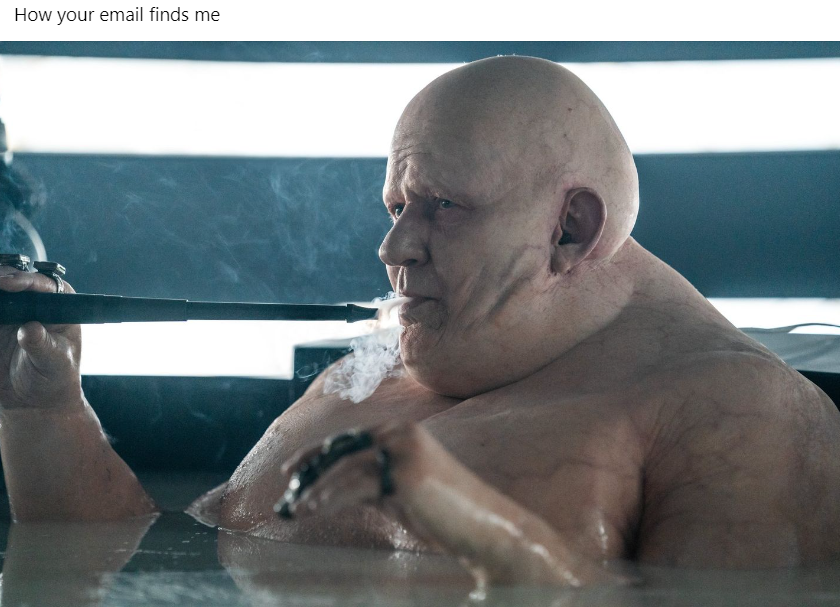
This image depicts a scene from the TV show Queer as Folk where a character (played by Michael Emerson) is soaking naked in a bathtub while smoking a pipe and holding a gun, appearing visibly anxious or distressed. From the perspective of the "Queer - Anxiety" meme culture, this image is used to represent the crushing vulnerability and mental health struggles of being a closeted gay man who must hide his identity and deal with life's pressures in a compromising and humiliating situation. The text "How your email finds me" at the top serves as the caption, reinforcing the awkwardness and fear of rejection that are central to the meme's theme of queer identity crisis.
simple-description (llama3.2-vision_11b)
The meme is a screenshot of a character from the TV show "The Expanse" with the text "I'm not arguing, I'm just explaining why I'm right" overlaid on top. The character is depicted with a serious expression, and the text suggests that the person is trying to justify their point of view, but is actually just being confrontational. The meme is likely used to poke fun at someone who is being overly defensive or argumentative.
detailed-analysis (gemma3-27b-vision)
Okay, here's an analysis of the image based on the requested theoretical frameworks. It's a complex image, so these sections may be more developed for some frameworks than others.
Visual Description
The image depicts a very muscular, bald man, likely intended to resemble a large, heavily built figure, possibly inspired by the character of Kingpin. He is seated in what appears to be a bathtub or similar recessed space, partially submerged in water. The lighting is subdued and dramatic, casting strong shadows and highlighting the man's physique. He’s smoking a pipe, creating a plume of white smoke that emphasizes his imposing presence. Around his neck is a large, ornate pendant, and what appears to be an arm tattoo is visible on his bicep. His expression is stoic and almost indifferent. The background is blurred and indistinct, suggesting a sense of confinement and isolation. The caption "How your email finds me" is present above the image.
Foucauldian Genealogical Discourse Analysis
The image, coupled with the caption, can be examined through a Foucauldian lens. The phrase "How your email finds me" points to the pervasive reach of digital surveillance and the way power operates in the modern era. Foucault's concept of "panopticism" is relevant here. The email represents a form of digital observation – a system that monitors and collects information. The figure, isolated in his bath, is unaware of the extent of this surveillance, yet he's subject to it.
The man’s sheer physicality can be seen as a manifestation of power – a brute force that resists, or appears to resist, the more subtle forms of control. However, his isolation and the fact that he is being reached by the email suggest that even this immense physical power is ultimately susceptible to the pervasive reach of digital power structures.
The genealogy would investigate how this system of email reach evolved—tracing the historical development of digital communication, surveillance technologies, and the normalization of data collection. It would explore how these mechanisms were created and justified, ultimately shaping our current understanding of privacy and control.
Critical Theory (Frankfurt School)
The image can be read as a critique of modern alienation and the loss of individual agency in a hyper-connected world. The man's imposing figure suggests a desire for control and autonomy, but the caption indicates that he is, in fact, being reached – potentially manipulated or controlled – by external forces (the sender of the email).
This resonates with the Frankfurt School’s concern with the “culture industry” and its role in manufacturing consent and suppressing critical thought. The email, in this context, can be seen as a symbol of this manipulation – a constant stream of information designed to shape our desires, beliefs, and behaviors.
The man's isolation and stoic expression might reflect a sense of powerlessness or resignation – the feeling that individuals are ultimately unable to resist the forces of mass culture and technological control.
Marxist Conflict Theory
From a Marxist perspective, the image might represent the inherent conflict between the powerful (represented by the large man) and the systems of control that permeate even their lives. The man’s physical strength could be interpreted as a symbol of capital or productive forces, but the email signifies the intrusion of ideological control—the ways in which those in power maintain their dominance.
The email is a means of communication, but also a mechanism for reinforcing existing power structures. It could be delivering information that serves the interests of a dominant class, reinforcing their control over resources and labor. The isolation of the man suggests a struggle for autonomy, but one that is ultimately limited by the reach of this digital control.
Postmodernism
The image embraces a postmodern sensibility through its ironic juxtaposition of the archaic (the large, almost mythical figure, the pipe) with the thoroughly modern (the email). The caption creates a deliberate disconnect, undermining any straightforward interpretation of the scene. It asks the viewer to question the very notion of power and control in a world where digital communication is ubiquitous.
The image also plays with the concept of simulation and hyperreality. The man’s imposing figure could be seen as a constructed image, a simulation of power rather than authentic authority. The email, as a digital message, is itself a form of simulation – a representation of communication that lacks the immediacy of face-to-face interaction. The blending of these elements creates a sense of ambiguity and uncertainty, characteristic of postmodern art.
Queer Feminist Intersectional Analysis
This framework is the most challenging to apply directly, as the image doesn't inherently address gender or sexuality. However, it’s possible to interpret the image through an intersectional lens by considering the performance of masculinity and the ways in which it's linked to power. The figure’s exaggerated muscularity represents a hyper-masculine archetype—a performance of dominance and control.
From a queer perspective, this performance could be seen as a rigid and limiting expression of gender, reinforcing traditional power dynamics and marginalizing alternative expressions of masculinity and femininity.
An intersectional analysis might also consider how this hyper-masculine performance intersects with other forms of power, such as class and race. The man’s imposing physique could be seen as a symbol of privilege and dominance, potentially reinforcing existing inequalities.
The digital reach of the email could also be seen as a form of surveillance and control that disproportionately impacts marginalized communities.
Disclaimer: These interpretations are subjective and open to debate. The meaning of an image is always contingent on the context and the perspective of the viewer.
simple-description (llama3.2-vision)
This meme is an image of a character from the TV show "Game of Thrones" (Varys) sitting in a bathtub, smoking a hookah. The text at the top of the image reads "How your email finds me" and the text at the bottom reads "In a hidden cache of ancient knowledge, deep in the dark web". The image is humorous because it implies that the character's email inbox is a mysterious and obscure place, much like the character's hidden knowledge.
tesseract-ocr
How your email finds me — q ( , a N Ne ‘i i = 4 _ 4 < “ , i . _ ps ™ ‘ he “~ P}