First Seen
2023-05-10T21:03:39+00:00
simple-description (llama3.2-vision_11b)
The meme is a humorous image of a person with a worried expression, with the text "I don't know where I am, but I know I'm not where I'm supposed to be" and "I don't know what I want, but I know I don't want what I've got". The image is likely a play on the anxiety and uncertainty that can come with being queer and navigating one's identity, with the text poking fun at the idea that even when you think you know what you want, you might still be unsure about what that is.
detailed-analysis (gemma3-27b-vision)
Okay, let's break down this image (a still from Dirty Harry) with analysis using the requested theoretical lenses. Please note that some lenses will be more applicable/fruitful than others, and I'll explain why if a section is omitted.
Visual Description
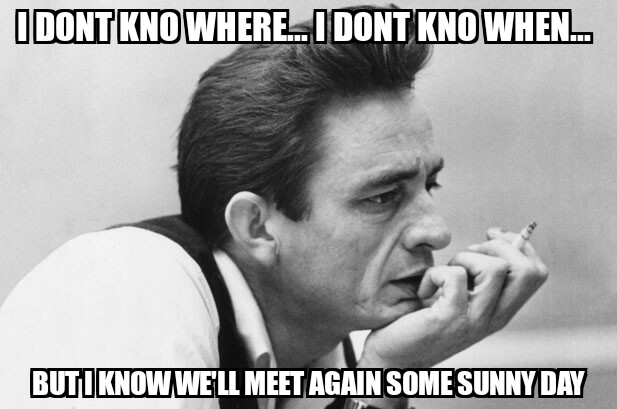
The image is a black and white still, a close-up portrait of actor Clint Eastwood in the role of "Dirty Harry" Callahan from the 1971 film Dirty Harry. He appears distressed, with a furrowed brow and a hand clasped to his face. He is smoking a cigarette. The background is blurred, suggesting focus on the figure's emotional state. Text is superimposed on the image in a classic "meme" format: "I DON'T KNOW WHERE... I DON'T KNOW WHEN..." above the figure and "BUT I KNOW WE'LL MEET AGAIN SOME SUNNY DAY" below. The framing and lighting emphasize the severity and weariness in Eastwood’s expression. The composition draws attention to the face, implying a deep-seated internal conflict.
Foucauldian Genealogical Discourse Analysis
This image, when contextualized with the quote and the film, becomes a site for examining discourses around justice, law, and power. Foucault's genealogy seeks to uncover the historical development of concepts and practices, revealing how they are constructed and maintained through power relations.
- Discourse of Law & Order: Dirty Harry emerged during a period of social unrest and rising crime rates in the US. The film's narrative constructed a discourse around the perceived failures of the legal system and the need for a more forceful, vigilante approach to justice. "Dirty Harry" represents a critique of procedural due process, positioning it as an obstacle to effective law enforcement. The image captures a moment of Harry's internal conflict about the 'rules' he's supposed to follow.
- Discourse of Masculinity: The image embodies a certain type of hyper-masculine figure. Eastwood’s performance (and the image) constructs “Dirty Harry” as a strong, independent, and stoic figure. This reinforces a particular masculine ideal that values action over contemplation, and self-reliance over dependence on institutions. The cigarette can also be seen as part of this construction of rebellious, masculine self-image.
- Power/Knowledge: The film presents a particular "knowledge" about crime, justice, and effective law enforcement. This knowledge isn’t neutral; it's tied to power. "Dirty Harry" operates outside the traditional power structures, claiming a "superior" knowledge of how to deal with criminals. The image becomes symbolic of a rejection of bureaucracy and a pursuit of justice through a different means.
Critical Theory
The image can be analyzed through the lens of Critical Theory, specifically in relation to the culture industry and ideology.
- The Culture Industry: Adorno and Horkheimer argued that the culture industry produces standardized, mass-produced commodities that lull the audience into passive consumption and conformity. Dirty Harry, as a popular action film, can be seen as part of this industry. It offers a simplified narrative about crime and justice that often reinforces existing power structures and societal norms.
- Ideology: The film promotes an ideology that frames the failures of the legal system as a result of bureaucratic red tape and lenient sentencing, rather than systemic issues or social inequalities. The image, by capturing Harry’s apparent frustration with these failures, subtly reinforces this ideological message. It suggests that a more “direct” approach is necessary, appealing to feelings of frustration and disillusionment.
- Commodification of Rebellion: The image, within the meme format, can also be seen as commodifying rebellion. The “dark” and “frustrated” figure becomes an easily digestible image for sharing online, potentially diminishing the actual critique the film originally presented.
Marxist Conflict Theory
Marxist theory analyzes society through the lens of class struggle and power imbalances.
- State Apparatus & Control: The film's depiction of the legal system can be interpreted as a critique of the state’s role in maintaining social control. “Dirty Harry” sees the legal system as hindering his ability to protect the “innocent” (a class construct in itself), portraying it as serving the interests of those in power, rather than protecting the vulnerable.
- Class Conflict: The film's criminals are often presented as marginalized individuals, and the film’s implied social commentary suggests that crime is a symptom of broader economic and social inequalities. The image encapsulates the frustration of a law enforcer working within a system that he believes fails to address these root causes.
- Hegemony: The film, through its popularity, contributes to the maintenance of dominant ideologies that legitimize the use of force and the suppression of dissent. It reinforces the idea that a "strong" law enforcement is necessary to maintain order, even if it means violating certain rules.
Postmodernism
Postmodern thought challenges grand narratives and emphasizes the subjective nature of truth and knowledge.
- Deconstruction of Heroism: The figure of "Dirty Harry" challenges the traditional image of the heroic cop. He is flawed, cynical, and operates outside the bounds of the law. This deconstruction of traditional heroism reflects a postmodern skepticism towards grand narratives and idealized figures.
- Simulation & Hyperreality: Within the meme context, the image becomes a simulation of the character's inner turmoil. It’s divorced from the original context of the film, and its meaning is often determined by the individual viewer's interpretation. The image becomes a hyperreal representation of frustration and alienation, amplified and circulated through social media.
- Fragmentation of Meaning: The meme format itself contributes to the fragmentation of meaning. The image is stripped of its original context and juxtaposed with a new textual message, creating a new, often ironic, interpretation.
Queer Feminist Intersectional Analysis
This lens is arguably the least directly applicable to the image itself, but we can still extract some observations:
- Hypermasculinity & Violence: The image reinforces a hypermasculine ideal that is often associated with violence and aggression. Feminist theory would critique this portrayal as contributing to a culture of toxic masculinity that perpetuates harmful norms and behaviors.
- Absence of Female Voices & Agency: The film (Dirty Harry) has been criticized for its lack of significant female characters and its portrayal of women as either victims or objects of desire. This absence contributes to the marginalization of female voices and experiences. The image reflects this broader issue by focusing solely on the male figure and his internal conflict.
- Intersectionality of Power: The image, when combined with the film’s broader context, highlights the intersectionality of power. "Dirty Harry" operates within a system of power that is based on race, class, and gender. His actions and decisions are shaped by these intersecting factors, and his portrayal reinforces existing power imbalances.
I hope this comprehensive analysis is useful! Let me know if you'd like me to elaborate on any specific aspect or theoretical lens.
simple-description (llama3.2-vision)
This meme is a humorous image of Johnny Cash with a caption that pokes fun at his song "I Walk the Line". The image features a photo of Johnny Cash with a deadpan expression, and the text "I don't know where it leads, I don't know where it goes" is overlaid on top of it, but the rest of the caption is "I don't know where it leads, I don't know where it goes, but I know I'm not there yet, I know I'm not there yet, I don't know where it leads, I don't know where it goes, but I know I'm not there yet" is replaced with "I don't know where it leads, I don't know where it goes, but I know I'm not there yet, but I know I'm not there yet, but I know I'm not there yet".
tesseract-ocr
ITO WEES CCO LTT, _ \ ts. q = e , f/ BOIICH ay Pat TTT EY