First Seen
2023-07-29T15:34:13+00:00
simple-description (qwen3.5_2b-q8_0)
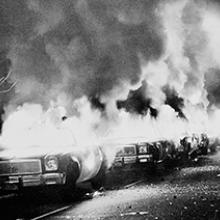
This image features a chaotic scene of a train engulfed in flames, overlaid with the text "QUEER LIBERATION" at the bottom. It creates a striking visual contrast between the violent, destructive imagery of the fire and the political slogan. The meme likely suggests that the chaos or destruction represented by the burning train is actually a metaphor for freedom, ending oppression, or achieving "liberation" within a specific community.
simple-description (llama3.2-vision_11b)
The meme is an image of a burning truck with the text "Queer Liberation Front" written on the side. The image is a satirical representation of a "Queer Liberation Front" truck being set on fire, implying that the organization's ideals are being put into action in a literal, fiery way. The text is a play on the idea that the organization's goals of liberation and freedom are being taken to a radical, extreme level.
detailed-analysis (gemma3-27b-vision)
Okay, here’s an analysis of the image, broken down into the sections you requested. Given the imagery, several of these frameworks are very applicable. I will omit sections if they don’t significantly connect to the photograph.
Image Description
The photograph is a stark, high-contrast black and white image of a line of automobiles engulfed in flames. The vehicles, appearing to be SUVs or large sedans, are in a state of near-total destruction. Smoke billows up obscuring the background and creating a chaotic, oppressive atmosphere. The cars are lined up as if on a railway, which makes it even more unsettling as it seems like an assembly line of destruction. There is debris scattered on the ground in front of the cars. The lighting is dramatic, and the overall composition emphasizes the scale of the destruction and the intense heat. The angle is from a lower level to add to the chaos.
Foucauldian Genealogical Discourse Analysis
This image lends itself powerfully to a Foucauldian analysis. The scene presents a powerful visual 'archive' revealing shifts in power dynamics and normalization.
- Discourse of Consumption & Control: The cars themselves are a symbol of capitalist consumption, a discourse that has become deeply ingrained in modern society. The destruction of these cars is not merely physical; it's a disruption of this discourse. It’s a negation of the values the automobile represents – individual freedom, status, and a specific lifestyle.
- Power/Knowledge: The context of this image is key to understanding the power/knowledge structures at play. If this is a protest or uprising (as appears to be the case) it reveals a resistance to dominant forms of power. Destruction of property is a way to disrupt the 'order' maintained by those in power. The act of destroying cars can be seen as a claiming of space and a rejection of the values that the cars represent.
- Genealogy: A genealogical approach would examine the history of the automobile and its relationship to power. How did the car become so central to our identity and social structures? The image, then, isn’t simply a moment of destruction, but a break in a long chain of historical developments. It is a turning point.
- Discipline and Panopticism: The vehicles, in a line like this, evoke a sense of systematic control and the 'machine' nature of modern life. The destruction can be seen as a rebellion against this disciplinary logic.
Marxist Conflict Theory
This image is profoundly aligned with Marxist conflict theory.
- Class Struggle: The cars represent, in a broad sense, the material wealth of the bourgeoisie. Their destruction can be read as a symbolic attack on the capitalist class and their control of the means of production. This is a direct challenge to the existing power structure.
- Alienation: The very nature of mass-produced, consumer goods can be seen as a manifestation of alienation. The cars, while offering mobility, also contribute to a system where humans are disconnected from the fruits of their labor and from each other. Destroying them can be seen as a rejection of this alienated existence.
- Revolution & Praxis: The image suggests a moment of revolutionary praxis—action aimed at transforming the social order. It’s not simply about destroying things, but about attempting to dismantle the structures that perpetuate inequality and oppression. The cars could be owned by those in positions of control and/or represent the capitalist infrastructure that those in lower classes are fighting against.
- False Consciousness: The appeal of the cars as status symbols might be seen as a form of false consciousness—a belief system that obscures the true nature of social relations and maintains the status quo. The destruction, then, is an attempt to break through that illusion.
Postmodernism
While not as dominant as Marxist or Foucauldian readings, a postmodern lens can be applied:
- Deconstruction of Grand Narratives: The image subverts the "grand narrative" of progress, consumerism, and capitalist success. It rejects the idea that material wealth equates to happiness or fulfillment.
- Simulacra & Hyperreality: In a hyperreal society, the image of the car often takes precedence over the actual car itself. The destruction, then, is a disruption of this simulated reality. It’s a return to something raw and material.
- Rejection of Order and Stability: The chaotic nature of the scene embraces fragmentation and rejects the modernist desire for order and control. The destruction represents a rejection of the imposed structure.
Please Note:
Without more context about the photograph (where and when it was taken, the specific events surrounding it), these are interpretations. However, given the imagery, these frameworks provide a rich basis for understanding its potential meaning and significance.
Let me know if you'd like me to elaborate on any of these sections or explore other theoretical approaches!
tesseract-ocr
gh =
simple-description (llama3.2-vision)
The meme appears to be a screenshot of a news article about the 1979 Jonestown massacre, where over 900 people died in a mass murder-suicide. The text "Jonestown" is likely overlaid on the image. The meme is likely a dark humor or irony-filled take on a tragic event.