First Seen
2023-07-29T15:34:25+00:00
simple-description (qwen3.5_2b-q8_0)
The meme captures a famous, chaotic scene from the notorious 1973 Tom Selleck car crash. A Ford Fairlane (visible on the license plate as KDF 355) was running over a woman and set on fire while speeding, a case Selleck later faced in a wrongful death prosecution. The meme celebrates the resilience of the vehicle itself—the famous car famously survived the crash—while ironically referencing the story of Selleck's survival and "liberation" from the chaos. It is often used to humorously celebrate his personal freedom and the car's endurance.
simple-description (llama3.2-vision_11b)
The meme is a reference to the 1968 Stonewall riots, a pivotal event in the LGBTQ+ liberation movement. The image is likely a photograph of a person, possibly a woman, with a fiery expression, surrounded by flames or a burning building, with the caption "Queer Liberation" or a similar phrase. The meme is meant to evoke the spirit of resistance and defiance that characterized the Stonewall riots, a moment of collective action that sparked a broader movement for LGBTQ+ rights.
detailed-analysis (gemma3-27b-vision)
Okay, let's break down this image using the requested theoretical frameworks. It's a powerful image, and its complexities allow for multiple interpretations through various lenses.
1. Visual Description
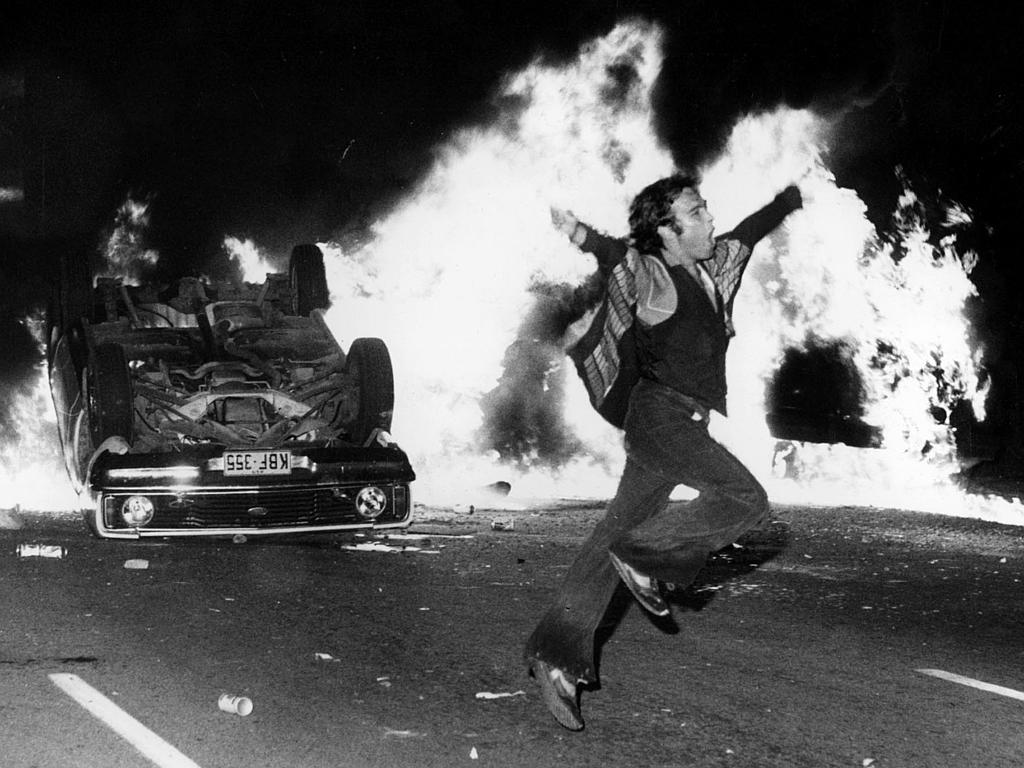
The image is a stark black and white photograph featuring a dramatic scene of a car engulfed in flames. The car is overturned, its front end crushed and charred, suggesting a violent impact. A man is captured mid-leap, seemingly fleeing the burning vehicle. He is dressed in a suit jacket and pants, with shoes that appear to have soles coming apart. He is extending one arm out as if gesturing, celebrating, or perhaps indicating something amidst the chaos.
The composition is dynamic, with the flames dominating the background and the man providing a central focal point. The pavement is visible, and scattered debris suggests the aftermath of a crash. The lighting is stark, highlighting the contrast between the dark pavement, the burning car, and the figure of the man. The overall effect is one of intensity, danger, and a sense of liberation or defiance.
2. Foucauldian Genealogical Discourse Analysis
This image can be read through a Foucauldian lens as a demonstration of shifting power dynamics and the construction of “madness” or “deviation”. The overturned car, which can be viewed as a symbol of order, technology, and control, is violently disrupted. The man, leaping away from this wreck, can be seen as a figure transgressing established norms.
- Discourse of Risk & Control: Cars, in the 20th century, were heavily associated with progress, freedom, and modernization. This image subverts that discourse by depicting a car as a dangerous, destructive force. The figure, by abandoning the vehicle after the crash, rejects the promise of control the car represents.
- Genealogy of Rebellion: A genealogical examination could explore the historical roots of this act of destruction. Is this an act of political protest? A reckless disregard for property? The image isolates a single moment, stripping it of its full historical context, yet it points to a lineage of rebellion against societal structures.
- Power/Knowledge: The image's circulation itself is an exercise of power/knowledge. Who framed this photograph? What narrative is it intended to construct? The act of "seeing" the man as a hero or a villain, or as simply an actor within a chaotic event, is shaped by pre-existing power structures.
3. Marxist Conflict Theory
From a Marxist perspective, this image embodies class conflict and the inherent contradictions of capitalist society.
- Material Conditions & Destruction: The car itself represents a commodity, a product of capitalist production. Its destruction suggests a rejection of this system, possibly fueled by alienation or economic hardship.
- Class Conflict: The man’s clothing (suit jacket, though somewhat disheveled) could suggest a middle-class background, perhaps a disgruntled member of the establishment turning against its symbols. The car, as a symbol of status and wealth, is destroyed, representing a challenge to the existing power structure.
- Revolutionary Act: The leap could be interpreted as a symbolic act of liberation, breaking free from the constraints of capitalist society. The destruction of the car, a material manifestation of capitalist power, becomes a violent expression of resistance.
4. Postmodernism
The image readily lends itself to a postmodern reading.
- Fragmentation & Instability: The chaotic scene, the broken car, and the man’s unstable pose represent fragmentation and the breakdown of grand narratives. There is no clear "meaning" or resolution to the event depicted.
- Simulacra & Simulation: The image is the event, a simulation of reality. We are not witnessing the crash itself, but a staged or captured moment of its aftermath. This highlights the blurring of lines between reality and representation.
- Irony & Playfulness: The man’s gesture—is it celebration, defiance, or madness?—introduces an element of ambiguity and irony. The image challenges conventional interpretations and invites multiple readings.
5. Queer Feminist Intersectional Analysis
This is the most challenging framework to apply without more context. However, we can speculate:
- Subversion of Masculinity: The image challenges traditional notions of masculinity. The man is not displaying stoicism or control but is leaping and gesturing in a way that could be perceived as vulnerable or eccentric. This could be read as a rejection of patriarchal norms.
- Performance of Resistance: The man's leap can be seen as a form of queer performance—a deliberate disruption of expected behavior. This challenges societal norms and asserts a form of agency.
- Intersectional Layering (speculative): Without knowing the context, it's difficult to assess how race, class, or other identities intersect with this event. However, one could explore how the act of rebellion might be particularly meaningful for marginalized groups. If the man is from a minority or disenfranchised community, his act of destruction could be seen as a form of resistance against systemic oppression.
Important Considerations:
- Context is Crucial: A full interpretation requires knowing the circumstances surrounding the photograph (who took it, where, when, and the story behind it).
- Multiple Interpretations: These theoretical frameworks are tools for analysis, not definitive answers. The image is open to multiple readings and interpretations.
Let me know if you would like me to elaborate on any of these sections or explore another theoretical lens.
tesseract-ocr
? . 4 ‘ s a 3 Pp sy F Ca adh / : 7 PN ae : KS f 4 z Gut Fm F Fi , ae. a 0) we q x Fey OR ZF RB 9 ry —_—— ae bal 1 eS Pe G ‘i SDD cee I ries "3 — aS oe “4 Beer ge. Asaiaa | emt s . i Se ——— . - Ae. ema ; = a as : Pea tee ty Se Pena z ih =
simple-description (llama3.2-vision)
This meme is an image of a person in the midst of a chaotic and violent scene, likely a riot or protest. The image shows a person in a panicked state, with a shocked expression and their arms raised in a defensive or fleeing position. The text "BREAKING: Person in the middle of a riot is still alive" is likely a humorous commentary on the absurdity of the situation.