First Seen
2023-07-29T15:34:00+00:00
simple-description (qwen3.5_2b-q8_0)
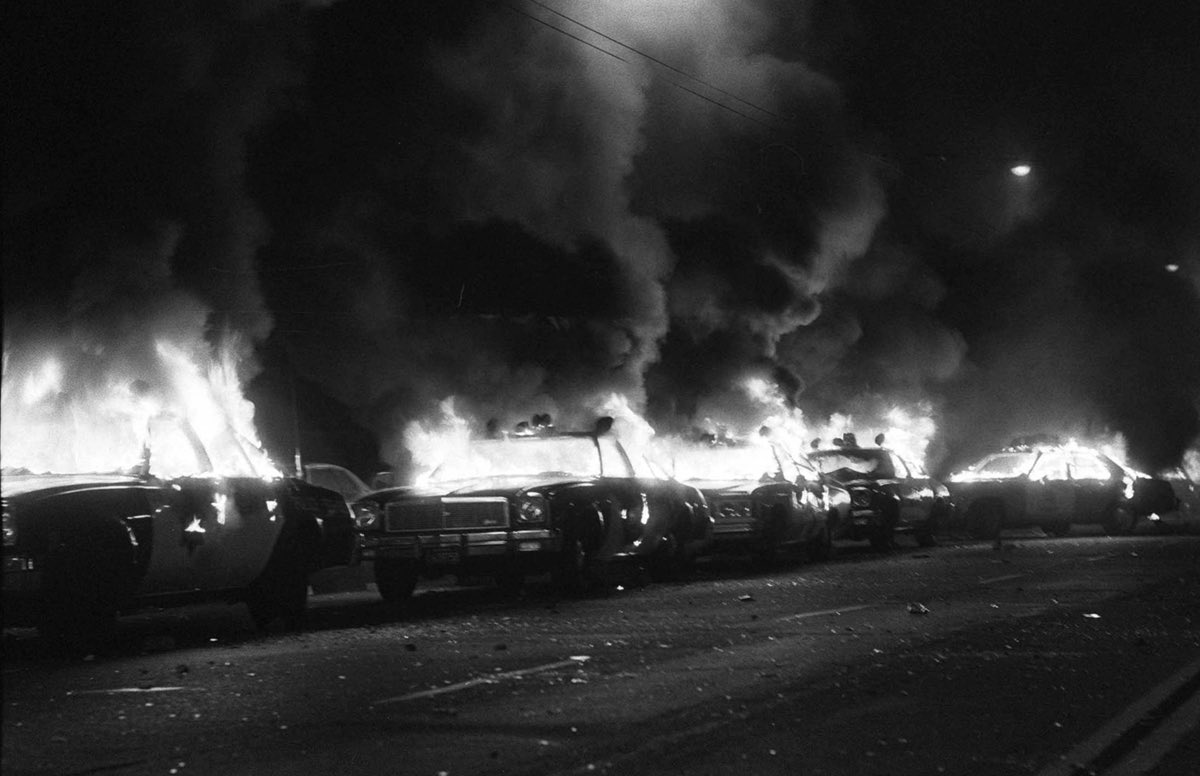
This meme originates from the Burning of 1964, a pivotal event in the history of the Civil Rights Movement and LGBTQ+ liberation in San Francisco. The image depicts a row of police cars engulfed in flames at night, which activists used to protest anti-drug laws and symbolize resistance against oppression. The text "1964 is visible on the vehicles, marking the specific year when this event occurred and linking it to the broader struggle for civil equality.
simple-description (llama3.2-vision_11b)
This meme is a reference to the 1973 film "The Towering Inferno," but with a queer liberation twist. The image shows a row of police cars on fire, with the text "Queer Liberation is on fire" overlaid on top. The meme is a play on the idea that the police are often seen as a symbol of oppression, and that queer liberation is a movement that seeks to challenge and dismantle those systems of oppression.
detailed-analysis (gemma3-27b-vision)
Okay, let's analyze this powerful image using the frameworks you've requested. Given the subject matter, several of these frameworks will be highly applicable, while others will have limited relevance. I will organize the response into sections, only including those relevant frameworks.
Please note: Interpretation is always subjective. The following is an analysis based on the imagery and applying the principles of each school of thought.
Visual Description
The image is a stark, high-contrast black and white photograph depicting a row of vehicles – seemingly police cars – engulfed in flames. The scene is at night, illuminated by the intense glow of the fires and a few artificial light sources, likely streetlights, which appear as blurry points in the upper part of the image. The vehicles are lined up relatively close together, creating a linear composition that accentuates their shared fate.
The flames are the dominant feature, shooting upwards and creating swirling patterns of smoke that obscure the background. The cars appear almost skeletal in the fire's light, their forms becoming indistinct. Debris litters the road around them. The overall impression is one of destruction, chaos, and a deliberate act of defiance or revolt. There's a strong sense of heat and tension conveyed through the dramatic lighting and the intensity of the fire. The perspective appears to be at street level, giving a viewer a very immersive feeling.
Foucauldian Genealogical Discourse Analysis
This image is fertile ground for a Foucauldian analysis. The burning police cars aren’t just physical objects; they symbolize the very discourse of power, control, and social regulation.
- Power/Knowledge: Foucault argues that power and knowledge are inextricably linked. Police cars are physical manifestations of the state's power and the body of law that underpins it. Their destruction is a direct challenge to this established power/knowledge regime. It’s a visual statement that says, "We reject the legitimacy of this power."
- Genealogy: A genealogical approach would ask how the authority and legitimacy of the police, and the institutions they represent, came to be established. The burning cars can be seen as a rejection of that historical process, a disruption of the established order built on past assumptions and justifications.
- Discipline & Punishment: Historically, the police represent a shift from sovereign power (public spectacle of punishment) to disciplinary power (surveillance, regulation of bodies, normalization). Burning the cars can be seen as a symbolic 'reversal' - the state's tools of discipline being subjected to destruction. It is an attempt to disrupt the constant surveillance and control enforced by the state.
- Biopower: The image can also be linked to biopower, the way modern states regulate populations. Police cars are integral to this regulation (traffic control, crime prevention). Destroying them can be seen as a rejection of this attempt to control life and bodies.
Critical Theory (Specifically Frankfurt School)
The image resonates strongly with themes explored by the Frankfurt School.
- Instrumental Reason: The police represent the ‘instrumental reason’ of the state – the application of logic and efficiency to maintain order. The burning cars represent a visceral rejection of this cold, rational approach to social control.
- Culture Industry: While the cars themselves aren’t part of the culture industry, the response to this event (media coverage, political debates) is. The Frankfurt School would be interested in how this event is commodified, sensationalized, or used to reinforce existing power structures.
- Domination & Emancipation: The burning cars can be seen as a symbolic act of resistance against systemic domination. It's a desperate attempt to break free from structures of control. While the image itself doesn’t offer a solution, it highlights the deep-seated frustration and anger felt by those who feel oppressed.
- The Authoritarian Personality: The image might be seen as the outcome of a repressed and frustrated collective, driven to violent expression against perceived authority.
Marxist Conflict Theory
This image is a prime example of conflict theory in action.
- Class Struggle: The burning cars likely represent a clash between marginalized groups (often those experiencing economic hardship, systemic racism, etc.) and the forces of the state that uphold the existing power structure. This is a visible manifestation of underlying tensions.
- Ideology & False Consciousness: The state's authority is often maintained through ideology—beliefs that legitimize the existing order. The destruction of the cars is a rejection of this ideology, a refusal to accept the status quo.
- Revolution & Social Change: While the image doesn’t necessarily signify a full-scale revolution, it represents an act of rebellion, a challenge to the dominant power structure. It's a desperate attempt to disrupt the system and force change.
- The State as an Instrument of Oppression: Marxist theory views the state, including its police forces, as an instrument used by the ruling class to maintain its power and suppress dissent. The burning of the cars is a direct attack on this instrument of oppression.
Queer Feminist Intersectional Analysis
While not the most immediately apparent framework, an intersectional analysis can shed further light on the image.
- State Violence & Marginalized Bodies: Police brutality disproportionately impacts marginalized communities—particularly BIPOC, LGBTQ+ individuals, and those with disabilities. The burning cars can be seen as a reaction to this history of systemic violence and oppression.
- Resistance as Self-Defense: The act of destroying the cars can be interpreted as an act of self-defense—a refusal to submit to further violence and control.
- Disruption of Normative Power: Police cars represent the enforcement of normative social order—the rules and expectations that privilege certain groups while marginalizing others. Destroying them is a rejection of this order and a call for a more inclusive and equitable society.
- Visibility of Rage: For groups often rendered invisible or silenced, the burning cars is a striking display of collective anger and frustration. It signals a refusal to passively accept injustice.
Hopefully, this comprehensive analysis provides a layered interpretation of the image. It’s important to remember that art is open to interpretation, and these are just a few of the many ways to understand the meaning and significance of this powerful photograph. Let me know if you'd like me to elaborate on any particular aspect of this analysis.
tesseract-ocr
ae | eels te 2
simple-description (llama3.2-vision)
The meme is a black-and-white image of a crowded parking lot on fire, with flames engulfing rows of cars. The image is captioned "when you finally understand the parking situation at the gas station". The meme is likely referencing a frustrating or chaotic situation, and the image is a humorous exaggeration of that feeling.