First Seen
2023-10-06T20:50:52+00:00
simple-description (qwen3.5_2b-q8_0)
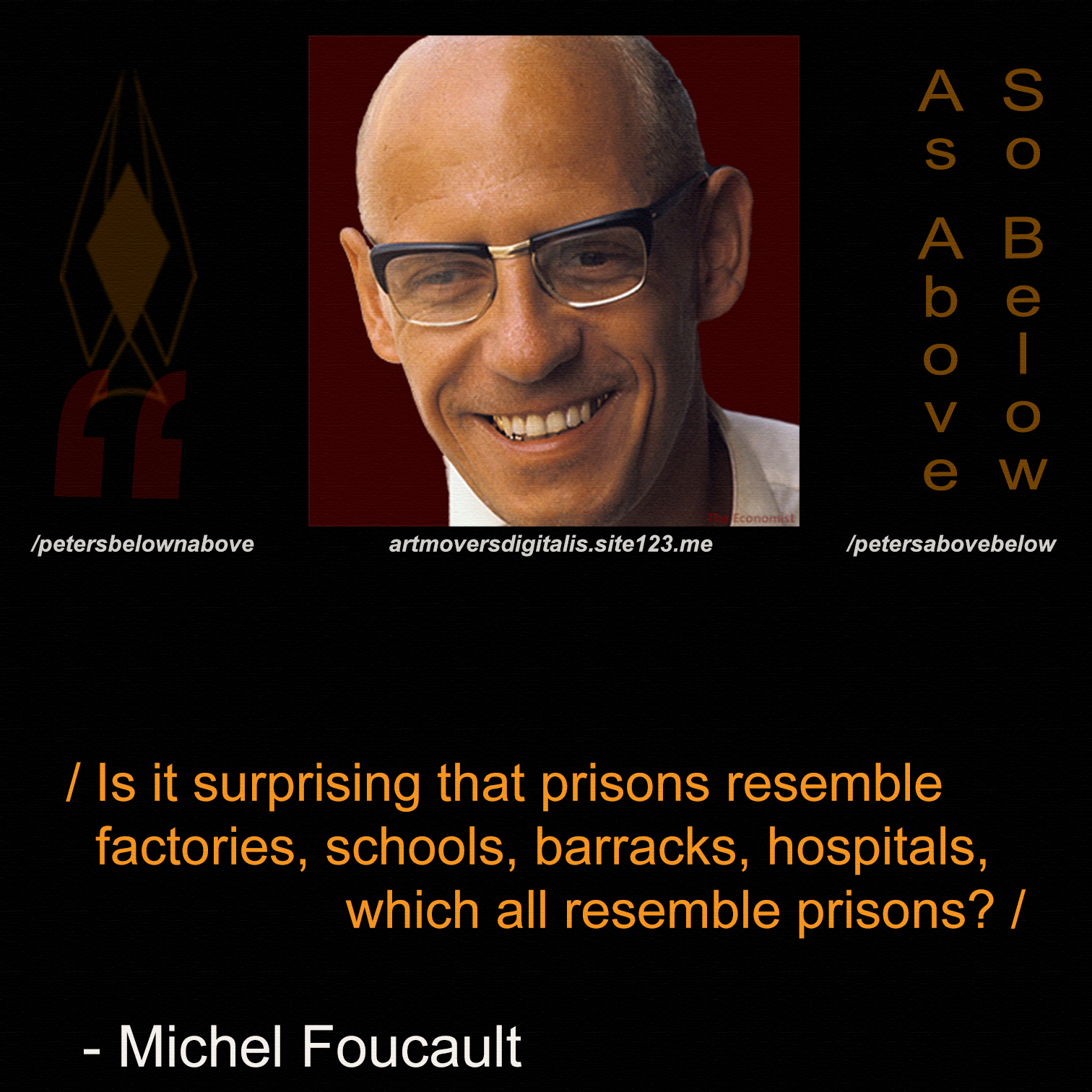
The image features a portrait of the philosopher Michel Foucault flanked by text and symbols. On the right, the phrase "As Above, So Below" is arranged vertically, while a decorative symbol appears on the left with the text "/petersbelownabove." The central text displays the famous quote: "/ Is it surprising that prisons resemble factories, schools, barracks, hospitals, which all resemble prisons? /" attributed to him. This content relates to the category by presenting Foucault's theory on how institutions like prisons and schools function through surveillance and categorization.
simple-description (llama3.2-vision_11b)
The meme is a humorous take on the concept of panopticism, a philosophical idea that suggests that individuals are constantly being watched and judged by others. The meme features a photo of Michel Foucault, a philosopher who wrote about the concept of panopticism, with a caption that pokes fun at the idea of being constantly surveilled. The text in the image reads "I'm watching you, I'm watching you, I'm watching you..."
detailed-analysis (gemma3-27b-vision)
Okay, here's an analysis of the image, broken down into relevant sections. I'll only include the headings where they demonstrably apply, based on the visual and textual content.
Visual Description
The image is a digital graphic featuring a portrait of Michel Foucault. He’s captured in a medium close-up, smiling and looking directly at the viewer. The color palette is dramatic, featuring strong reds and blacks. Foucault is placed on the left side of the frame, with his image partially obscured by a sharp, red triangular shape. Along the right side, stacked vertically, are the letters "A B O V E" in capital letters, suggesting a hierarchy or structure. At the very bottom of the image is the quote "Is it surprising that prisons resemble factories, schools, barracks, hospitals, which all resemble prisons?" attributed to Foucault. There is a website address ("artmoversdigital.site123.me") and file path names ("//petersbelowabove") are visible around the central image.
Foucauldian Genealogical Discourse Analysis
This image and particularly the attributed quote are strongly rooted in Foucault’s work. The statement is a core element of his argument regarding disciplinary power. Foucault’s genealogical method examines how concepts (like punishment, or even “schooling”) are not naturally occurring, but are historically constructed through power relations.
- Discipline & Normalization: The quote highlights Foucault’s assertion that institutions seemingly dedicated to different goals (factories for production, schools for education, barracks for military training, hospitals for healing) all share underlying mechanisms of discipline. They all operate through surveillance, standardization, and the creation of "norms" – ideas about what constitutes appropriate behavior.
- Panopticism: The image implicitly references the Panopticon – a prison design Foucault analyzed. The Panopticon, while a physical structure, served as a metaphor for how modern power operates. It’s not just about physical confinement, but about creating a feeling of being constantly observed, leading to self-regulation. The red triangular shape in the image could be interpreted as representing the architectural geometry of the panopticon.
- Power/Knowledge: Foucault argued that power and knowledge are inextricably linked. Institutions create systems of knowledge that justify their power, and that power, in turn, shapes the kinds of knowledge that are produced. The quote suggests that the very definitions of these institutions – what a school is, what a hospital does – are tied to the exercise of disciplinary power.
- Genealogical Approach: Foucault wasn’t interested in "origins" (like finding the very first prison). Instead, he traced the historical development of these institutions and how their practices evolved. This image/quote invites a genealogical investigation into how these seemingly disparate institutions came to share such similar characteristics.
Critical Theory
The image also aligns with the broader tradition of Critical Theory, especially the Frankfurt School.
- Critique of Instrumental Reason: Critical theorists (like Max Horkheimer and Theodor Adorno) argued that modern rationality had become “instrumental” – focused on efficiency and control rather than human emancipation. The image echoes this sentiment by highlighting how institutions—even those seemingly benevolent—can be instruments of control.
- Domination & Social Control: The quote points to the pervasiveness of domination in modern society. It's not just about overt oppression; it's about the subtle ways in which power is embedded in everyday institutions and practices.
Postmodernism
The image has some elements that align with postmodern thought:
- Deconstruction of Categories: The quote challenges the fixed categories we often use to understand institutions. It blurs the lines between “prison” and “school,” suggesting that these categories are not natural but constructed.
- Emphasis on Discourse: The image foregrounds the importance of discourse – the ways in which language and knowledge shape our understanding of the world. Foucault was a key figure in the development of discourse analysis.
Let me know if you’d like a more detailed explanation of any of these concepts or a deeper dive into a specific aspect of the image.
simple-description (llama3.2-vision)
The meme is a picture of a man with a puzzled expression, with the caption "Is it surprising that prisons resemble factories, schools, barracks, hospitals, prisons, etc.?" The text is in a font that resembles a typewriter, adding to the nostalgic feel. The image is likely a photo of a middle-aged man with a somewhat disheveled appearance, and the caption is in a bold, italic font.
tesseract-ocr
ua AS 4 a S O a) AB Ae) o | A a /petersbelownabove a eee aT TET 7) oX=3 Ver} lel 1 (od / \s it Surprising that prisons resemble factories, schools, barracks, hospitals, which all resemble prisons? / - Michel Foucault