First Seen
2023-05-10T21:03:40+00:00
simple-description (llama3.2-vision_11b)
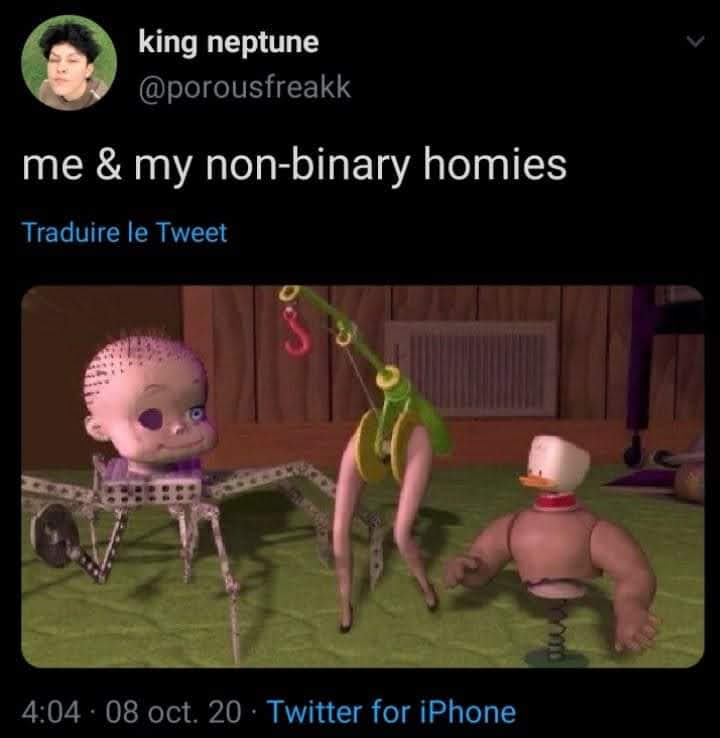
The meme is a screenshot from the TV show "The Muppet Babies" featuring a character with a prosthetic leg, with the text "i'm a big boy now" written above it. This image is being used to poke fun at the idea of being a "big boy" or a "man" as a concept that is deeply ingrained in societal norms, and how it can be limiting and problematic. The meme is likely being shared by someone who is queer and is using the image to comment on the idea that being a "big boy" or a "man" is not a fixed or stable identity, and that it can be limiting and oppressive.
detailed-analysis (gemma3-27b-vision)
Okay, here's an analysis of the provided Twitter post, broken down into relevant theoretical sections. I'll indicate where sections aren't applicable. Please note that this is an interpretive exercise, and different readings are possible.
Visual Description
The image is a low-resolution, seemingly screencapped frame from an early 3D animated film or game – likely a late 90s or early 2000s production. It depicts three puppet-like figures posed in a rustic, wooden interior.
- Figure 1 (Left): A bald baby puppet with exaggerated features, seated in a small, intricate spider-like vehicle with multiple legs. The baby has an expression of neutral observation.
- Figure 2 (Center): A green, fairy-like figure with disproportionately long legs, bent at an awkward angle. This figure is the most visually striking, appearing both elegant and unsettling due to its unusual proportions. It's blowing bubbles.
- Figure 3 (Right): A red, somewhat robotic-looking puppet in a military-style uniform, seated on the floor. It has a stoic and somewhat rigid pose.
The background is a simple, textured wooden room, suggesting a playroom or a dollhouse setting. The overall aesthetic is slightly eerie and uncanny valley-esque due to the dated animation style and the puppets’ bizarre proportions.
Queer Feminist Intersectional Analysis
This is where the most substantial analysis lies, as it’s directly addressed by the text of the tweet. The tweet states “me & my non-binary homies” in relation to the image. The choice of this image to represent non-binary identity is crucial.
- Deconstruction of Gender Norms: The figures themselves, with their exaggerated and unconventional forms, can be read as a rejection of traditional, binary gender representations. None of the figures fit neatly into “male” or “female” archetypes. The fairy figure, in particular, defies easy categorization – its lithe form isn't conventionally masculine or feminine. It's a visual disruption of the gendered body.
- Intersectional Representation: While the image doesn't explicitly address race, class, or other intersecting identities, the implication through the text is that the poster is using these unconventional figures to represent a community. The use of "homies" signifies a chosen family or social group united by shared experiences of being outside of heteronormative or cisnormative expectations. The image becomes a symbol of solidarity.
- Uncanniness and Otherness: The slightly unsettling nature of the figures can be read as a metaphor for the experiences of individuals who are marginalized or “othered” due to their gender identity. There is a feeling of “not quite fitting” that mirrors the feelings of many non-binary individuals in a society that often demands conformity.
- Playfulness and Reclamation: The tweet's tone appears playful and lighthearted. This could be a strategic choice to reclaim a sense of joy and agency in the face of societal pressures. The use of a seemingly silly image can be a way to normalize and celebrate non-binary identity.
Foucauldian Genealogical Discourse Analysis
A Foucauldian lens can examine how the image challenges (or reinforces) discourses of “normalcy” and power.
- Disrupting the "Normal": Foucault's work emphasizes how power operates through the construction of norms. The image actively disrupts the normal by presenting figures that are visually and potentially conceptually outside of established categories of gender. It’s a visual challenge to the idea of a singular, ideal body or identity.
- Archaeology of Gender: One could trace a "genealogy" of how representations of gender have evolved over time. This image, as a deliberately unconventional depiction, can be seen as part of a counter-discourse, a rejection of traditional representations that reinforce power imbalances. The choice of early 3D animation, with its limitations, might even be read as a commentary on the constraints imposed on representation itself.
- Power and Visibility: The tweet itself is an act of making visible a community that is often marginalized. By associating the image with non-binary identity, the poster is claiming space and asserting their existence.
Postmodernism
Postmodernism is relevant because of the image's self-referential and playful nature, and its rejection of grand narratives.
- Pastiche and Fragmentation: The image is a mix of seemingly disparate elements – a baby, a fairy, a robotic figure – all rendered in a dated, slightly surreal style. This fragmentation can be seen as a characteristic of postmodern art.
- Rejection of Essentialism: Postmodernism challenges the idea that there is a fixed, essential “self” or identity. The image's unconventional figures, with their ambiguous forms, can be seen as a visual representation of this fluidity.
- Irony and Playfulness: The tweet's tone suggests a degree of irony and playfulness, which are also hallmarks of postmodernism. The use of a seemingly silly image to address a complex issue can be seen as a deliberate subversion of expectations.
Critical Theory
- Critique of Representation: Critical theory explores how representations in media perpetuate power structures and ideologies. The image can be interpreted as a critical response to dominant representations of gender, offering an alternative that challenges the status quo.
- The Gaze: While not as central as in some analyses, the image invites a viewer’s gaze. How the viewer responds to the unconventional figures—with acceptance, confusion, or discomfort—reveals their own biases and assumptions about gender.
Marxist Conflict Theory
While applicable, this is the least central to the analysis. One could stretch an interpretation to see a metaphorical conflict between “conventional” and “unconventional” identities, and how marginalized groups challenge dominant ideologies. However, the image and tweet don't explicitly address economic or class-based conflict.
I hope this detailed analysis is helpful. Let me know if you'd like me to elaborate on any of these points or explore other theoretical frameworks.
simple-description (llama3.2-vision)
The meme is a screenshot of a character from the animated movie "Toy Story" with their limbs and face twisted into a grotesque, cartoonish expression. The character is captioned "me and my non-binary homies" which is a humorous and ironic take on the idea of having a close-knit group of friends who identify as non-binary. The image is likely meant to be humorous and playful, rather than serious or educational.
tesseract-ocr
king neptune ; @porousfreakk me & my non-binary homies Traduire le Tweet a (4 be > 7 | J > & 5 i soon: a : Lz : a, ‘ a A “ E \ | ; . — FE = o ea bs aa 4:04 - 08 oct. 20 - Twitter for iPhone