First Seen
2023-05-10T21:03:40+00:00
simple-description (llama3.2-vision_11b)
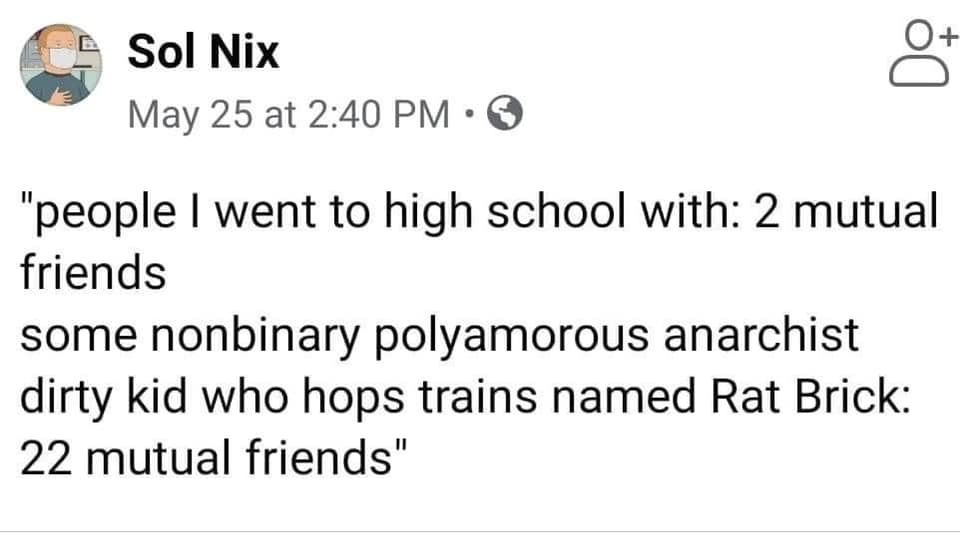
The meme is a humorous commentary on the intersection of queer identity and post-structuralist theory. It presents a contrast between the expectations of a queer person's social interactions (e.g. "they/them" pronouns) and the absurdity of a post-structuralist's (e.g. "they/them" pronouns) expectations of social interactions. The meme is saying that a queer person's expectations of social interactions are similar to those of a post-structuralist, in that both are expecting a certain level of social interaction that is not actually present.
detailed-analysis (gemma3-27b-vision)
Okay, here's an analysis of the social media post, broken down into sections based on the frameworks you requested. I'll only include sections where the frameworks demonstrably apply, and will indicate when a framework doesn't provide much value to the analysis. I will lean into interpretation, as this is based on a limited textual snippet, but will attempt to ground that interpretation in the relevant theoretical lenses.
Please note: The analysis can lean into assumptions, as only a small amount of text is provided.
Visual Description
The post displays a Facebook profile (indicated by a circular image and "Sol Nix" as the user's name) with a timestamp of May 25th at 2:40 PM. There's a "globe" symbol to the right of the timestamp, and a "+o" at the top right, suggesting a shared post. The content of the post is text describing “mutual friends” associated with an individual named “Rat Brick.” The visual aspect is primarily functional – it indicates a social media post within a specific platform. There isn’t much to analyze in terms of semiotics or visual rhetoric.
Foucauldian Genealogical Discourse Analysis
This post is rich for a Foucauldian analysis. The very naming of the individual – "Rat Brick" – is a fascinating point. It's not a conventional name. This naming practice suggests a deliberate rejection of normative naming conventions and an embrace of an identity constructed outside of established social categories.
The labels applied to “Rat Brick” (nonbinary, polyamorous, anarchist, "dirty kid who hops trains") are not inherent qualities, but discursive markers. Foucault would argue these are not descriptions of an inner essence, but rather terms deployed within specific power/knowledge regimes. These terms are used to categorize, define, and ultimately regulate (or attempt to regulate) individuals.
- Power/Knowledge: The post reveals how certain categories (nonbinary, polyamorous, anarchist) are constructed through discourse. These terms are simultaneously descriptive and prescriptive, shaping how “Rat Brick” is understood and treated. The "dirty kid who hops trains" is a way to stigmatize and marginalize, associating them with deviance and illegality.
- Genealogy: A genealogical approach would investigate how these terms have emerged historically. What discourses shaped the understanding of nonbinary identities? How did “anarchism” evolve as a political ideology and a label? What historical conditions made train-hopping a form of protest or survival? This would reveal the contingent and constructed nature of these identities.
- Discipline/Normalization: The post implicitly positions “Rat Brick” as outside the norms of conventional society. The high number of mutual friends (22) might suggest a network of individuals who also operate outside these norms, forming a counter-discourse.
Queer Feminist Intersectional Analysis
This post is intensely relevant to queer feminist intersectional analysis. "Rat Brick's" identified identities – nonbinary, polyamorous, anarchist – all challenge normative structures.
- Intersectionality: The post demonstrates how these identities intersect to create a unique experience of marginalization and resistance. Being nonbinary, polyamorous, and an anarchist creates a complex web of power dynamics.
- Challenge to Norms: The labels actively resist the binary logic of gender (nonbinary), the monogamous/heteronormative assumptions of relationships (polyamorous), and the established authority of the state (anarchist).
- Embodied Resistance: The phrase "dirty kid who hops trains" evokes a physicality and a transgression of boundaries – both physical (train tracks, societal expectations) and symbolic (cleanliness, conformity). This is an embodied form of resistance.
- Queer Politics: The post suggests a politics of refusal—a rejection of normative categories and a commitment to creating alternative ways of being and relating. The emphasis on the number of mutual friends implies a strong network of support and solidarity.
Critical Theory
Critical Theory, particularly in the Frankfurt School tradition, would focus on how this post exposes the underlying power structures and ideologies of contemporary society.
- Critique of Ideology: The post implicitly critiques the dominant ideologies of gender, sexuality, and political organization. By presenting an alternative way of being (nonbinary, polyamorous, anarchist), it challenges the "naturalness" of conventional norms.
- Emancipatory Potential: The post might be seen as having an emancipatory potential—a possibility for challenging and transforming oppressive structures. The act of naming and identifying with alternative categories is a form of resistance.
- Commodification & Spectacle (less directly): While the post isn’t overtly about commodification, one could argue that even the posting of such a statement on social media is a form of spectacle, potentially co-opted by the attention economy. However, this is a weaker connection.
Marxist Conflict Theory
While not the primary focus, elements of Marxist conflict theory can be applied. The identification of "Rat Brick" as an anarchist directly invokes a rejection of capitalist structures and a desire for a more egalitarian society. Train hopping, in this context, can be interpreted as a rejection of private property and a means of circumventing the capitalist system of transportation. The conflict, here, is implicit—a challenge to the dominant class and the status quo. However, the post doesn’t explicitly address class struggle, so this is a less potent analytical lens.
Postmodernism
Postmodernism is somewhat applicable, though perhaps less insightful than the other frameworks. The rejection of fixed categories (gender, relationships, political ideology) aligns with postmodern sensibilities. "Rat Brick's" identity is fluid and unstable, resisting essentialism. The emphasis on multiple identities and the rejection of grand narratives also resonate with postmodern thought. However, the post doesn't explicitly engage with concepts like deconstruction or simulation, making postmodernism a less central analytical lens.
Let me know if you'd like me to elaborate on any of these sections, or explore other theoretical frameworks.
simple-description (llama3.2-vision)
This meme is a humorous comparison between two groups of people. The text reads: "people I went to high school with: 2 mutual friends / some non-binary polyamorous anarchist who loves trains: 22 mutual friends". The meme is poking fun at the idea that someone who is unconventional and has a unique identity is more likely to have a large social network than someone who is more mainstream.
tesseract-ocr
& Sol nix ot May 25 at 2:40 PM: @ "people | went to high school with: 2 mutual friends some nonbinary polyamorous anarchist dirty kid who hops trains named Rat Brick: 22 mutual friends"