First Seen
2023-05-10T21:03:40+00:00
simple-description (llama3.2-vision_11b)
From a post-structuralist perspective, this meme is a commentary on the societal norms and expectations placed on individuals, particularly those in the LGBTQ+ community. The image is likely a photo of a person with a traditional or "straight" appearance, with the caption "I'm not gay, I'm just..." implying that the person is trying to conform to societal norms and avoid being perceived as gay. The meme is poking fun at the idea that people feel the need to hide their true identities or preferences, and the use of "I'm not gay, I'm just..." is a tongue-in-cheek way of saying that they're actually just being themselves, but are trying to avoid being perceived as gay.
detailed-analysis (gemma3-27b-vision)
Here's an analysis of the image, broken down by the requested theoretical lenses. It's important to note that some lenses apply more strongly than others, and some may overlap.
Visual Description
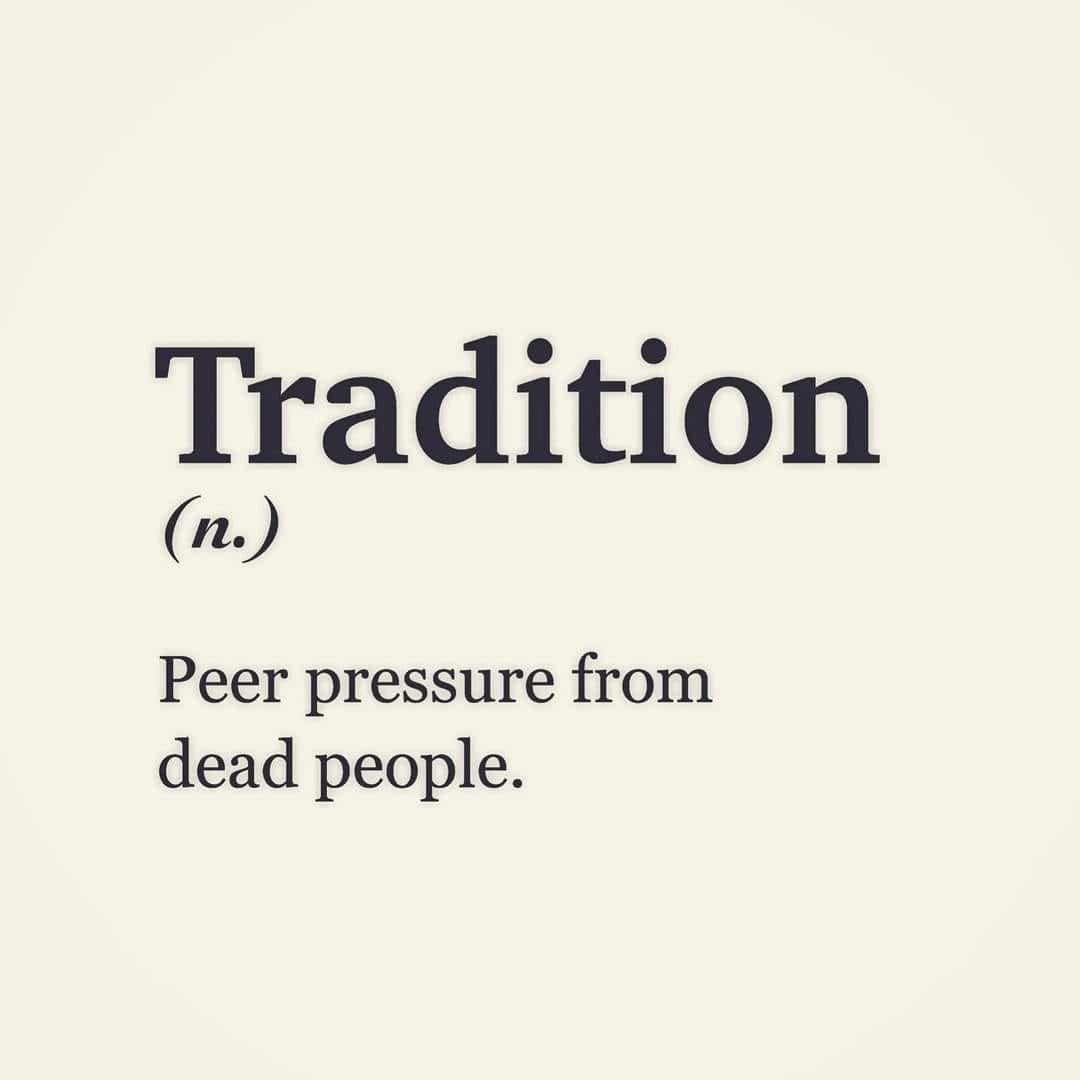
The image is a minimalistic graphic. The background is a pale, neutral beige or cream. In large, bold, black sans-serif font is the word "Tradition." Underneath, in a smaller font and italicized, is “(n.)” indicating it is a noun. Below that, in a regular black sans-serif font, is the definition: “Peer pressure from dead people.” The overall aesthetic is clean and dictionary-like, designed to mimic a lexical definition, but offering a humorous and cynical take on the concept of tradition.
Foucauldian Genealogical Discourse Analysis
This image strongly lends itself to a Foucauldian reading. Michel Foucault's genealogical method examines how concepts and power structures develop historically, tracing their origins not as a continuous progression of truth, but as a series of contingencies and power struggles.
- Discourse and Power: The image directly challenges the "natural" or benevolent understanding of tradition. By framing tradition as "peer pressure from dead people," it demonstrates how traditions are imposed through historical and social power dynamics. The "dead people" aren't benevolent ancestors offering wisdom; they are a force exerting pressure across time.
- Historical Contingency: The image rejects the idea that tradition is inevitable or inherently good. It suggests traditions are constructed, not discovered. The definition highlights that traditions aren’t simply handed down, but are the result of specific historical circumstances and power relations.
- Normalization and Discipline: Traditions, in this framing, are mechanisms of social control, enforcing norms and disciplining individuals to conform to past expectations. They represent a “history” that continues to exert force on the present.
Critical Theory
The image aligns well with critical theory, particularly the Frankfurt School’s focus on challenging dominant ideologies.
- Ideology Critique: The image is a pointed critique of the ideology of tradition, exposing it as not neutral, but rather a form of social control disguised as something positive or natural. It dismantles the notion of traditions as sources of wisdom or stability and reveals them as potentially oppressive.
- Deconstruction: The image deconstructs the conventional understanding of tradition. It strips away the romanticized or sentimental associations, leaving only the raw power dynamic of past generations influencing the present.
- Emancipation: By exposing the power structures embedded within tradition, the image subtly suggests the possibility of breaking free from them. It implies a need to critically examine and potentially reject traditions that are harmful or oppressive.
Marxist Conflict Theory
While not as direct as the other lenses, a Marxist interpretation is possible.
- Power and Control: The "dead people" can be seen as representatives of historically dominant groups (aristocracy, patriarchs, etc.) whose values and practices continue to shape society and maintain power imbalances.
- Ideological Apparatus: Tradition, in this framing, can function as an ideological apparatus, perpetuating the values and interests of the ruling class across generations. It reinforces existing hierarchies and suppresses dissent.
- Class Struggle: While not explicitly about economic class, the image suggests a "struggle" between present desires and past expectations. Rejecting tradition can be seen as a form of resistance against oppressive social norms.
Postmodernism
The image embodies several postmodern characteristics.
- Rejection of Metanarratives: The image actively challenges the traditional “grand narratives” surrounding the concept of tradition. It doesn't offer a positive or cohesive explanation of tradition; instead, it provides a cynical, fragmented definition.
- Deconstruction of Meaning: The image deliberately subverts the conventional meaning of "tradition," dismantling the established association with wisdom, heritage, and stability.
- Irony and Playfulness: The image is presented with a degree of irony and playfulness, suggesting a skepticism towards any attempt to impose a fixed or absolute definition on complex concepts.
Queer Feminist Intersectional Analysis
This lens could be applied, although it requires some nuance.
- Challenging Normativity: Traditional norms often reinforce patriarchal and heteronormative structures. Framing tradition as "peer pressure from dead people" can be seen as a way to dismantle these structures and create space for alternative ways of being.
- Intergenerational Trauma: For marginalized groups, "tradition" can be linked to historical trauma and oppression. The image implicitly acknowledges this, suggesting that the “pressure” from the past can be harmful and limiting.
- Intersectionality: The image can be expanded to consider how different forms of oppression intersect within tradition. For instance, how traditional gender roles, racial biases, and class hierarchies are all perpetuated through intergenerational transmission.
In conclusion, the image is a powerful visual statement that invites critical reflection on the concept of tradition. It is particularly strong when viewed through the lenses of Foucault, Critical Theory, and Postmodernism, offering a cynical and subversive take on a seemingly benign concept.
simple-description (llama3.2-vision)
This meme is a humorous commentary on the concept of "tradition" and how it can be used to justify or explain the existence of certain social norms or practices. The meme states "Tradition: because why not?" in a deadpan tone, implying that the reason for doing something a certain way is simply because it has always been done that way, rather than because it makes sense or is beneficial. The meme is likely to be relatable to people who feel like they're following outdated or unnecessary rules.
tesseract-ocr
Tradition (n.) Peer pressure from dead people.