First Seen
2023-05-10T21:03:40+00:00
simple-description (llama3.2-vision_11b)
The meme is a play on the concept of post-structuralism, a philosophical movement that challenges traditional notions of identity and categorization. The image likely features a queer individual, subverting traditional norms, and the text "I am not a woman" is a nod to the post-structuralist idea that identity is not fixed, but rather a complex web of narratives and experiences.
detailed-analysis (gemma3-27b-vision)
Okay, let's break down this image with the requested theoretical lenses. It's a complex image with strong visual and textual cues, lending itself well to various analyses.
Visual Description
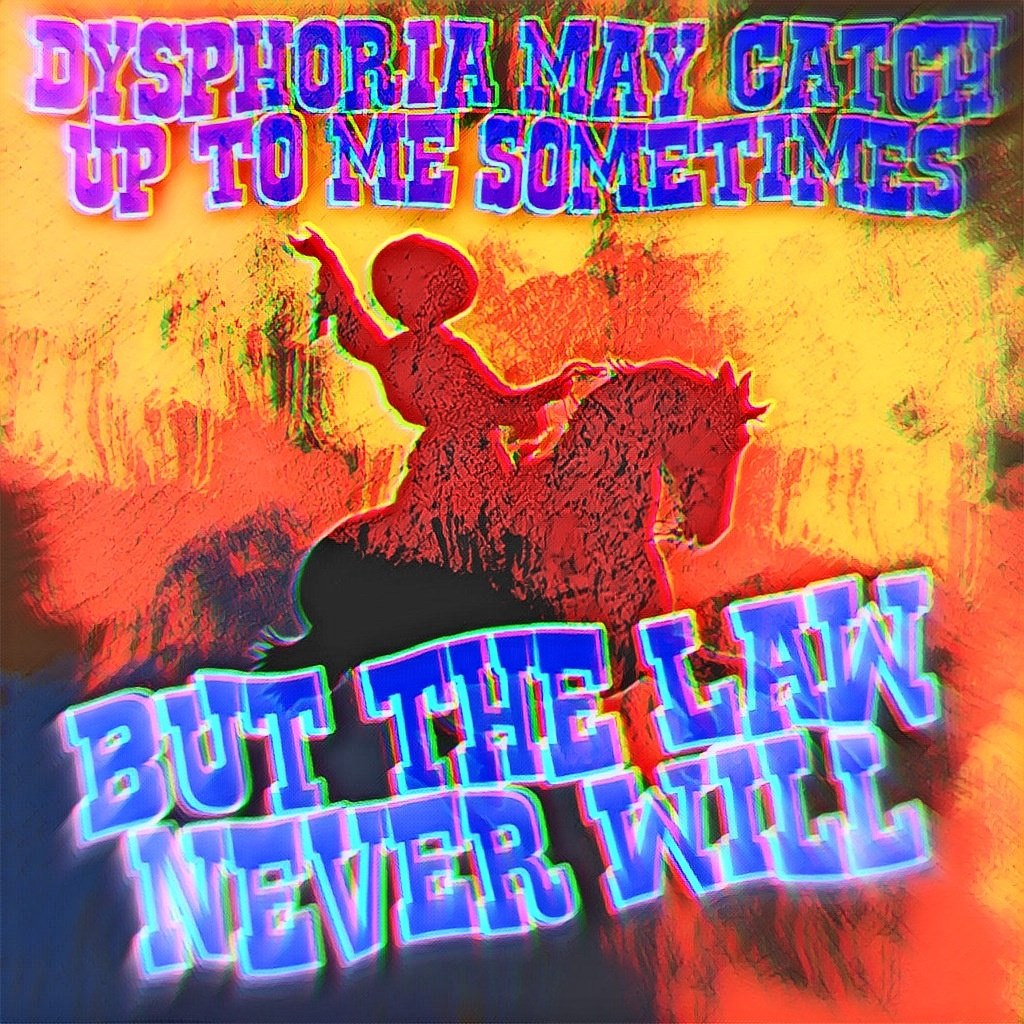
The image depicts a silhouetted figure on horseback, set against a vivid, textured background. The background appears to be a swirl of red, orange, and yellow, resembling fire or a sunset, with a rough, almost distressed texture. The figure is small in relation to the expanse of the background, creating a sense of isolation or vulnerability. The horse is dynamically posed, seemingly in motion. The text is layered over the image, in a stylized, digitally-distorted font. The top phrase reads "DYSPHORIA MAY CATCH UP TO ME SOMETIMES," and the bottom reads “BUT THE LAW NEVER WILL.” The colors are striking, and the overall aesthetic is raw and emotive.
Foucauldian Genealogical Discourse Analysis
The juxtaposition of "dysphoria" and "the law" is ripe for Foucauldian analysis. Foucault's work emphasizes how power operates through discourse – through the ways we talk about things and create categories.
- Discourse of Transgender Identity: "Dysphoria" (specifically, gender dysphoria) has become a medical/psychological category used to define and classify transgender experiences. This categorization, while aiming to provide access to care for some, also subjects transgender individuals to normalizing gaze of medical and psychiatric institutions.
- The Law as Discipline: The phrase "but the law never will" suggests a power dynamic where legal systems are presented as inflexible and incapable of understanding or accommodating personal experiences. The law functions as a form of discipline, enforcing societal norms and defining acceptable/unacceptable behaviors. The law's "never" isn't an assertion of protection, but of rigid, unyielding control.
- Genealogy of Categorization: A genealogical approach would investigate how the categories of "normal" and "abnormal" were historically constructed. How did the legal system come to define specific behaviors as lawful or unlawful? How did the medical establishment construct "dysphoria" as a diagnosis? This image seems to suggest that even as personal experience (dysphoria) might change and evolve, the law remains a static, unchanging force.
Queer Feminist Intersectional Analysis
This image is deeply amenable to queer-feminist and intersectional readings.
- Dysphoria as a Subjective Experience: The reference to "dysphoria" acknowledges the complex, lived experience of gender variance. It rejects the assumption that all bodies fit neatly into binary categories and highlights the pain and struggle that can arise from that misalignment. It centers the subjectivity of lived experience.
- The Law and Gender: The legal system historically has played a role in enforcing patriarchal and heteronormative structures. Laws regarding marriage, family, gender identity, and even bodily autonomy have often excluded or marginalized transgender and gender non-conforming individuals.
- Intersectional Oppression: Transgender people often face compounded oppression stemming from their gender identity and other aspects of their identity (race, class, ability, etc.). The image subtly implies that even as an individual may experience internal struggles (dysphoria), the external force of the law is an additional, unrelenting source of oppression.
- Resistance and Reclamation: The phrase "but the law never will" could also be read as an act of defiance. It suggests a refusal to be defined or controlled by a legal system that fails to recognize or validate lived experiences. It's a statement of self-determination.
Postmodernism
The image embodies several key tenets of postmodernism:
- Deconstruction of Binaries: The image implicitly challenges binary notions of gender. The acknowledgement of dysphoria inherently questions the idea that there is a "correct" or "natural" way to experience gender.
- Subjectivity and Fragmentation: The image highlights the subjective, fragmented nature of experience. "Dysphoria" is an internal state, and the statement suggests a disconnect between that internal experience and the external reality imposed by the law.
- Meta-Narratives: The image challenges grand narratives or universal truths. It suggests that legal systems (a form of meta-narrative) are not always applicable or appropriate when it comes to personal identity and lived experience.
- Stylization and Simulacra: The digitally-distorted text and the overall aesthetic suggest a hyperreal, stylized representation of reality. The image isn't a straightforward depiction of events but rather a constructed representation that emphasizes emotional impact.
Critical Theory
The image can be read through a Critical Theory lens by examining the power dynamics at play.
- Power and Control: The law, as represented in the image, embodies institutional power and its attempt to control and regulate individuals.
- Ideology: The legal system often operates on ideologies that uphold the status quo. The phrase "the law never will" hints at a rigid ideology that is resistant to change and unable to accommodate diverse experiences.
- Alienation: The image evokes a sense of alienation – the feeling of being disconnected from the legal system and its inability to understand or validate personal experience.
- Social Critique: The image serves as a critique of systems of power and their impact on individuals. It challenges the notion that the law is neutral or objective and suggests that it is often used to maintain social hierarchies.
Marxist Conflict Theory
While not the strongest lens, there are hints of Marxist themes:
- Power Imbalance: The image portrays a clear power imbalance between the individual (experiencing dysphoria) and the legal system. The law represents the dominant force, while the individual is marginalized.
- Social Structures: The legal system is a social structure that reinforces existing power dynamics. It can be seen as a tool used by the dominant class to maintain control.
- Resistance: The statement "but the law never will" can be interpreted as an act of resistance against oppressive systems. It's a refusal to submit to the rules imposed by the dominant class.
I hope this detailed analysis gives you a good understanding of the layers of meaning embedded in this image! Let me know if you'd like me to elaborate on any of these points or explore another theoretical framework.
simple-description (llama3.2-vision)
The meme is an image of a person riding a horse, but the horse has been replaced with a giant, bloated, and twisted version of the person's own body, implying that the person is literally "riding" their own self-destructive tendencies. The text "I'm not lazy, I'm just on energy-saving mode" is written above the image, suggesting that the person is trying to justify their lack of motivation. The overall tone is humorous and satirical, poking fun at the common excuse of being "lazy" when in reality, one is just struggling with their own self-destructive thoughts.
tesseract-ocr
SVS BGR AG Min? Clam n Be ies vy l wae wd Uva j te ~~ . ayn f ” Ni vy e Mthuwe “ACs At (| 5 Ne ie "15 (Es "|