First Seen
2023-05-10T21:03:40+00:00
simple-description (llama3.2-vision_11b)
The meme is a satirical representation of the concept of "Queer-Post-Structuralism," a term coined by philosopher and cultural critic, Judith Butler. The meme juxtaposes the term with a series of mundane, everyday objects, implying that the concept is so abstract and complex that it can only be applied to the most mundane of things. The text "Queer-Post-Structuralism: it's like, uh, a chair" is often used to illustrate the absurdity of applying such a complex and abstract concept to something as ordinary as a chair.
detailed-analysis (gemma3-27b-vision)
Okay, let's break down this image, the "Horseshoe Theory of Chair Design and Function," through the lenses you've requested. It's a complex visual and rife with potential for layered analysis.
Please Note: This analysis relies heavily on interpreting the intent of the creator, given the subjective nature of associating political ideologies with chair designs. I'll offer possible interpretations but acknowledge it's open to debate.
1. Visual Description
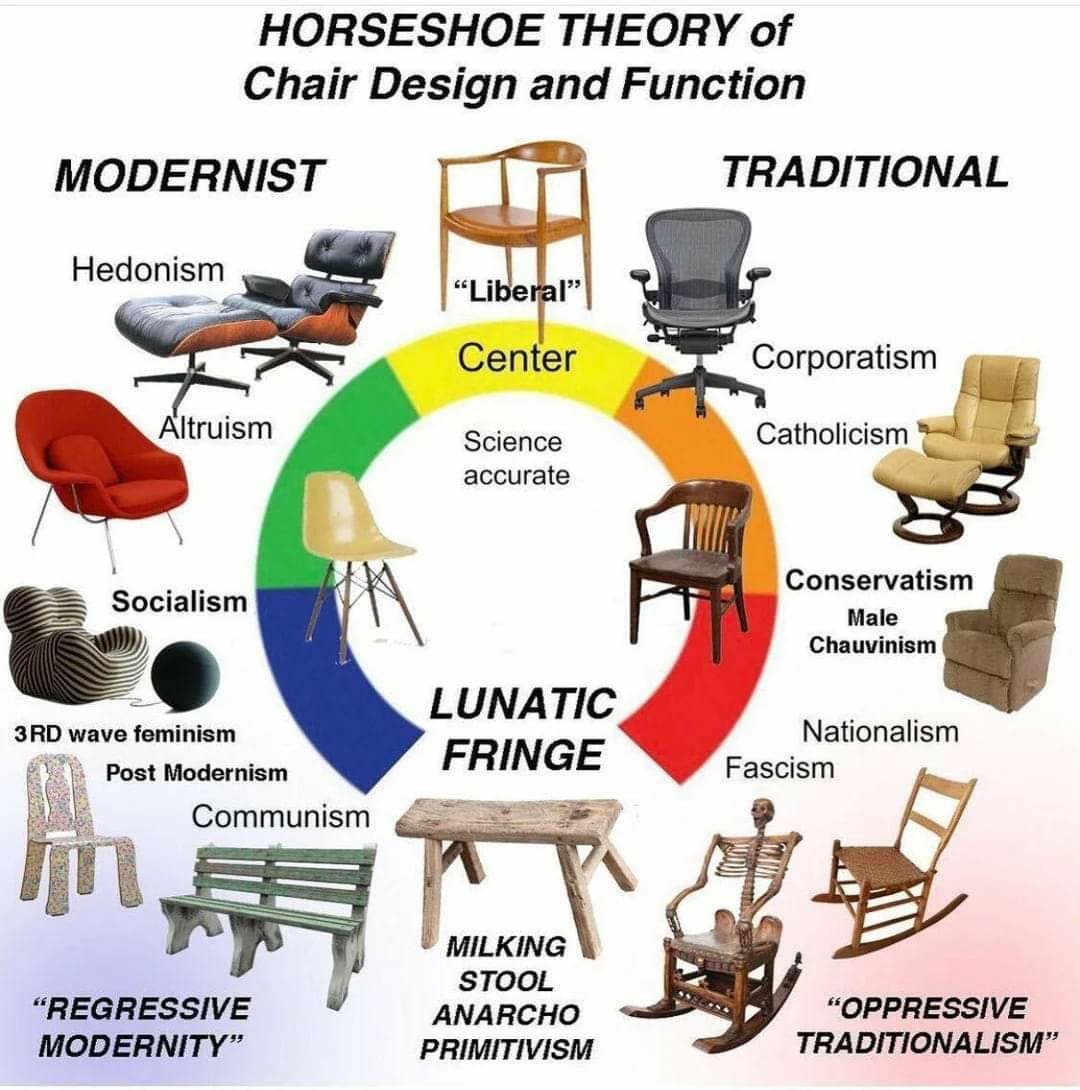
The image is a circular diagram resembling a color wheel, with a spectrum of chair designs positioned around its circumference. The circle is divided into sections labeled: "Modernist" (left), "Lunatic Fringe" (bottom), and "Traditional" (right). A central section is labeled "Center" with the term "Liberal" and "Science Accurate" within. Each chair is accompanied by a political/philosophical label.
The chairs range from sleek, mid-century modern designs (associated with concepts like Hedonism and Altruism) to more austere and ornate designs (connected to concepts like Catholicism and Fascism). Some chairs are intentionally bizarre or primitive (e.g., the “Milking Stool” connected to Anarcho-Primitivism). The arrangement appears to suggest that extremes of the political spectrum (Modernist and Traditional) converge at the "Lunatic Fringe," while a “Liberal” center exists between them. Each segment has additional labels to show nuance within the spectrum.
The overall style is somewhat cartoonish, suggesting a provocative rather than strictly academic intent. The chairs, while representative of design periods, are being used as symbols of ideologies.
2. Foucauldian Genealogical Discourse Analysis
Michel Foucault's work examines how knowledge, power, and discourse are intertwined and shape our understanding of the world. This image lends itself well to such an analysis.
- Discursive Formation: The creator of this image is actively constructing a new discourse – a way of understanding the relationship between political ideologies and material objects (chairs). It's not a "natural" connection; it's imposed through the act of labeling. This challenges conventional ways of thinking about political philosophy and design.
- Archaeology of Knowledge: Tracing the historical roots of the association between specific chair designs and ideologies is key. For example, the association of ornate, religious-style chairs with Catholicism ties into the history of church authority, material displays of wealth, and the control of space. Similarly, the mid-century modern designs are often linked to post-war prosperity, individualism, and consumerism.
- Power/Knowledge: The diagram suggests that certain chair designs embody and reinforce specific power structures. A regal, high-backed chair can visually express authority, while a minimalist chair might signal egalitarianism (or even a rejection of status). The creator is using the chair as a site where power operates.
- Discipline & Normalization: The "Liberal" center implies a norm, and the arrangement suggests that deviations from this norm—toward either extreme—are somehow "fringe." This enforces a particular way of seeing and categorizing political beliefs.
The image isn’t simply describing the relationship between ideology and design; it's performing a specific categorization and establishing a hierarchy.
3. Critical Theory
Critical Theory, largely stemming from the Frankfurt School, seeks to understand how societal structures perpetuate power imbalances and oppression.
- Ideology and Material Culture: The diagram explicitly links abstract ideologies to concrete material objects. This reinforces the Critical Theory concept that ideology isn't just a set of ideas; it's embedded in everyday life and material culture. The chair becomes a symbol of broader social forces.
- Commodification and Consumption: The chairs themselves represent consumer goods. The image subtly critiques how political ideologies can be commodified and marketed – how design can be used to attract and reinforce certain beliefs. The design itself becomes an ideological statement.
- Domination and Control: The arrangement of the chairs, with the "Lunatic Fringe" as a convergence point, can be interpreted as a commentary on the dangers of extremism and the ways in which seemingly opposite ideologies can lead to similar outcomes (authoritarianism, control).
- False Consciousness: The "Liberal" center could be seen as a representation of a dominant ideology that obscures the underlying power structures and perpetuates inequality. The arrangement implies that true understanding lies in recognizing the connections between seemingly disparate ideologies.
The image invites a critical examination of how design choices are never neutral, but always carry ideological baggage.
4. Marxist Conflict Theory
From a Marxist perspective, history and society are driven by class struggle and the exploitation of one group by another.
- Means of Production & Ideology: The chairs can be seen as products of the means of production (factories, designers, material resources). The creator is suggesting that the design of these chairs reflects the dominant class interests and ideologies of their time.
- Base and Superstructure: The "base" (economic system) shapes the "superstructure" (culture, ideology, politics). The arrangement implies that the chairs are part of the superstructure, and their design reflects the underlying economic and political relations of power.
- False Consciousness & Commodification: The image subtly critiques how capitalism commodifies even ideologies, turning them into marketable designs. The arrangement suggests that the "Lunatic Fringe" is a result of the inherent contradictions and exploitations of the capitalist system.
- Alienation: The arrangement and labeling of the chairs suggests that individuals are alienated from their own beliefs and desires, and are instead manipulated by dominant ideologies.
From a Marxist lens, the creator is using the image to expose the underlying power dynamics and contradictions of the capitalist system.
5. Postmodernism
Postmodernism challenges grand narratives, embraces fragmentation, and questions the notion of objective truth.
- Deconstruction of Meaning: The image deconstructs the traditional association of political ideologies with specific meanings. By assigning these labels to chairs, the creator is challenging the very idea of a fixed, stable meaning.
- Simulacra and Simulation: The chairs become simulacra – copies without an original. They represent ideologies that have been divorced from their historical context and reduced to mere symbols.
- Fragmentation and Pluralism: The arrangement of the chairs reflects a fragmented, pluralistic worldview. There is no single, unifying truth; instead, there are multiple perspectives and interpretations.
- Irony and Parody: The image is inherently ironic and parodic. It mocks the seriousness with which we often approach political ideology, and suggests that it is all just a matter of perspective.
The image is a quintessential postmodern statement, embracing ambiguity, fragmentation, and the rejection of grand narratives.
6. Queer Feminist Intersectional Analysis
This lens examines how various forms of oppression (sexism, homophobia, transphobia, racism, classism, etc.) intersect and create unique experiences of marginalization.
- The Absence of Marginalized Voices: A significant critique is the lack of explicit representation of chairs associated with truly marginalized groups (e.g., designs created by and reflecting the experiences of queer, BIPOC, or disabled communities). This absence reinforces the dominance of mainstream, often patriarchal and Eurocentric, perspectives.
- Gendered Design & Power: The shapes and styles of the chairs can be interpreted through a gendered lens. Certain designs may be seen as inherently masculine (e.g., large, imposing chairs) or feminine (e.g., delicate, ornate chairs). This reinforces traditional gender roles and power dynamics.
- Intersection of Ideology & Design: The arrangement of the chairs reveals how certain ideologies (e.g., fascism, Catholicism) are historically linked to the oppression of marginalized groups. The design of the chairs can be seen as embodying and reinforcing these oppressive structures.
- Queering the Narrative: A queer feminist analysis would challenge the inherent assumptions and categorizations of the diagram. It would question the notion of a fixed political spectrum and embrace the fluidity and complexity of identity and ideology.
This lens highlights the ways in which design and ideology are deeply intertwined with systems of power and oppression, and calls for a more inclusive and intersectional approach to understanding the relationship between the two.
This is a complex image, open to multiple interpretations. The analysis above offers a starting point for exploring the deeper meanings and implications of this provocative visual statement. Let me know if you'd like me to delve deeper into any specific aspect!
simple-description (llama3.2-vision)
This meme is a humorous illustration of the "hierarchy of needs" concept, but with a satirical twist. The image depicts a series of chairs, each representing a different philosophical or ideological system, from "Hedonism" to "Anarchism". The text "Hedonism to Anarchism" appears above the image, and the text "Hedonism: You do you. Anarchism: You do nothing." appears below it.
tesseract-ocr
HORSESHOE THEORY of Chair Design and Function MODERNIST TRADITIONAL Hedonism , “Liberal”| YW ; Center —_ Corporatism ~ Altruism Scisnes ER Catholicism saalamis accurate = eal \ Til i“ Socialism \ a) =~ * Chauvinism 3RD si fr LUNATIC Nationalism Bl Post Modernism FRINGE Fascism iit Communism gas sess 4 pr r r 0 ) ! wiKina Ke _” g STOOL <j ¢ “REGRESSIVE ANARCHO a 4 “OPPRESSIVE MODERNITY” PRIMITIVISM TRADITIONALISM”