First Seen
2023-05-10T21:03:40+00:00
simple-description (llama3.2-vision_11b)
This meme is a play on the concept of post-structuralism, a philosophical movement that challenges traditional notions of meaning and language. The image features a character with a speech bubble saying "I :> don't :> exist" and "I :> don't :> know :> what :> I :> am :> doing :> here", poking fun at the idea that language is inherently ambiguous and context-dependent.
detailed-analysis (gemma3-27b-vision)
Okay, let's break down this image through a few relevant theoretical lenses. It’s important to note that meme-based imagery often invites multi-layered interpretation, so several of these readings will overlap.
Visual Description
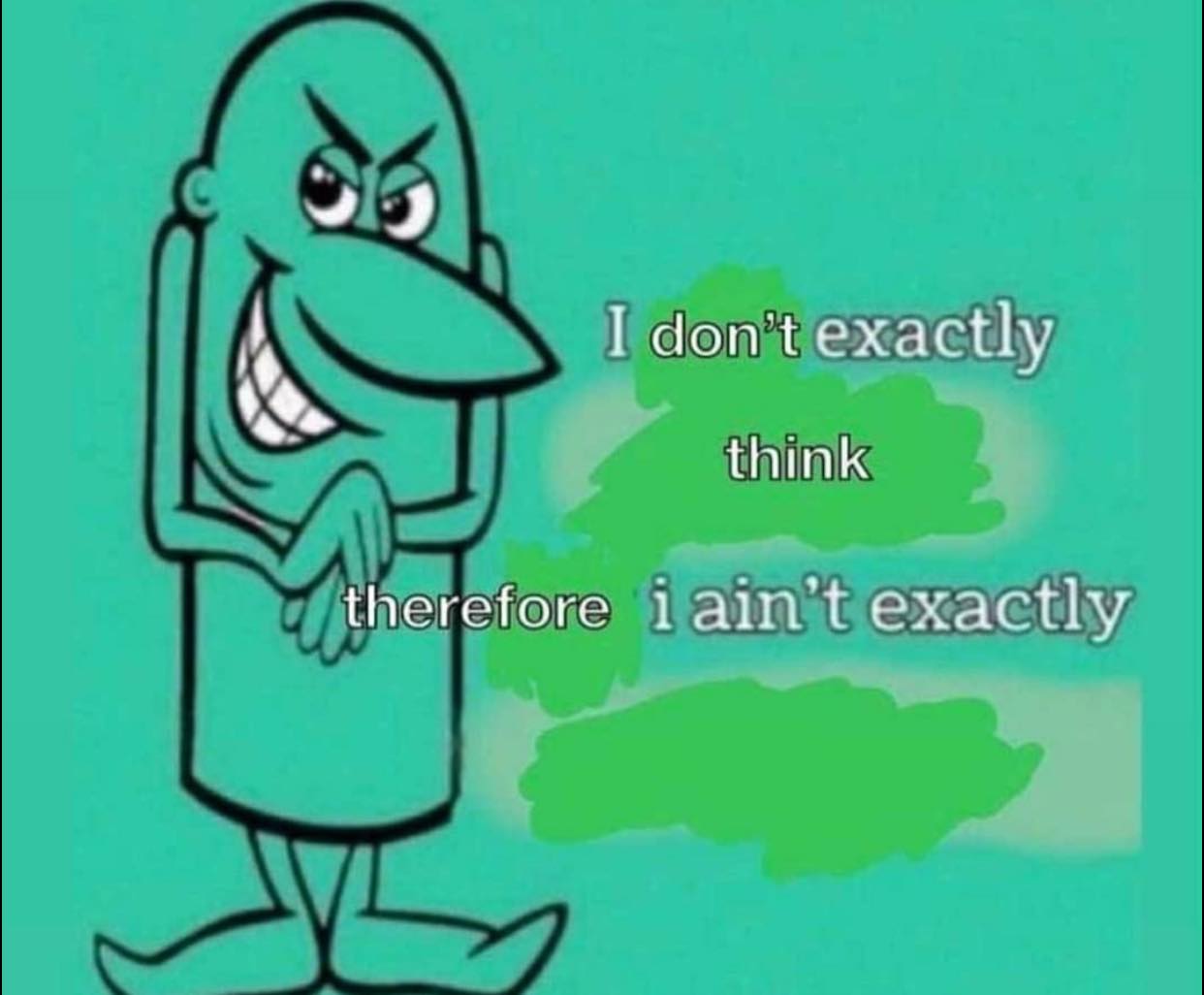
The image is a simple cartoon depiction of a teal-colored character with exaggerated features. The character is standing with a scowling expression, featuring furrowed brows and a wide, almost manic grin that emphasizes its teeth. Its hands are clasped together, creating a slightly menacing posture. Superimposed over the image are lines of text: “I don’t exactly think” on top and “therefore i ain’t exactly” on the bottom, with "think" in between. The text is set against a slightly blurred, lighter teal background, creating a hazy visual effect. The overall aesthetic evokes a deliberately low-resolution, early 2000s internet vibe. The style is purposefully simplistic and ironic.
Postmodernism
The image is deeply rooted in postmodern sensibilities.
- Irony & Parody: The cartoon figure’s exaggerated expression juxtaposed with the grammatically unconventional text (“ain’t”) immediately signals irony and parody. It’s playing with the idea of intellectual seriousness, and undermining it through a deliberately childish aesthetic. The structure deliberately evokes syllogistic logic but then degrades it through linguistic play.
- Deconstruction of Language: The grammatical errors (use of “ain’t” in place of “am not”), and the deliberate halting of thought (“I don’t exactly think…”) deconstructs the idea of coherent, logical thought. Postmodernists would argue that all systems of meaning, including language, are unstable and subject to interpretation.
- Meta-Commentary: The image is a comment on the act of thinking and arguing. It's not a substantive thought itself, but rather a statement about the limitations or absurdities of rational discourse. This self-reflexivity is a key characteristic of postmodernism.
- Pastiche & Intertextuality: The image’s visual style (simple cartoon, early internet aesthetic) and the use of fragmented text create a pastiche – a mixing of styles and references. This evokes the postmodern notion that originality is a myth, and all art is a reinterpretation of existing forms.
Foucauldian Genealogical Discourse Analysis
From a Foucauldian perspective, the image reveals power dynamics embedded in discourses of intelligence and rationality.
- Discourse of Rationality: The image is inherently about the discourse of rationality and intellectual thought. It establishes a norm (the expectation of clear, logical thinking) and then deliberately disrupts it.
- Power/Knowledge: Foucault argued that power and knowledge are inseparable. The expectation of ‘rational thought’ itself is a form of power, shaping how we understand the world and ourselves. The cartoon subverts this power by rejecting that standard.
- Genealogy & Disruption: A genealogical analysis would investigate the historical emergence of the notion of ‘rationality’ as a dominant discourse. The image can be seen as an attempt to disrupt this discourse by embracing irrationality or a lack of thought.
- Subjectification: The cartoon is a kind of performative act that potentially affects how we perceive ourselves as thinking subjects. It suggests that ‘thinking’ isn’t necessarily a natural or essential quality, but something constructed through discourse.
Critical Theory
The image can also be viewed through a lens informed by Critical Theory, specifically examining the subversion of hegemonic ideals.
- Hegemony & Ideology: The expectation of ‘rationality’ can be seen as a hegemonic ideal—a dominant way of thinking that is presented as natural or inevitable. The image challenges this by embracing a lack of logic or coherence.
- Critique of Enlightenment Reason: The image subtly critiques the Enlightenment emphasis on reason and logic. The cartoon figure's expression and phrasing are deliberately anti-intellectual.
- Alienation: The phrase "I don't exactly think" could be interpreted as expressing a sense of alienation—a feeling of disconnect from one's own thoughts and rationality. This relates to the broader Critical Theory concern with the alienating effects of modern society.
In conclusion: This seemingly simple image is layered with meaning. It's a playful and ironic deconstruction of the very notion of thinking, challenging established norms and prompting viewers to question the assumptions embedded in our discourses of rationality and intelligence. The strength of this image is that it's open to a multitude of interpretations, making it a rich subject for theoretical analysis.
simple-description (llama3.2-vision)
This meme features a character with a sarcastic expression, implying that someone is being overly defensive or dismissive of a simple fact. The text "I don't even know" is often used in this context, but in this case, it's replaced with "I don't even..." and then the phrase "I don't even" is followed by "exist".
tesseract-ocr
( NG) |