First Seen
2023-05-10T21:03:40+00:00
simple-description (llama3.2-vision_11b)
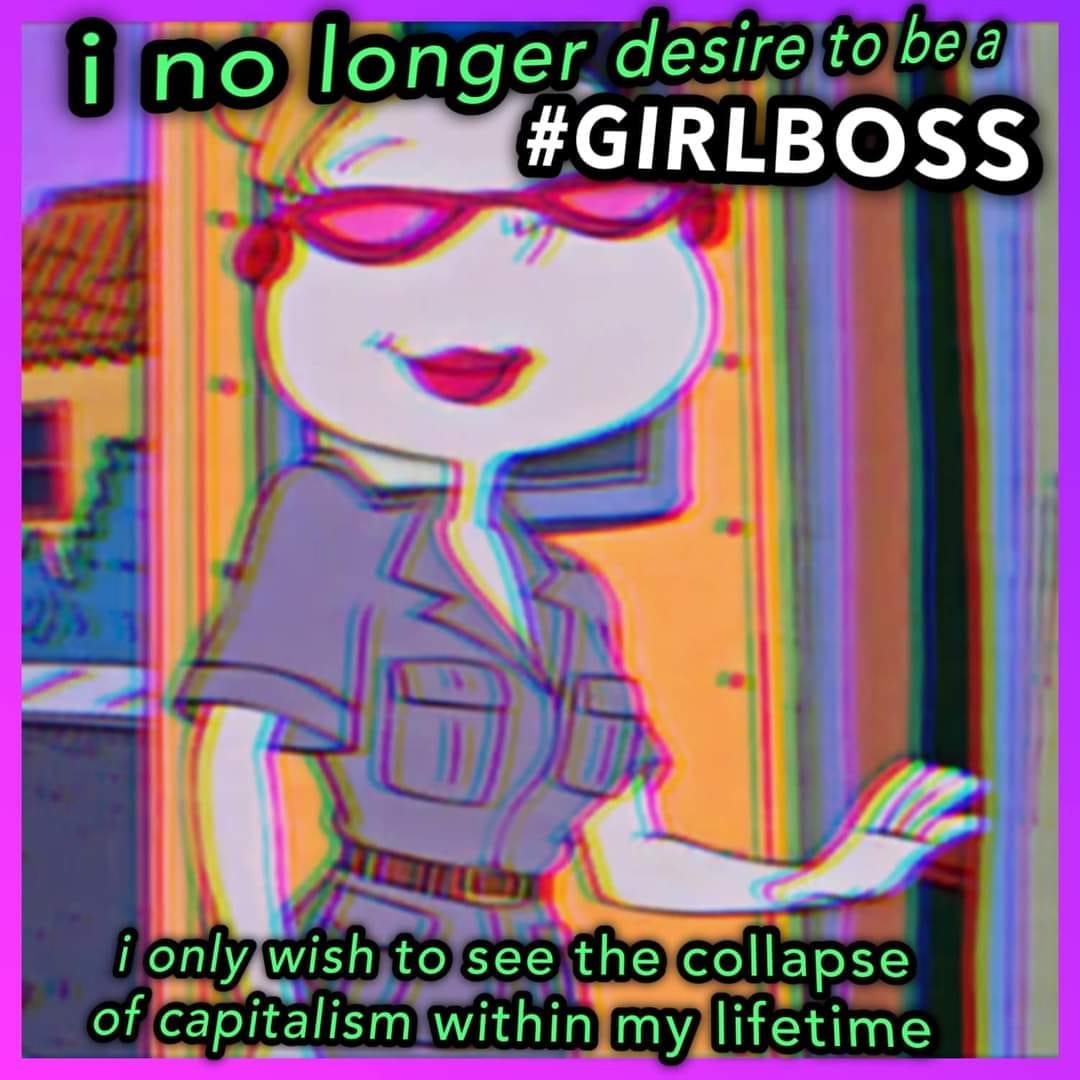
This meme is a commentary on the societal expectations placed on women, particularly those who identify as queer. The image features a cartoon character from a children's TV show, "Rocko's Modern Life," with the caption "I would never want to be a 'girl boss'... I only want to be a 'girl' who doesn't have to be a boss." The meme pokes fun at the idea of "girl boss" culture, which often expects women to be assertive and ambitious, but also acknowledges the desire to simply exist without the pressure of being a leader.
detailed-analysis (gemma3-27b-vision)
Okay, here's an analysis of the image, broken down into the requested sections. It's a complex image lending itself to multiple interpretations, and the sections are included only if they are applicable to the image's themes.
Visual Description
The image is a digitally manipulated screenshot, likely of a Bratz doll. The doll is rendered in a saturated, glitchy aesthetic with vertical bands of color distortion, creating a sense of digital decay or unease. It is seated and appears to be staring directly at the viewer with a somewhat intense expression. The doll is wearing a business suit with a belt. Superimposed text appears at the top and bottom of the image. The top reads, "i no longer desire to be #GIRLBOSS." The bottom text reads, "i only wish to see the collapse of capitalism within my lifetime." The glitch effect, combined with the bold text, creates a stark, ironic, and deliberately abrasive visual statement. The image quality is purposefully degraded, contributing to the feeling of disaffection and digital exhaustion.
Foucauldian Genealogical Discourse Analysis
This image is ripe for analysis through a Foucauldian lens. The hashtag "#GIRLBOSS" is central. Foucault’s genealogical method would trace the history of the concept – how it emerged as a discourse, the power/knowledge relations it embodies, and how it's been used to shape subjectivities.
- Discourse & Power: The "Girlboss" discourse, popularized in the 2010s, initially aimed to empower women in business. However, it often became entangled with neoliberal ideals – individual responsibility, self-optimization, and the valorization of entrepreneurship within the existing capitalist system. This creates a power dynamic where women are encouraged to “lean in” and succeed despite systemic inequalities, effectively masking those inequalities.
- Subject Formation: The image shows a rejection of this subject position. By declaring "no longer desire," the image deconstructs the "Girlboss" subject – someone defined by ambition, entrepreneurialism, and (often performative) empowerment within the capitalist framework. The glitchy aesthetic can be interpreted as a visual representation of the unraveling of that subject position.
- Archaeology of Knowledge: Tracing the origins of the "Girlboss" concept reveals it as a product of a specific historical moment—the rise of social media, late-stage capitalism, and a particular form of feminist marketing. The image actively disrupts that history by refusing the terms of the discourse.
Critical Theory
The image strongly resonates with core tenets of Critical Theory, particularly the Frankfurt School’s critique of culture.
- Culture Industry: The "Girlboss" concept, heavily promoted through social media and lifestyle branding, can be seen as a product of the “culture industry.” It’s a manufactured ideology that obscures the underlying contradictions of capitalism by offering the illusion of empowerment within a system designed to perpetuate inequality.
- False Consciousness: The image suggests a breaking of "false consciousness" – a recognition that individual success within capitalism does not challenge the systemic problems that create inequality. The statement is a rejection of the idea that "pulling oneself up by one’s bootstraps" is a viable solution to structural issues.
- Ideology Critique: The image actively critiques the ideology of neoliberal feminism, which often prioritizes individual achievement over collective liberation. It argues that true empowerment cannot be achieved within a system that inherently disadvantages certain groups.
Marxist Conflict Theory
The image is explicitly linked to Marxist conflict theory through its direct call for the collapse of capitalism.
- Class Struggle: The statement about the collapse of capitalism underscores the inherent conflict between the bourgeoisie (the capitalist class) and the proletariat (the working class). The image implicitly aligns itself with the proletariat's desire for systemic change.
- Historical Materialism: The image suggests a belief that material conditions (economic systems) shape consciousness and social relations. The rejection of the “Girlboss” identity is seen as a consequence of recognizing the limitations of individual achievement within a capitalist system.
- Alienation: The saturated, glitchy aesthetic can be interpreted as a visual representation of alienation – the feeling of disconnect and meaninglessness that Marx argued is inherent to capitalist production.
Postmodernism
Several elements within the image align with postmodern themes.
- Irony & Pastiche: The image utilizes irony – juxtaposing the aspirational “Girlboss” hashtag with a radical anti-capitalist statement. This creates a sense of playful subversion. The repurposing of the Bratz doll, a product of mass consumer culture, is a form of pastiche.
- Deconstruction of Grand Narratives: The image challenges the “grand narrative” of capitalist success—the idea that hard work and entrepreneurship will lead to prosperity. It rejects the idea that this is the ultimate goal.
- Simulacra & Hyperreality: The “Girlboss” persona itself can be seen as a simulacrum – a copy without an original. It’s a constructed identity mediated through social media and consumer culture.
Queer Feminist Intersectional Analysis
While the image doesn’t explicitly deal with sexuality or gender identity, a queer feminist intersectional reading adds further layers to its meaning.
- Critique of Neoliberal Feminism: The image critiques the ways in which neoliberal feminism often focuses on the success of privileged women (typically white, cisgender, and heterosexual) while ignoring the systemic barriers faced by marginalized groups.
- The Limits of Individual Empowerment: The image suggests that individual empowerment within a patriarchal and capitalist system is insufficient. True liberation requires collective action and a dismantling of oppressive structures.
- Challenging Dominant Narratives: The image challenges the dominant narratives of success and empowerment, particularly those that prioritize individual achievement over collective liberation. It offers a counter-narrative that prioritizes systemic change.
In conclusion, the image is a complex and layered statement that draws upon multiple theoretical frameworks. It critiques the ideology of neoliberal feminism, challenges the dominance of capitalist values, and offers a call for radical systemic change. The use of visual distortion and ironic juxtaposition adds to the image's power and resonance.
simple-description (llama3.2-vision)
This meme features a cartoon character from the 1990s TV show "Rocko's Modern Life" with a sarcastic expression. The text "I would never have sex with you" appears above the character, while "I would never make out with you" is written below.
tesseract-ocr
ei a i ! Va 1a a la rs 0 re to ey A SCX UEXe S55 ita < _ 4 7 i " ee ' Cateoal , : qi ¥ a } | = uh | iff QI) » | | : 7 | zz ] ID \ j 4 \ Yee ; a Tre \ » -~ = Day in — ae — ) i] Onlyawish tolsee theltc aie Se | oF a PALE CULOTITAVVILITITT lifetime