First Seen
2023-05-10T21:03:40+00:00
simple-description (llama3.2-vision_11b)
The meme features a photo of a "Runaway" movie poster, but with a twist: the title is changed to "Queer- Runaway" and the tagline is "I was going to escape, but I found myself in a queer relationship". The meme is a play on the idea that the movie "Runaway" is about a woman who escapes from her husband, but the meme adds a queer twist by implying that the woman's escape is actually a romantic relationship with someone of the same sex.
detailed-analysis (gemma3-27b-vision)
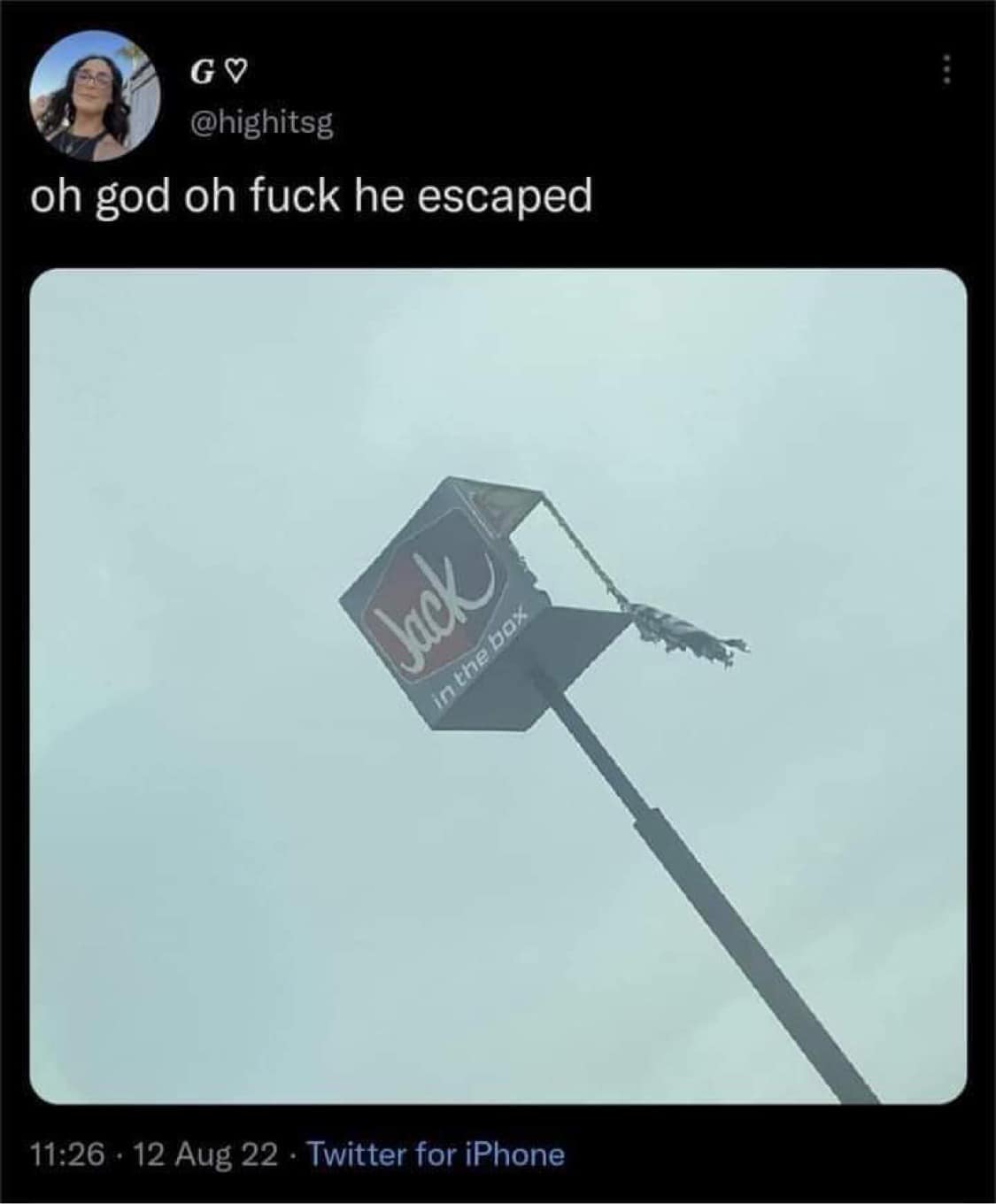
Okay, let's break down this Twitter post (image of a Jack in the Box sign against a washed-out sky) through several theoretical lenses.
1. Visual Description
The image presents a Jack in the Box restaurant sign, dominating the frame. It’s a classic design: a box-shaped sign, tilted at an angle, with the brand’s name prominently displayed. The lighting is somewhat desaturated and diffused, giving it a slightly melancholic or washed-out aesthetic. The sky is a pale, almost faded green-blue, suggesting either an overcast day or an artificial filter. The sign appears to be photographed from a low angle, emphasizing its height and looming presence. The photo quality seems slightly grainy or filtered, contributing to a slightly ethereal or dreamlike quality. The overall impression is less about the bright, cheerful branding of Jack in the Box and more about a sense of isolation, perhaps even a slightly ominous atmosphere.
2. Postmodernism
The image and accompanying text lend themselves well to a postmodern reading. The caption “oh god oh fuck he escaped” is absurdist – it doesn't connect to the visual in a straightforward manner. The “he” is not identified, the “escape” is unexplained. This deliberate lack of coherence and reliance on viewer interpretation is a hallmark of postmodern art.
The washed-out color and slightly grainy aesthetic could be seen as a rejection of the hyper-real, glossy imagery so common in advertising. It's a move away from the 'perfect' image and embraces a sense of fragmentation and impermanence. The act of taking a simple, everyday object (a fast-food sign) and imbueing it with emotional weight (fear, anxiety, implied narrative) is a postmodern tactic, disrupting the object’s original function and meaning. The image performs an emotion rather than depicting a concrete scene.
3. Foucauldian Genealogical Discourse Analysis
A Foucauldian reading could examine the discourse surrounding fast food, consumerism, and even the very concept of "escape." The Jack in the Box sign isn’t simply a marker for a restaurant; it's a node in a wider network of power/knowledge.
- Discipline and Panopticism: The sign represents a system of control—the fast food industry. It’s a constant, visible presence, subtly regulating our behavior (through hunger, convenience, and social norms). The 'escape' mentioned in the text could be seen as a metaphorical rejection of this system.
- Genealogy of "Escape": What does 'escape' mean in a late capitalist society? Is it literal physical escape, or a psychological withdrawal? A genealogical analysis would trace the historical shifts in the meaning of 'escape' and how that meaning is connected to broader social structures.
- Power/Knowledge: The Jack in the Box brand embodies power – economic, cultural, and social. The sign is a manifestation of this power, and the act of referring to an ‘escape’ from it hints at a desire to dismantle or subvert that power.
4. Queer Feminist Intersectional Analysis
This is more nuanced, but a queer feminist lens could explore the image as a representation of desire and containment.
- Containment & The 'Box': The 'box' in the brand name is literally a container. Queer theory often deals with the ways in which societal norms attempt to 'box in' individuals who fall outside those norms. The 'escape' could represent a breaking free from restrictive expectations or identities.
- Desire & Consumerism: The fast-food industry often taps into desires for convenience, pleasure, and instant gratification. These desires can be exploited, particularly for marginalized groups. The text implies something, or someone, desired to escape the sign.
- Intersectional Considerations: A full analysis would require more context about the person who posted the tweet. Is this person reflecting on personal experiences with restriction or alienation? Do these experiences intersect with their gender, race, class, or other identity categories?
5. Critical Theory
Using a critical theory framework, we can see the image as a commentary on the alienation of modern life.
- Commodification & Alienation: The Jack in the Box sign represents the commodification of food and experience. In a capitalist system, even basic needs are turned into commodities. This process can lead to feelings of alienation—a sense of disconnect from oneself, others, and the world.
- The Spectacle (Debord): The sign is part of the pervasive ‘spectacle’ that dominates modern life—a constant stream of images and messages that distract us from real social issues. The image, coupled with the text, ironically draws attention to this spectacle.
- False Consciousness: The image could be read as an attempt to pierce through the illusion of consumer satisfaction. The ‘escape’ implies that something is fundamentally wrong with the system, even if that system seems to provide comfort and convenience.
Important Notes:
- Context is Key: This analysis is based solely on the image and text provided. More information about the poster and their motivations would provide a deeper understanding.
- Multiple Interpretations: Theoretical frameworks are tools for analysis, not definitive answers. Different readers may interpret the image in different ways.
- Interconnectedness: The various theoretical lenses are not mutually exclusive. They often overlap and complement each other.
Let me know if you'd like me to elaborate on any of these points or explore additional theoretical perspectives!
simple-description (llama3.2-vision)
This meme is a humorous image of a person running away from a Jack in the Box restaurant, with a caption "oh god oh f**k he escaped". The image is likely a playful illustration or a screenshot from a movie or TV show, depicting a character making a frantic escape from the restaurant. The caption is a lighthearted and exaggerated reaction to the character's escape, implying that they've managed to break free from the restaurant's grasp.
tesseract-ocr
E-) (Cav) ay @highitsg oh god oh fuck he escaped 11:26 - 12 Aug 22 - Twitter for iPhone