First Seen
2023-05-10T21:03:40+00:00
simple-description (llama3.2-vision_11b)
The meme is a screenshot of a fictional character, likely from a fantasy or science fiction series, with a quote overlaid. The text reads: "I am not a hero, I'm a monster. I am not a hero, I am a monster. I am not a hero, I am a monster..." The meme is a commentary on post-structuralism, a philosophical movement that challenges traditional notions of identity and heroism. The character's repetition of "I am not a hero, I am a monster" subverts the idea of a heroic identity, instead embracing the complexity of being a monster.
detailed-analysis (gemma3-27b-vision)
Okay, here's an analysis of the image, broken down into sections based on the requested theoretical lenses. Given the image content, not all sections will be equally applicable, and some may be brief.
Visual Description
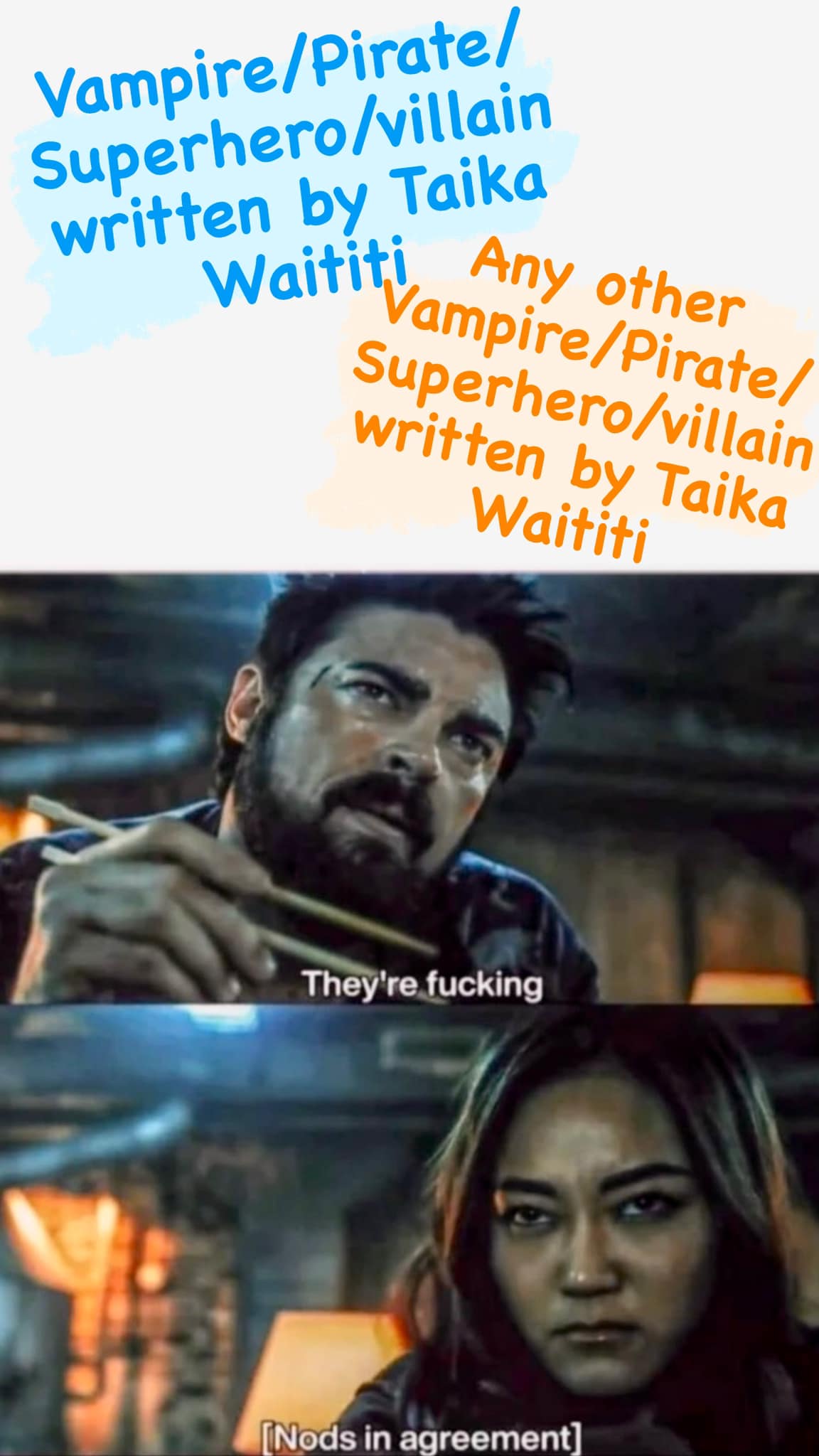
The image is a screencap from the film What We Do in the Shadows (directed by Taika Waititi and Jemaine Clement). It's presented as a meme format with text overlaid.
The top panel features a close-up of a pale, somewhat disheveled man (Vladislav, played by Jemaine Clement) with a noticeable smear of what appears to be blood on his mouth. He's wearing a dark, vintage-style suit, and the lighting is dim and somewhat bluish. He's staring intensely, and the text reads, "They're f*cking."
The bottom panel shows a woman (Nanook, played by Rose McMahon) with dark hair, also dressed in dark clothing. She is looking directly at the camera with a stern, confirming expression and “nods in agreement.” The background is blurry and seems to be a nightclub or similar environment with bright orange and blue lights. The image overall evokes a somewhat gritty, darkly comedic aesthetic.
Foucauldian Genealogical Discourse Analysis
The image, specifically the dialogue and Nanook's affirmation, reveals a normalizing discourse around the vampire's behavior. Foucault would be interested in how this 'they're fcking' becomes a casual observation, a statement of fact rather than an expression of moral judgment. This normalization is achieved through the film's consistent framing of the vampire's activities—feeding, fighting, and, apparently, engaging in sex—as simply what they do*.
A genealogical approach would trace the historical (or fictional historical) conditions that produce this acceptance. Why, in this vampire "culture", is this behaviour casually discussed? The film subtly deconstructs traditional notions of morality associated with vampires. It doesn't defend the behavior, but it presents it as inherent to their existence, stripped of the usual gothic horror trappings. The lack of judgment, emphasized by Nanook’s simple affirmation, establishes it as a power dynamic within the vampire community.
Critical Theory
This image, and the film from which it's taken, can be analyzed through a Critical Theory lens as a subversion of established tropes. The traditional portrayal of vampires in media often centers on predation, monstrousness, and the transgression of societal norms. What We Do in the Shadows doesn't entirely abandon these elements, but it humanizes the vampires through a comedic lens, focusing on their mundane domesticity, petty squabbles, and awkward social interactions.
The image is an example of this deconstruction. The shocking frankness of Vladislav’s statement is juxtaposed with Nanook’s deadpan agreement. This deflates the sensationalism typically associated with vampire behaviour. It encourages the audience to consider the vampires not as monstrous "others," but as individuals with their own complex lives and desires. It challenges the binary of “normal” and “monstrous” by presenting a world where monstrous behaviour is normalized within a specific community.
Marxist Conflict Theory
From a Marxist perspective, this image hints at a power dynamic within the vampire community, and potentially a broader conflict between vampires and humans. While not explicitly stated, the 'they're f*cking' implies some degree of exploitation or domination. It suggests that certain vampires might be "taking" from others (perhaps literally, in the context of vampire feeding).
Nanook's affirmation implies a tacit acceptance of this inequality. It could be interpreted as a reflection of a hierarchical structure within the vampire society where certain behaviours are condoned or even encouraged, while others are not. This aligns with a Marxist analysis of power relations based on exploitation and domination. The image could represent a microcosm of broader social struggles, where those in power maintain their position through the control of resources and the suppression of dissent.
Postmodernism
The image exemplifies several postmodern characteristics. The film, and this image, engage in intertextuality—drawing on and playfully subverting existing vampire tropes and horror conventions. It’s a self-aware parody, acknowledging the audience’s familiarity with the genre. The casual, conversational tone ("They're f*cking") is a deliberate breaking of the fourth wall, challenging the conventions of gothic horror and dramatic tension.
The film embraces pastiche and fragmentation, presenting a chaotic and absurd world where vampires struggle with mundane problems. The blurring of boundaries between the monstrous and the mundane, the high and the low, is also characteristic of postmodernism. The image is not attempting to offer a grand narrative or moral lesson, but rather to deconstruct and playfully reassemble existing tropes.
Queer Feminist Intersectional Analysis
This section is more complex, as the image doesn't explicitly portray overt gender or sexuality, but offers avenues for analysis.
The casualness of the statement could be read as a dismantling of traditional notions of sexual privacy or taboo. The fact that the vampires are discussing (or observing) the sexual activity of others without judgment could be seen as a subversion of patriarchal norms around sexuality. The emphasis on the act itself, rather than the gender of those involved, could be interpreted as a queer sensibility.
An intersectional approach would also consider the power dynamics involved. If there's an imbalance of power between the vampires involved in the act, this could be analyzed through a feminist lens. The acceptance of the act by Nanook could be seen as a reflection of a community that prioritizes its own needs and desires over the well-being of those being exploited. The vampire identity, itself, could be seen as representing a form of ‘otherness’ and a challenging of societal norms.
Hopefully, this breakdown provides a comprehensive analysis of the image through the requested theoretical lenses! Let me know if you'd like me to expand on any particular section.
simple-description (llama3.2-vision)
This meme is an image of a character from the TV show "Westworld" (played by Evan Rachel Wood) with a shocked expression. The text above the image reads: "When you finally understand the plot of Westworld and it's just a bunch of characters saying 'I'm a robot, but I have feelings'". The meme is a humorous commentary on the show's complex and often confusing storyline.
tesseract-ocr
Any V, ; Othe Super" /Pirate y Writ} hero/viti ; en by Tae Waitit; “4 ee — @qg» % el y & ~ | ae 4 = » They're.fucking . , : ol lNods in agreement]