First Seen
2024-04-06T18:47:15+00:00
simple-description (qwen3.5_2b-q8_0)
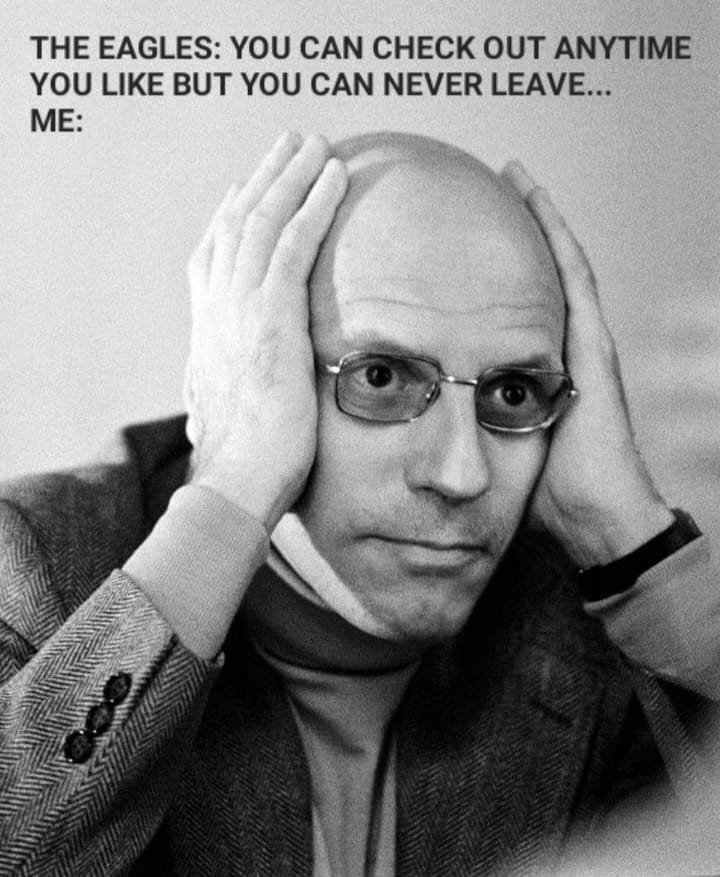
This meme employs a queer-post-structuralist framework to deconstruct rigid binary oppositions. The Eagles' assertion that you "never leave" acts as an immutable, non-negotiable signifier, trapping "Me" in a state of impossible loyalty. The visual of the panicked hands illustrates the anxiety of a character caught within a grand narrative that refuses to allow for fluidity or escape, exposing how fixed identities create the very trauma of being stuck in a role that denies the self.
simple-description (llama3.2-vision_11b)
The meme is a playful take on the concept of post-structuralism, which challenges traditional notions of identity and self. The image features a photo of philosopher Jean Baudrillard, who is known for his work on post-structuralism, with a caption that pokes fun at the idea of a "self" or "identity" that can be easily "downloaded" or "unlocked" by others. The text reads: "The Eagles: You can check out any time you like, but you can never leave... Me: I'm still here."
detailed-analysis (gemma3-27b-vision)
Okay, let's break down this image and its text pairing through the lenses of the requested theoretical frameworks.
Visual Description
The image is a black and white portrait of a man, who appears to be Michel Foucault. He's seated and looking directly at the viewer. He's wearing glasses, a turtleneck sweater, and a tweed jacket. His hands are raised to the sides of his head, in a gesture that suggests distress, exasperation, or a feeling of being overwhelmed. The image is grainy, likely a still from a photograph or film. The composition is tight, focusing on his face and upper body. The image has a vintage aesthetic. Above the portrait, there is text that says "The Eagles: You Can Check Out Any Time You Like But You Can Never Leave" with "Me:" below.
Foucauldian Genealogical Discourse Analysis
This pairing of image and text is rich with Foucauldian implications. Foucault's work centers on how power operates through discourse, shaping knowledge, subjectivity, and ultimately controlling individuals.
- Panopticism and Surveillance: The Eagles' lyrics evoke the panoptic structure – the feeling of being constantly observed, even if that observation is not direct. You can check out (appear to exit the system), but there’s always a sense of inescapable monitoring. The lyrics speak to a system that is not just about confinement, but the internalization of the rules and the feeling of being always under evaluation.
- Disciplinary Power: Foucault argued that modern power is less about direct repression and more about discipline and normalization. The lyrics imply a subtly insidious form of control. The system encourages a performative conformity. You're allowed to leave, but the psychological cost—the feeling of never truly being able to escape—is the core of its control.
- Genealogy of the Self: The image of Foucault himself, a theorist of power, adds a layer of meta-commentary. He looks overwhelmed and distressed, suggesting the weight of understanding these systems of control. His presence hints that even those who analyze power structures are not immune to their effects.
- The Subject as Constructed: Foucault would say that "you" as the subject in this image are not a self-determined entity but rather a product of these systems of knowledge and control. Your desire to "check out" is itself a product of the power structure that defines “leaving” as a possibility.
Critical Theory
The image aligns with themes found in the Frankfurt School's Critical Theory.
- Culture Industry: The Eagles' song can be seen as a product of the culture industry, a system that standardizes and commodifies experiences. The song sounds like freedom (the ability to leave), but the message is ultimately about being trapped. It’s a manufactured sentiment that reinforces a larger system of control.
- Instrumental Reason: Critical Theorists would argue that this system of control is driven by instrumental reason – valuing efficiency and control above all else. The system doesn't care about why you want to leave, only that you remain within it.
- Alienation: The sense of being trapped, even with the possibility of exit, speaks to alienation. The subject is alienated from their own agency and autonomy.
Postmodernism
The pairing can also be seen through a postmodern lens.
- Simulation and Hyperreality: The idea of checking out but never leaving can be interpreted as a state of hyperreality. The distinction between reality and simulation blurs. The feeling of freedom is presented, but it's ultimately illusory.
- Deconstruction of Meaning: The lyrics themselves can be deconstructed. What does "leave" actually mean in this context? What does it mean to "check out?" The image and lyrics question the stability of these concepts.
- Skepticism towards Grand Narratives: Postmodernism rejects overarching explanations. The image doesn’t suggest a single cause of oppression but rather the pervasive and fragmented nature of power.
Marxist Conflict Theory
While not directly a conflict between economic classes, a Marxist reading could emphasize the power dynamics at play.
- False Consciousness: The system—whatever it represents—offers the illusion of choice, masking the underlying structures of control. The ability to "check out" creates a false consciousness, preventing subjects from recognizing the true extent of their oppression.
- Ideology: The lyrics function as ideology, naturalizing a state of confinement and presenting it as normal.
In Summary
The image and text pairing is potent and complex. It speaks to the subtle and insidious ways in which power operates in modern society. It invites us to question the nature of freedom, control, and the very construction of the self. The fact that the image is of Michel Foucault himself adds another layer of metacommentary, suggesting that even those who analyze power structures are not immune to their effects.
Let me know if you'd like me to expand on any of these interpretations or explore other theoretical frameworks.
simple-description (llama3.2-vision)
This meme is a humorous take on the Eagles' song "Hotel California" and its infamous line "You can check out any time you like, but you can never leave." The meme features a photo of a person with a shocked expression, with the caption "You can check out any time you like, but you can never leave... ME" implying that the person is stuck in a situation from which they cannot escape. The meme is likely meant to be humorous and relatable, poking fun at the idea that sometimes we feel trapped in situations that we can't escape.
tesseract-ocr
THE EAGLES: YOU CAN CHECK OUT ANYTIME YOU LIKE BUT YOU CAN NEVER LEAVE... ME: -» \ | °c ag!) A 1 \ = f | , if ; ) e ZN 4 A 4 ld . a WEBS