First Seen
2023-06-02T19:43:57+00:00
simple-description (qwen3.5_2b-q8_0)
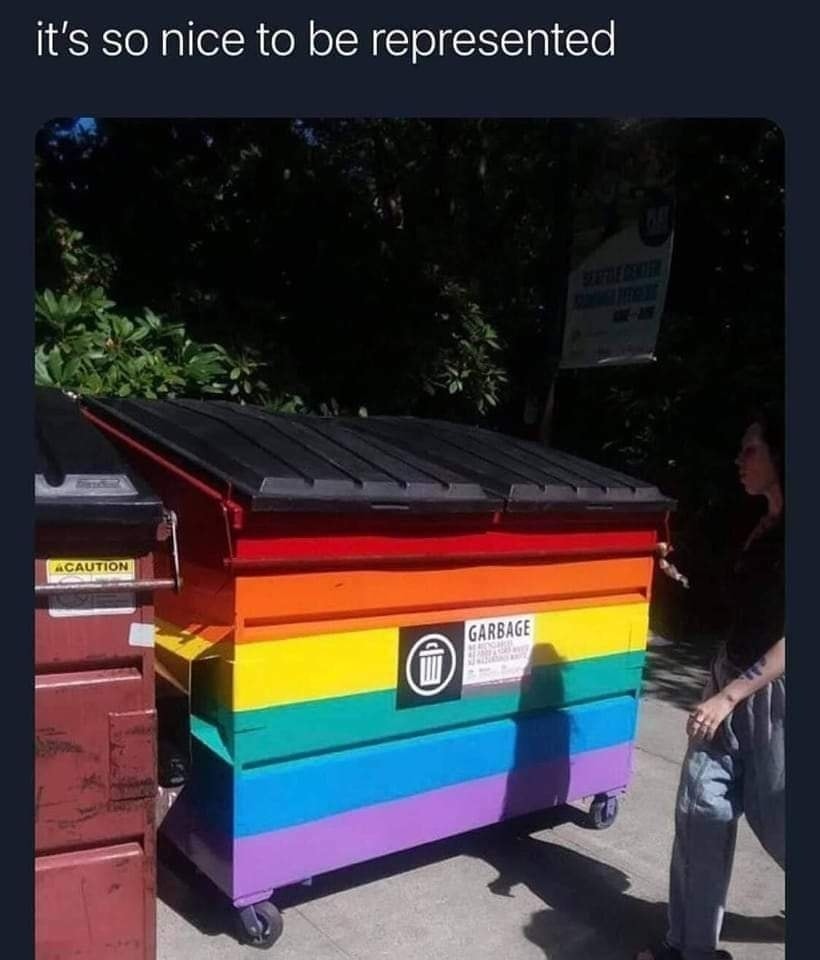
This meme humorously plays on the disconnect between the text "it's so nice to be represented" and the reality that the dumpster is simply labeled "GARBAGE." It suggests a critique of tokenism, where the desire for visual inclusion is treated as a label, rendered absurd by the material reality of the object.
simple-description (llama3.2-vision_11b)
The meme is a humorous representation of the intersection of queer culture and post-structuralist philosophy. The image depicts a dumpster with a rainbow flag painted on it, implying that even the most mundane and oppressive spaces (like a dumpster) can be reclaimed and recontextualized as a symbol of queer identity and resistance. The text "it's so gay" is a nod to the idea that even the most mundane objects can be reinterpreted and recontextualized as a symbol of queer identity and resistance.
detailed-analysis (gemma3-27b-vision)
Okay, let's break down this image and the accompanying text ("it's so nice to be represented") through several theoretical lenses, as requested. I'll include headings only for those lenses that meaningfully apply.
Visual Description
The image depicts a large metal dumpster, painted with the colors of the rainbow flag (red, orange, yellow, green, blue, violet). It is outdoors, on what appears to be a street or sidewalk, with trees in the background. There's another, plain, metal dumpster to the left. A person is visible walking away from the rainbow dumpster, obscured in partial profile. The dumpster is labeled “GARBAGE” in white letters with a depiction of trash in a can. There's a sign in the background, but the text on it is too small to be deciphered. The overall composition is somewhat stark and direct.
Queer Feminist Intersectional Analysis
This image is rich in potential meaning when viewed through this lens. The juxtaposition of the rainbow flag—a symbol of LGBTQ+ pride and visibility—painted onto a dumpster, a container for waste, is profoundly ironic and potentially critical.
- Symbolic Violence: The painting of the rainbow flag onto a dumpster can be interpreted as a form of symbolic violence against the LGBTQ+ community. It implies a devaluation and a relegation of queer identities to something disposable, unwanted, and ultimately trash. The statement "it's so nice to be represented" becomes bitterly sarcastic, highlighting the way in which representation is being offered - a superficial gesture that masks deeper exclusion.
- Intersectional Critique of Visibility: The image challenges the notion that visibility automatically equates to acceptance or respect. Simply being "seen" or "represented" (even through a rainbow wash on a garbage bin) doesn't address the systemic issues of homophobia, transphobia, and other forms of discrimination. It highlights the difference between token representation and genuine inclusion.
- Queer Subversion: At the same time, the image can also be seen as a form of queer subversion. By embracing the "trash" metaphor, the LGBTQ+ community could be reclaiming a marginalized position, challenging dominant norms, and finding power in visibility, even if it's presented in a demeaning context. It says, "We will be seen, even if you want to see us as something to discard."
- Intersectionality: This image could represent the intersection of multiple marginalized identities - not just being a member of the LGBTQ+ community, but also any identity associated with being marginalized. The imagery serves as a metaphor for being discarded by the mainstream.
Postmodernism
The image engages with postmodern themes of irony, pastiche, and the questioning of grand narratives.
- Deconstruction of Symbolism: Postmodernism encourages the deconstruction of symbols. The image undermines the "pure" meaning of the rainbow flag by placing it on an object associated with waste, effectively disrupting its intended message of pride and unity.
- Irony and Sarcasm: The text "it's so nice to be represented" is heavily ironic, particularly when coupled with the image. It mocks the performative nature of some forms of representation, suggesting that it’s a superficial gesture lacking in genuine substance.
- Challenge to Authenticity: Postmodernism questions the concept of authenticity. The rainbow flag on a dumpster can be seen as an inauthentic representation of LGBTQ+ identity, a commodification of a movement, or a hollow gesture toward inclusivity.
Foucauldian Genealogical Discourse Analysis
A Foucauldian analysis focuses on the historical construction of power relations and the discourses that shape our understanding of the world.
- Discourse of Marginalization: The image can be interpreted as a manifestation of the historical discourse that has marginalized and pathologized LGBTQ+ individuals. The dumpster serves as a material representation of this discourse, literally placing queer identities in a position of "waste" or "discard."
- Power/Knowledge: Foucault argued that power and knowledge are inextricably linked. The image suggests that the dominant power structures define what is considered "normal" and "acceptable," and anything that deviates is relegated to the margins. The painting of the rainbow flag onto the dumpster is a power move – an attempt to visually control and categorize LGBTQ+ identity.
- Genealogy of Homophobia: By examining the history of how LGBTQ+ individuals have been represented and treated, one can trace the genealogy of homophobia and the social norms that perpetuate it. The image is a snapshot in this historical process.
Important Note: I have not included sections for Critical Theory or Marxist Conflict Theory because, while these lenses could be applied to the image, they don't seem to be as central or illuminating as the analyses above. The image's core message revolves around representation, identity, and power dynamics, which are more directly addressed by the Queer Feminist Intersectional, Postmodern, and Foucauldian perspectives.
I hope this detailed breakdown is helpful! Let me know if you'd like me to elaborate on any of these points or explore other theoretical frameworks.
simple-description (llama3.2-vision)
This meme is a humorous image of a rainbow-colored trash can, often referred to as a "gay trash can" or "pride trash can." The image features a brightly colored trash can with a rainbow flag design, and the text "it's so gay" is written above it. The caption "it's so gay" is a playful and ironic reference to the trash can's rainbow colors, implying that the trash can is so gay that it's even in a trash can.
tesseract-ocr
it's so nice to be represented a) ae ; ree : ee —— Aaa Ce es ae a, — i , 6 7 “ “Fe ; " | i z | P ei e