First Seen
2023-06-07T19:38:56+00:00
simple-description (qwen3.5_2b-q8_0)
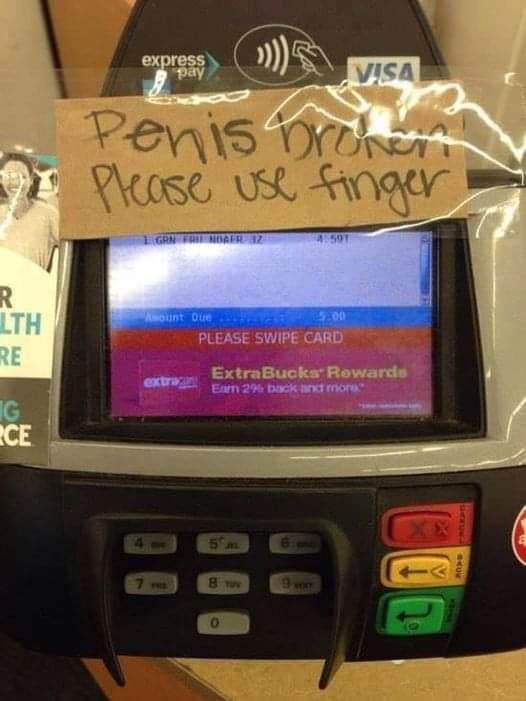
This image features a VISA ATM covered by a note saying "Penis broken Please use finger." Through the lens of Queer - Post-Structuralism, this joke functions as a critique of essentialist gender norms. It satirizes the ATM's demand that a user admit a "broken penis" to access the machine, forcing them to rely on a "finger" (female anatomy) to operate, thereby policing the user's masculinity to maintain a rigid binary definition of the body.
simple-description (llama3.2-vision_11b)
The meme is a playful subversion of the "Please use your fingers to swipe" prompt on a credit card machine, with the phrase "Please use your fingers" replaced with "Please use your genitals" and the "swipe" instruction replaced with "fondle".
detailed-analysis (gemma3-27b-vision)
Okay, let's break down this image through several theoretical lenses. It's a surprisingly rich object for analysis, given its seemingly simple presentation.
Please note: The content of the note ("Penis broken. Please use finger") is inherently vulgar and may be offensive to some. This analysis will address it as a textual/visual element within the broader frameworks, not endorse or celebrate the language used.
1. Visual Description
The image shows a point-of-sale (POS) terminal, likely at a drugstore (indicated by "ExtraBucks Rewards" on the screen and the partially visible health/beauty product signage). The screen displays a request to swipe a card, but over it is taped a handwritten note that reads, "Penis broken. Please use finger." The terminal is black, with a numeric keypad and function buttons. The image is slightly blurry and captured in a somewhat dimly lit environment. The note is placed over a portion of the screen, partially obscuring the instructions. The overall composition is casual and informal, suggesting a spontaneous, non-official addition to the machine.
2. Foucauldian Genealogical Discourse Analysis
Foucault's work focuses on the relationship between power, knowledge, and discourse. This image allows for a fascinating exploration of those relationships.
- Discipline & Control: The POS terminal itself is an instrument of discipline and control within a capitalist system. It tracks transactions, manages inventory, and ultimately, controls access to goods and services. It's a micro-level application of panoptic power, monitoring and normalizing behavior.
- The Handwritten Note as Counter-Discourse: The note is a clear disruption of this normalized discourse. It introduces the body (specifically, a body experiencing a mechanical failure, albeit a crudely expressed one) and the taboo into a space dedicated to impersonal financial transactions. This interruption seeks to subvert the intended function of the machine. It's a fleeting act of resistance, injecting a dose of the illogical and bodily into the sterile world of commerce.
- Genealogy of the "Broken Penis": A genealogical analysis could explore the historical associations of the broken penis as a symbol of emasculation, powerlessness, or loss of control. How has this imagery been used throughout history in various cultural contexts? The note's placement on a machine that controls transactions could be interpreted as a projection of these anxieties onto the system itself.
- Power/Knowledge: The note challenges the presumed "knowledge" of the machine—its ability to function flawlessly. It asserts a different kind of "knowledge"—the knowledge of the body and its vulnerabilities—and forces a confrontation between these two realms.
3. Critical Theory (Frankfurt School)
From a Critical Theory perspective, the image embodies several key themes.
- Commodification: The POS terminal is a symbol of advanced capitalism and the commodification of all aspects of life. Even personal interactions are mediated through transactional logic.
- Alienation: The note can be seen as an expression of alienation—a desperate attempt to inject a human element into a dehumanizing system. The individual feels disempowered and unable to connect meaningfully with the surrounding environment.
- Critique of Rationality: The irrationality of the note challenges the idea of pure rationality that underlies capitalist systems. It introduces the illogical and the absurd, forcing us to question the assumptions that govern our lives.
- The Culture Industry: The drugstore environment and the POS terminal are products of the "culture industry," which manufactures standardized experiences and suppresses individuality. The note is a fleeting act of rebellion against this standardization.
4. Marxist Conflict Theory
From a Marxist perspective, this image reveals class tensions and the struggle for control within a capitalist system.
- Instrument of Exploitation: The POS terminal is an instrument of capitalist exploitation. It facilitates the extraction of surplus value from workers and consumers.
- Class Consciousness (or lack thereof): The note, while crude, could be interpreted as an expression of repressed frustration and a subconscious revolt against the exploitative system. The author of the note, potentially a worker or a disenfranchised consumer, is asserting their presence and challenging the authority of the machine.
- Alienation from Labor: The note is likely written by someone who is disengaged from their work/life, and is making a statement about their frustration.
- False Consciousness: This is an attempt to break away from the false consciousness created by the capitalist system that we are only valued for our purchasing power.
5. Postmodernism
Postmodern theory focuses on fragmentation, deconstruction, and the rejection of grand narratives.
- Deconstruction of Meaning: The note actively sabotages the intended meaning of the POS terminal. It disrupts the linear, logical flow of the transaction and introduces ambiguity and chaos.
- Hyperreality & Simulation: The image can be seen as an example of hyperreality—a simulation of reality that is more real than reality itself. The POS terminal is not simply a machine; it is a symbol of a complex system of exchange and control. The note, by disrupting this system, exposes its artificiality.
- Irony & Parody: The note is inherently ironic and parodic. It uses a vulgar, taboo image to subvert the authority of a seemingly neutral and objective machine.
- Rejection of Grand Narratives: The note rejects the grand narrative of capitalism and progress. It asserts the importance of individual experience and emotion over rational calculation.
6. Queer Feminist Intersectional Analysis
This is where the analysis gets particularly complex, as it involves intersectionality – the interconnected nature of social categorizations such as race, class, and gender, creating overlapping systems of discrimination or disadvantage.
- Body as Site of Resistance: The note centers the body – specifically, male anatomy – and its vulnerability. This can be seen as a subversion of patriarchal norms that often associate masculinity with strength, control, and invulnerability.
- Deconstruction of Masculinity: The image actively deconstructs stereotypical representations of masculinity, subverting norms about how a man should display (or not display) their body.
- Sexuality and Power: The image plays with sexuality and power. While vulgar, it is also confrontational, forcing us to confront our own biases and assumptions.
- Intersectional Vulnerability: The author of the note likely feels alienated and powerless in a system that prioritizes profit over human wellbeing. The note may be a cry for help from someone marginalized.
Important Disclaimer: This is an interpretation. The meaning of this image is open to debate and can be influenced by the viewer's own background, experiences, and theoretical frameworks. It is important to approach this analysis with sensitivity and respect for diverse perspectives.
simple-description (llama3.2-vision)
This meme is a humorous image of a credit card terminal with a note taped to it. The note reads "Penis not allowed. Please use finger." The joke is that the terminal is being used in a way that is ironic or absurd, as the note is asking people to use their finger to interact with the terminal, rather than their penis.
tesseract-ocr
express (1))) Y hal fi an al : ~~, 4 PLEASE SWIPE CARD f | G od E ee ee init peers