First Seen
2023-10-07T20:56:19+00:00
simple-description (qwen3.5_2b-q8_0)
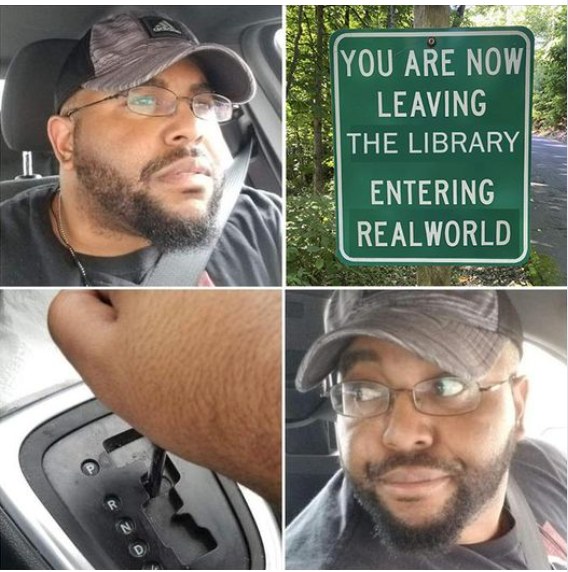
The meme deconstructs the rigid structure of a library policy by juxtaposing it with the unregulated flow of driving a car. It uses the text "you are now leaving the library entering realworld" to challenge the binary boundaries between structured academic settings and unfiltered reality. By treating the "realworld" label as a fluid identity rather than a fixed state, the meme deconstructs how social norms and boundaries are maintained and crossed.
simple-description (llama3.2-vision_11b)
The meme is a screenshot of a sign from a fictional "You Are Now Entering The Real World" sign, but with the words "You Are Now Entering The Real World" replaced with "You Are Now Entering The Queer World". The image is captioned "I can feel the post-structuralism in the air". This meme is poking fun at the idea that post-structuralism, a philosophical movement that challenges traditional notions of reality and meaning, is somehow being felt in the environment. The humor comes from the absurdity of the idea that a sign would suddenly declare the presence of a philosophical movement.
detailed-analysis (gemma3-27b-vision)
Okay, let's break down this image collage with the requested theoretical frameworks. Given the content, some of these will be more fruitful than others.
Visual Description
The image is a four-panel collage.
- Panel 1 (Top Left): A close-up portrait of a Black man, wearing a baseball cap, glasses, and a dark t-shirt. He is looking directly at the camera with a somewhat serious expression. The background suggests he is a passenger in a vehicle. The lighting is soft.
- Panel 2 (Top Right): A road sign reading "YOU ARE NOW LEAVING THE LIBRARY ENTERING REALWORLD." The sign is a standard green traffic sign and is positioned within a landscape of trees and greenery.
- Panel 3 (Bottom Left): A close-up shot of a car’s gear shift in “Park” (P) position. Focus is on the silver and black mechanics.
- Panel 4 (Bottom Right): A slightly different portrait of the same Black man, mirroring Panel 1, with a different expression.
The composition is striking because it juxtaposes a person with a transitional symbolic space (the Library-Realworld sign) and a physical marker of inactivity/potential for motion (the gear shift).
Foucauldian Genealogical Discourse Analysis
This image collage lends itself well to a Foucault-inspired reading. The sign itself ("Leaving the Library, Entering Realworld") can be seen as a discourse, a system of thought, language, and practice that constructs reality. This discourse positions the "library" as a space of abstraction, knowledge, or potentially, escape, while the “realworld” is presented as its opposite – a space of tangibility, hardship, or direct experience.
A genealogical analysis would trace the history of this binary. When and how did the "library" become metaphorically separated from "realworld" experience? What power dynamics are at play in constructing this opposition? Historically, libraries have been controlled spaces, spaces of sanctioned knowledge and often of exclusion (think access to education, literacy requirements). The “realworld” may represent the untamed, unregulated, chaotic outside.
The individual in the portraits interrupts this binary. He is a subject within both spaces. The placement within a car hints at mobility, a transition rather than an absolute departure. He is not simply ‘leaving’ the library, but navigating between spaces – a position of agency and potential subversion. He can be seen as performing a subjectivity that exists beyond the neat categorization proposed by the sign.
Critical Theory
From a critical theory perspective (drawing on thinkers like Adorno and Horkheimer), the collage might be interpreted as a commentary on the alienation of modern life. The "library" could represent a realm of intellectual or cultural pursuits that are increasingly detached from material realities. The "realworld" then embodies the harsh, commodified conditions of contemporary existence.
The man’s portraits, framed within the car, could symbolize a subject caught in this system. The car itself, a hallmark of consumer culture and a tool for navigating this commodified landscape, becomes central to the experience. The slightly melancholic expressions could represent a sense of disenchantment or a recognition of the limitations imposed by this system.
The image could be seen as critiquing the dominance of reason and abstraction in modern thought, and highlighting the need for a reconnection with lived experience, even if that experience is challenging.
Marxist Conflict Theory
A Marxist reading would likely focus on the power dynamics inherent in the construction of "library" versus "realworld."
The "library" could symbolize access to knowledge, culture, and opportunity - resources that are not equally distributed. This represents the superstructure of a society, built upon the economic base. The "realworld," with its implicit struggles for survival and material needs, represents that base.
The man in the car, as a subject navigating between these spaces, embodies the contradictions of class society. Does he have the privilege to choose to enter the "realworld"? What are the economic conditions that shape his access to knowledge and resources? The car itself is a symbol of both status and dependence on the capitalist system.
The image could be interpreted as highlighting the inherent conflict between intellectual pursuits and material survival, and the ways in which power and privilege shape access to both.
Postmodernism
From a postmodern perspective, the collage challenges the notion of a stable, unified "reality." The opposition between "library" and "realworld" is deconstructed as artificial and contingent. There is no clear separation; reality is a fragmented and fluid construct.
The image could be seen as a playful subversion of binary oppositions, highlighting the ways in which meaning is created through juxtaposition and association. The man’s portraits disrupt any attempt to neatly categorize him within either space. His subjectivity is fluid and complex, exceeding the limitations of the sign’s categorization.
The image embraces ambiguity and rejects the search for a grand narrative or underlying truth. It is a fragmented and self-reflexive commentary on the nature of reality itself.
Queer Feminist Intersectional Analysis
While this framework is less directly applicable, we can still draw some insightful interpretations.
The binary “library/realworld” can be read as a historically constructed opposition that privileges certain forms of knowledge and experience (often those of dominant groups) over others. The "library" could represent a space of patriarchal, colonial, or heteronormative knowledge that excludes or marginalizes alternative perspectives. The "realworld" then becomes the space where marginalized communities must navigate systems of oppression.
The man’s presence can be understood as a disruption of this binary. His Blackness, combined with his positioning within a mobile space (the car), challenges dominant narratives of knowledge and experience. The expression in his portraits hints at a complex negotiation of identity and power.
An intersectional analysis would emphasize that the experience of navigating between these spaces is shaped by multiple, intersecting forms of oppression and privilege, including race, class, gender, and sexuality.
I hope this comprehensive breakdown provides a useful exploration of the image from these various theoretical perspectives. Let me know if you'd like me to elaborate on any specific point or explore additional interpretations.
simple-description (llama3.2-vision)
This meme is a humorous image that uses a common "you're not going to believe this" trope. The image shows a person looking shocked or surprised, with a caption that reads "You're not going to believe what I just read" followed by a quote that says "You are now leaving the library and entering the real world." The meme is poking fun at the idea that people often feel a sense of disorientation or confusion when they transition from a controlled environment (like a library) to the real world.
tesseract-ocr
aN. aT \4 rs a wy i THE LIBRARY = AAG ) a cae \\ aa ede \ x Ewe i 0 | a . Z a a Ry wt s & e N