First Seen
2023-11-06T06:11:38+00:00
simple-description (qwen3.5_2b-q8_0)
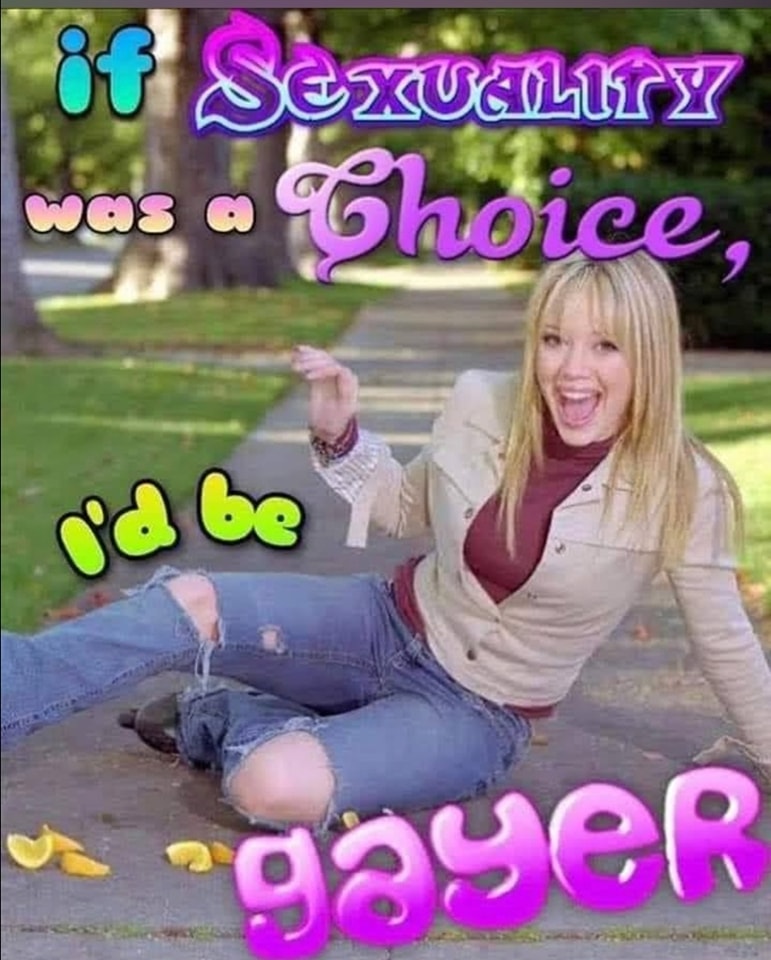
This meme plays with the grammatical structure of conditional sentences to play with language and gender identity, a common theme in queer theory. The text overlay reads "if Sexuality was a Choice," followed by "i'd be" and finally the large word "gayer" in purple letters at the bottom right. The image features a young woman sitting on the ground and laughing, making the text's suggestion of a hypothetical preference visually clear.
simple-description (llama3.2-vision_11b)
The meme is a humorous reference to the song "I'm a Slave 4 U" by Britney Spears, with the lyrics "I'm a slave 4 U, baby, I'm a slave 4 U" replaced with "I'm a queer 4 U" and a photo of Britney Spears with a queer flag emoji. The meme is a playful take on the song's lyrics, using the word "queer" to poke fun at the idea of being a "slave" to one's desires.
detailed-analysis (gemma3-27b-vision)
Okay, let's break down this image with analysis based on the frameworks you've requested. It's a meme, and therefore carries a lot of layered meaning, particularly due to its use of popular culture and internet humor.
1. Visual Description
The image is a digitally manipulated photograph featuring Hilary Duff (likely from her Disney Channel series Lizzie McGuire) in a somewhat awkward, staged "fall" onto a grassy surface. The photo is vibrant, with a bright green lawn and Duff in early 2000s fashion – ripped jeans, a brown tank top and a white jacket. The image is overlaid with bright, neon-colored text in a distinct internet-meme style.
The text reads:
- "if sexuality was a choice" (upper left)
- "I'd be" (lower left)
- "gayer" (lower right)
The use of the word "gayer" is intentionally hyperbolic and playful. The overall aesthetic leans heavily into the early-2000s meme aesthetic, employing vibrant colors and a deliberately "low-resolution" feel.
2. Foucauldian Genealogical Discourse Analysis
This meme operates within the realm of discourse surrounding sexuality, and a Foucauldian analysis can illuminate how power and knowledge shape our understanding of it.
- Discourse & Power/Knowledge: The meme implicitly challenges the dominant discourse that positions heterosexuality as the default or "natural" orientation. By framing sexuality as a choice (even hypothetically), it exposes the construction of sexual norms. This construction is driven by power dynamics – historically, societal institutions (religion, law, medicine) have defined and regulated sexuality, often in ways that privilege heteronormativity. The meme deconstructs this by suggesting that if sexuality were malleable, a different outcome could be desired.
- Genealogy: A genealogical analysis would trace the historical development of the concept of “choice” in relation to sexuality. The idea of sexual orientation as a “choice” has been used both to pathologize LGBTQ+ individuals (implying they choose to be different) and to attempt to “cure” or change them. The meme subverts this narrative by reclaiming the idea of choice. It presents it as something empowering and potentially affirming.
- Biopower: The historical control of sexuality through institutions is an example of biopower—the ways in which political and social technologies regulate life, bodies, and populations. The meme, through its humorous subversion, pushes back against this regulatory power.
3. Critical Theory
Applying a critical theory lens, particularly drawing on the Frankfurt School, we can see how this meme functions as a form of cultural critique.
- Mass Culture & Ideology: Hilary Duff, as a former Disney star, is a product of mass culture. The meme repurposes her image, stripping it of its original, controlled context and injecting it with a subversive message. This highlights how mass culture can be both a tool of ideological control (reinforcing norms) and a site of resistance.
- Commodity Fetishism: Duff's image itself is a commodity, circulated and consumed. The meme adds another layer of "meaning" to this commodity, challenging its intended purpose.
- False Consciousness: The meme, in its playful way, can be seen as attempting to awaken a kind of "false consciousness" – challenging viewers to question the assumptions about sexuality that have been ingrained in them through societal conditioning.
4. Queer Feminist Intersectional Analysis
This framework offers a particularly potent way to understand the meme's meaning.
- Deconstruction of Norms: The meme actively deconstructs the heteronormative assumption that sexuality is fixed and natural. By playfully imagining a different outcome, it challenges the binary logic that underpins many dominant understandings of sexuality.
- Performance & Identity: The meme can be viewed through the lens of Judith Butler’s concept of “performativity.” Sexuality isn’t an internal “essence” but is rather constructed through repeated performances and enactments. The meme, in its exaggerated form, gestures toward the performative nature of identity.
- Intersectionality: While this particular meme doesn't explicitly address issues of race, class, or other intersecting identities, it's important to recognize that sexuality is always experienced within these contexts. The meme's accessibility and broad appeal on the internet (a space where identities are often fluid and negotiated) can be seen as a potentially inclusive gesture.
- Reclaiming Power: For many queer individuals, the meme’s humor and self-affirmation can be seen as a way of reclaiming power and challenging the shame and stigma often associated with non-heterosexual orientations.
Let me know if you'd like me to elaborate on any of these points or analyze the meme from a different perspective.
simple-description (llama3.2-vision)
This meme is a photo of Hilary Duff, an American actress and singer, from her 2003 film "Lizzie McGuire" or its spin-off TV series. The image is captioned with the words "If sexuality was a choice, I'd be gay" - a phrase that is often used to express support for the LGBTQ+ community.
tesseract-ocr
“Ar VT \ar. ol i SEX ALTO XG - 3 §¢ bee AA co) ye Sel 5 i y 4 ce ell rl a | ‘ —— ets Fede