First Seen
2024-01-28T00:26:10.390574+00:00
simple-description (qwen3.5_2b-q8_0)
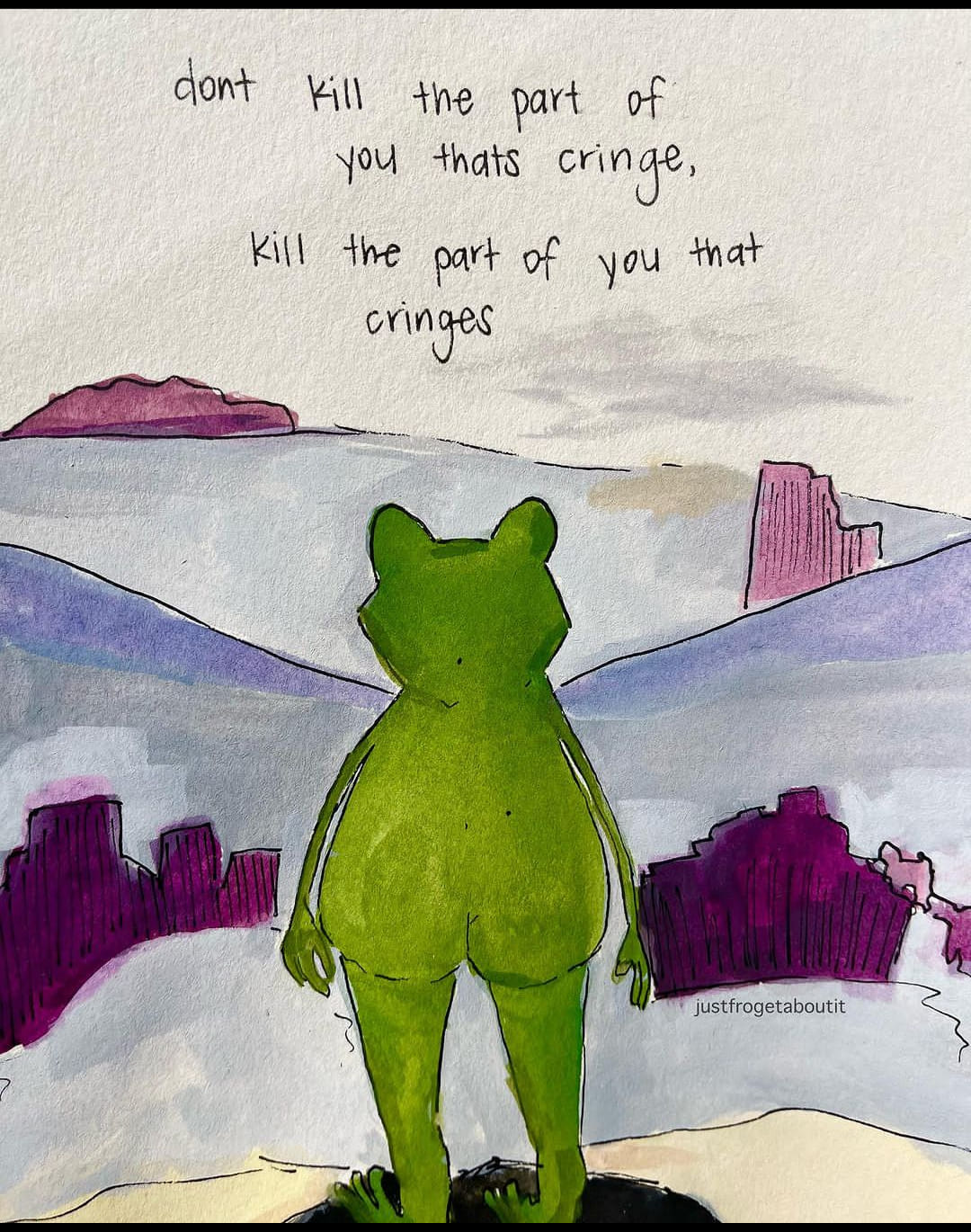
This image shows a green, humanoid figure standing in a desolate, purple landscape with a handwritten message telling viewers to "kill the part of you that cringes." From a queer and post-structuralist perspective, this scene acts as a deconstruction of rigid identity, suggesting that our awkward or uncomfortable aspects are not flaws to be suppressed but essential, fluid parts of the human experience. The figure's nudity and vulnerable stance emphasize a "raw" self that rejects the performance of a smooth, non-queer persona, arguing that the pressure to hide our messy or "cringe" moments is an exhausting burden.
simple-description (llama3.2-vision_11b)
The meme is a cartoon image of a cat with a missing body, represented by a pair of legs and a torso, with the text "don't think of it as a body, think of it as a hole" written above it. The meme is a humorous take on the concept of post-structuralism, a philosophical movement that challenges traditional notions of identity and meaning. The image is a playful way to illustrate the idea that our understanding of the world is not fixed, but rather a complex web of interpretations and meanings.
detailed-analysis (gemma3-27b-vision)
Okay, here's an analysis of the image, broken down into the sections you requested, only applying those lenses where they seem most relevant.
Visual Description
The image is a watercolor or similar painted illustration. It features a large, cartoonishly rendered, humanoid green frog standing with its back to the viewer. The frog dominates the foreground, dwarfing a miniature city in the middle distance. The city is rendered in shades of purple and pink, resembling a slightly abstract skyline. Behind the city, a hazy, blue-toned mountainous landscape completes the background.
The style is whimsical and somewhat naive, with simple lines and washes of color. The frog’s body is rounded and oddly proportioned, its buttocks prominently displayed. The overall aesthetic is somewhat dreamlike or fantastical. The top of the piece contains text written in cursive saying “don’t kill the part of you that cringes, kill the part of you that cringes”. A signature appears in the lower right corner that reads “justfrogaboutit”.
Postmodernism
This piece is ripe for postmodern analysis. Several key postmodern themes are present:
- Playfulness and Irony: The image’s humor lies in the absurdity of a giant frog overlooking a miniature city. The text, a self-help platitude, juxtaposed with the ridiculous image creates an ironic tension. It’s hard to take the message entirely seriously because of its presentation.
- Deconstruction of Meaning: The phrase “kill the part of you that cringes” is repeated, almost like a mantra, but within a context that undermines a straightforward reading. The repetition is used to undermine the significance of the phrase itself.
- Rejection of Grand Narratives: The self-help messaging is a component of a larger “grand narrative” about self-improvement, but the image doesn't offer a path toward that narrative; the message itself is defanged by the ridiculous imagery.
- Blending of High and Low Culture: The watercolor style suggests an attempt at artistic expression, but the subject matter (a cartoon frog) is distinctly low-brow. This mixing of styles challenges traditional boundaries of artistic worth.
Queer Feminist Intersectional Analysis
While not overtly stated, the image invites a queer feminist intersectional reading through its destabilization of norms and embrace of “cringe”:
- Embracing “Cringe” as Resistance: The message, while somewhat ambiguous, could be read as a validation of unconventionality and a rejection of societal pressures to conform. “Cringe” is often associated with vulnerability, authenticity, and transgressing expectations, all of which are valued within queer and feminist communities.
- Body Positivity: The prominent display of the frog's buttocks challenges conventional beauty standards and can be read as an assertion of body positivity. It’s an unusual visual choice that disrupts typical representations of the body.
- Subversion of Power Dynamics: The giant frog towering over the city can be interpreted as a subversion of traditional power dynamics. It's a playful, yet slightly unsettling, image that challenges the notion of established authority.
- Intersectionality: The image doesn't directly address intersectionality, but it does create a space for multiple interpretations and allows viewers to project their own experiences and identities onto the work.
Foucauldian Genealogical Discourse Analysis
A Foucauldian reading focuses on how power operates through discourse. In this image:
- Discourse of Self-Improvement: The text is an example of the pervasive discourse of self-improvement. Foucault would argue that this discourse is not neutral but rather functions as a mechanism of control, shaping individuals to fit societal norms.
- Normalization of “Cringe”: The message seems to be saying that the parts of us that feel embarrassing or awkward (the “cringe”) shouldn't be eliminated, but the repetition and imagery suggest that these “cringe” parts are potentially problematic or unwanted.
- The Frog as a Site of Power: The frog itself can be seen as a symbol of power, not through domination, but through its sheer size and presence. It disrupts the established order of the city and forces viewers to reconsider their own perspectives.
- Genealogical Tracing: One could trace the history of "cringe" as a social phenomenon, examining how it has evolved over time and how it is used to regulate behavior. The image then serves as a snapshot of this ongoing discourse.
Let me know if you'd like me to expand on any of these points or explore other potential interpretations.
simple-description (llama3.2-vision)
The meme is a cartoon of a frog with its legs and arms cut off, leaving only its torso. The text "don't kill the part of you that's ugly" is written above the frog, but the text in the meme is actually "don't kill the part of you that's cringe".
tesseract-ocr
dont Yi tne part of You thats ae Kill the oar of you nat ovinges 7 ee é a d es fs Ral / | ' Ss a y ; yt 3 j A / F A | * justfrogetaboutit p s | Se OOO Vie er —