First Seen
2024-03-17T23:31:37.633728+00:00
simple-description (qwen3.5_2b-q8_0)
For someone who cannot see the meme, here is an explanation broken down by the requested categories:
Queer & Post-Structuralism Context:
This image is a powerful visual metaphor for queer theory and post-structuralism, specifically regarding the "deconstruction of identity." It depicts the breakdown of rigid gender or binary categories (represented by the solid figures). The "pattern" the person falls into is a metaphor for societal expectations or a fixed "mask" we put on ourselves to be whole. The transition to a glowing stream of dots suggests gender fluidity and the liberation of the non-binary subject.
Textual Explanation:
The speaker realizes that their rigid, monolithic form (the person walking) is just a temporary "pattern" created by society or biology, not their true essence. They realize this mistake: "I will now step outside of it."
Visual Description:
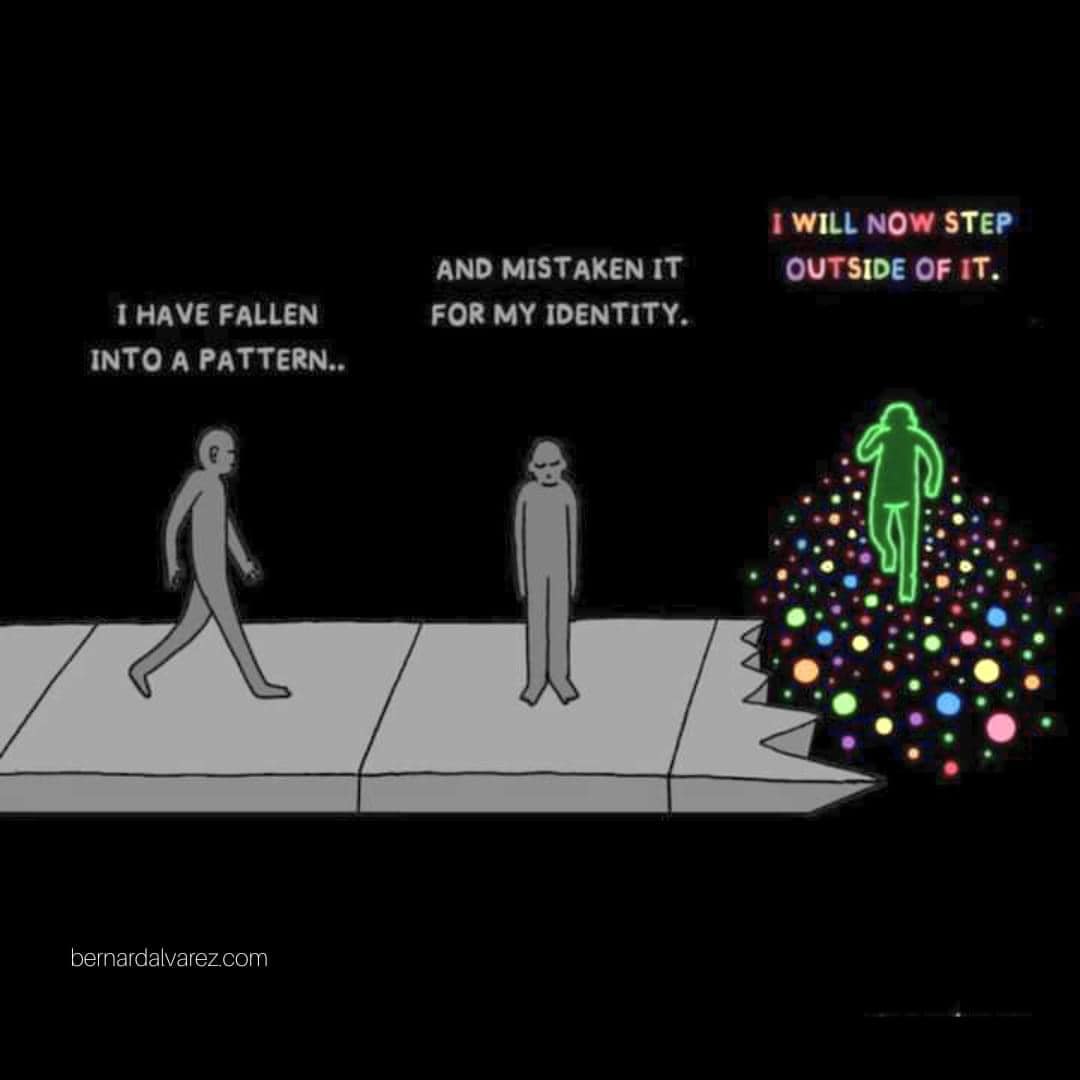
To the left, a featureless grey figure walks on a sidewalk. In the middle, a silent grey figure stands still. On the far right, a figure about to fall out of the ground is depicted as a glowing green silhouette made of colorful dots and particles.
simple-description (llama3.2-vision_11b)
The meme is a humorous illustration of the concept of "queer" identity, specifically post-structuralism, which challenges traditional notions of self and identity. The image shows a person walking in a straight line, representing a traditional understanding of identity, but then suddenly takes a detour and becomes a "queer" identity, symbolizing the fluid and non-linear nature of post-structuralist identity. The text "I have fallen into a pattern... and mistaken it for my identity" highlights the idea that our identities are not fixed, but rather a complex web of experiences and relationships that can change and evolve over time.
detailed-analysis (gemma3-27b-vision)
Okay, let's break down this image with the requested theoretical lenses.
Visual Description
The image is a stark, minimalist digital illustration in shades of grey and green. It depicts three faceless, stylized figures walking along what appears to be a paved path or sidewalk. The background is black. The figures are arranged sequentially, moving from left to right.
- Figure 1: Is walking forward, seemingly oblivious to anything around them. The text above reads, "I HAVE FALLEN INTO A PATTERN…"
- Figure 2: Is positioned directly after the first, similarly walking forward, but with an expression of realization or resignation. The text reads, “AND MISTAKEN IT FOR MY IDENTITY.”
- Figure 3: Is stepping off the edge of the pavement, breaking away from the path. A burst of colorful particles radiates outward from this figure. The text reads, “I WILL NOW STEP OUTSIDE IT.”
The visual composition emphasizes a progression and a choice. The starkness and lack of detail create a sense of universality, potentially suggesting a relatable experience about self-discovery and liberation. The bright burst of particles around the third figure suggests freedom or emergence.
Foucauldian Genealogical Discourse Analysis
This image lends itself particularly well to a Foucauldian reading.
- Discourse and Power: The "pattern" can be understood as a discourse—a system of thought, language, and practices that constructs meaning and, crucially, power relations. This pattern (perhaps societal norms, expectations, or internalized beliefs) operates as a disciplinary power, shaping the first two figures. The first figure falls into this discourse, and the second identifies with it, mistaking it for an essential part of themselves. This is where power functions most effectively – when it’s invisible and internalised.
- Genealogy: A genealogical approach would trace the historical formation of this "pattern," examining how it came to be established, what power dynamics were at play in its construction, and how it has been reproduced over time. What are the historical conditions that created this 'pattern'?
- Subjectivation: The first two figures are subjectivated by the pattern – they become defined by it. The third figure's act of stepping outside represents a rejection of this subjectivation, a reclaiming of agency and a move towards self-definition.
- Power/Knowledge: The image subtly demonstrates the link between power and knowledge. The 'pattern' isn't just a physical structure but a system of knowledge that has been internalized by individuals, shaping their understanding of themselves and the world.
Postmodernism
This image embodies several key tenets of postmodern thought.
- Rejection of Grand Narratives: The image challenges the idea of a fixed or essential "identity." The second figure's realization – that their identity has been mistakenly based on a constructed pattern – reflects the postmodern rejection of universal truths and stable meanings.
- Deconstruction: The act of stepping "outside" the pattern can be read as a deconstructive move—a dismantling of a seemingly solid structure to reveal its underlying instability and constructedness.
- Fragmentation and Subjectivity: The lack of facial features on the figures highlights the fragmented nature of the modern self. The emphasis is on subjective experience—the individual's realization and choice—rather than objective truth.
- Simulacra and Simulation: One could argue the 'pattern' is a simulacrum - a copy without an original. Meaning it has become detached from any real grounding or purpose, existing as a self-referential system of signs and symbols.
Critical Theory
A critical theory lens sees the "pattern" as a representation of social structures that maintain power imbalances.
- Ideology: The pattern can be understood as an ideological construct—a system of beliefs and values that serves the interests of a dominant group. The first two figures have internalized this ideology, leading them to accept a limited and potentially oppressive definition of self.
- Domination and Resistance: The image portrays a struggle between domination and resistance. The pattern represents a force that seeks to control and define individuals, while the third figure's act of stepping outside represents a rejection of this control and a move towards liberation.
- Emancipation: The image suggests the possibility of emancipation—the overcoming of oppression and the realization of individual freedom. By stepping outside the pattern, the third figure opens up the possibility of a more authentic and self-determined existence.
Queer Feminist Intersectional Analysis
This lens offers a particularly nuanced reading of the image.
- Normativity: The "pattern" could represent heteronormative and/or cisnormative societal expectations. For queer and trans individuals, these expectations often feel like inescapable structures that dictate how they are perceived and treated.
- Intersectionality: The pattern may not be a single structure, but an intersection of multiple forms of oppression (gender, race, class, sexuality, ability, etc.). The individual's experience of falling into the pattern is shaped by their unique position within these intersecting systems.
- Resistance and Self-Definition: The act of stepping outside the pattern becomes a radical act of resistance—a refusal to conform to oppressive norms and a reclaiming of self-definition. This is particularly relevant for marginalized groups who are often denied the right to define themselves.
- Breaking the Cycle: The image can be seen as a metaphor for breaking the cycle of intergenerational trauma and internalized oppression. The third figure's act of stepping outside represents a conscious effort to create a different future, free from the constraints of the past.
Let me know if you'd like me to elaborate on any of these interpretations, or if you'd like me to explore other theoretical frameworks.
simple-description (llama3.2-vision)
This meme is a humorous illustration of a person who has lost their way in life and is now trying to find their identity. The image shows a person standing on a path, looking confused, with a thought bubble above their head that reads "I have fallen into a pattern... and mistaken it for my identity." The person then steps out of the pattern and into a bright, colorful world, with the caption "I will now step out of it" and a final thought bubble that says "I will now step out of it... and into my true self."
tesseract-ocr
Pee le) Bais AND MISTAKEN IT OUTSIDE OF IT. Wis aa FOR MY IDENTITY. INTO A PATTERN.. ee | le \ ah Pn os ae i vee te eee Pa) Oe reek Ps a 2 ; LRT ar ri om Pe, rt . A by * o@ te <] i Pe ‘i @ J |. bernardalvarez.com