First Seen
2024-06-01T21:46:40.172307+00:00
simple-description (qwen3.5_2b-q8_0)
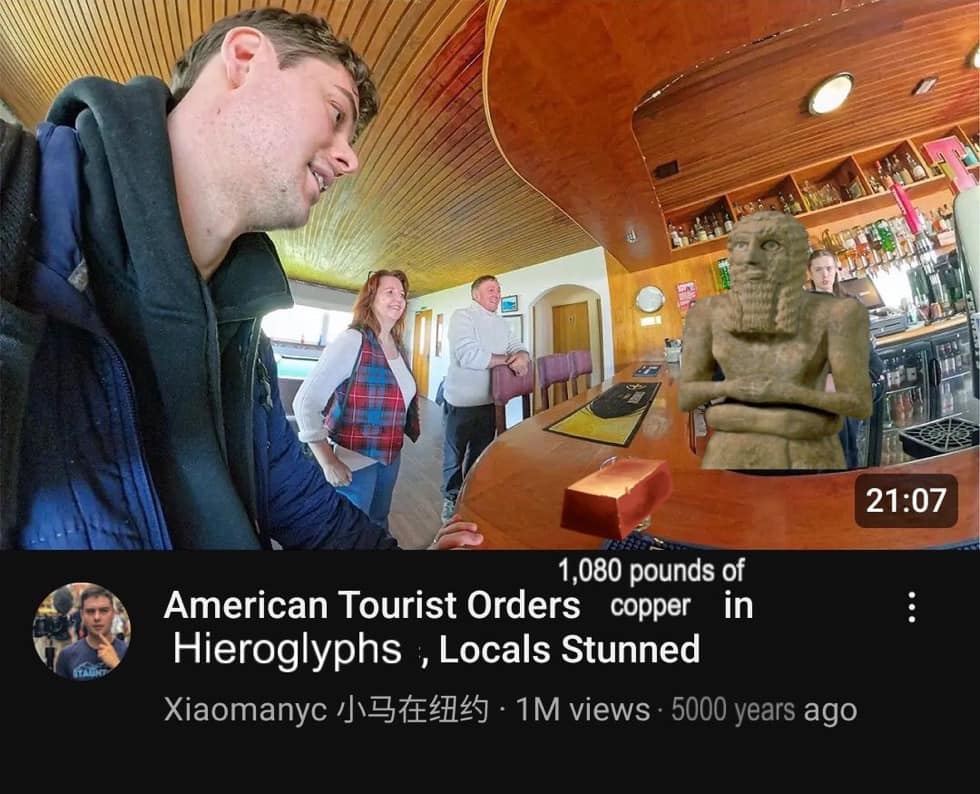
From a Queer - Post-Structuralist perspective, this image acts as a piece of ironic deconstruction, where the rigid meaning of the scene is broken down to create an absurdity. The nonsensical headline "American Tourist Orders copper in Hieroglyphs, Locals Stunned" creates a humorous disconnect between the mundane bar setting and the historical fantasy, playing with the reader's expectation much like queer theory playfully dismantles social norms. The humor relies on this self-aware disconnect, where the reality of a video is replaced by a nonsensical fantasy to mock the viewer's perception of what is possible.
simple-description (llama3.2-vision_11b)
The meme is a screenshot of a YouTube video with the title "1,080 pounds of American tourists trying to order in a Japanese restaurant" with a caption "1,080 pounds of American tourists trying to order in a Japanese restaurant" and a comment "1,080 pounds of American tourists trying to order in a Japanese restaurant". The image shows a group of tourists in a Japanese restaurant, with a waiter in the background, and a sign that says "1,080 pounds of American tourists trying to order in a Japanese restaurant". The meme is a humorous take on the stereotype of American tourists being clumsy and ignorant in foreign countries, with the title and caption referencing the absurdity of the situation.
detailed-analysis (gemma3-27b-vision)
Okay, let's break down this image/video thumbnail and its title through the lenses you've requested. It's important to note that we're interpreting a snapshot – a potentially curated moment, and a sensationalized title – so our analysis is speculative but grounded in theory.
1. Visual Description
The image is a screenshot from a YouTube video titled "American Tourist Orders 1,080 pounds of copper in Hieroglyphs; Locals Stunned". It shows the interior of what appears to be a bar or pub.
- Subject: A light-skinned man, presumably the "American tourist", is standing next to a large, intricately carved copper statue. He's gesturing with his hands and appears to be in conversation with a younger man in a red and white checkered shirt. The younger man appears to be shocked/stunned.
- Setting: The interior is warmly lit, with wooden paneling and a long bar stocked with bottles visible in the background. The décor suggests a relatively traditional establishment.
- Composition: The focus is on the man and the statue. The background is blurred. The sheer size of the statue compared to the people highlights its unusual nature. The timestamp in the bottom right corner (21:07) suggests this is from a longer video.
- Overall Impression: The image creates a sense of bewildered curiosity and potential cultural clash. The statue is clearly an unusual object to find in a bar setting, and the reactions of the locals suggest surprise and possibly amusement.
2. Foucauldian Genealogical Discourse Analysis
The title and image lend themselves to a Foucauldian reading. The concept of "hieroglyphs" functions as a discourse marker.
- Power/Knowledge: The act of commissioning such a statue (and specifically in hieroglyphs) asserts a particular type of power. It’s a power rooted in wealth, potentially exoticism, and a desire to imprint one’s own meaning onto a foreign cultural landscape. The tourist is enacting a power dynamic by imposing his will and resources onto a local context. The assumption that locals would be "stunned" suggests a perceived power imbalance.
- Genealogy of the "Tourist": A genealogical analysis would trace the historical development of the "tourist" figure. This involves understanding how the concept of travel, collecting, and displaying exotic objects have been constructed historically. The "tourist" in this image isn't just an individual; they are a product of specific historical and colonial power structures.
- Discursive Formation: The idea of "ordering" a statue in this manner is a specific discursive practice. It's not a natural way to interact with a culture, but rather a constructed set of rules and expectations.
3. Marxist Conflict Theory
The image can be interpreted through the lens of class conflict and the commodification of culture.
- Capital and Cultural Appropriation: The tourist’s act of commissioning the statue represents a display of capital. He has the financial means to purchase and customize a significant piece of art. There's a strong potential for cultural appropriation at play – taking elements from a different culture and using them for personal enrichment without understanding or respecting their original meaning.
- Commodification of Culture: The statue itself becomes a commodity – an object bought and sold in the capitalist marketplace. This process can strip the object of its cultural significance and reduce it to a mere status symbol.
- Economic Power Dynamics: The tourist’s wealth gives him the power to influence the local economy. The commissioning of the statue provides income for the artist and potentially others involved in its creation. However, this economic benefit may be outweighed by the cultural costs.
4. Postmodernism
Several elements of the image resonate with postmodern thought.
- Hyperreality: The very act of ordering a statue in hieroglyphs feels performative and self-conscious. It suggests a desire to create an image of authenticity that is ultimately artificial. This touches on the postmodern concept of hyperreality – a simulation of reality that becomes more real than reality itself.
- Pastiche and Irony: The combination of an American tourist, a traditional pub setting, and ancient Egyptian hieroglyphs is inherently ironic and creates a sense of pastiche – the mixing of different styles and eras without any unifying purpose.
- Deconstruction of Meaning: The title and image invite us to question the meaning of the statue and the tourist’s motivations. What does it mean to commission such a bizarre object? Is it art, a statement, or simply an act of conspicuous consumption?
5. Critical Theory
The image lends itself to a critical analysis of power, dominance, and cultural representation.
- Orientalism/Othering: The use of hieroglyphs, associated with ancient Egypt, evokes a sense of the “exotic” and “Other”. The tourist’s choice could be interpreted as a form of Orientalism, where the West constructs a romanticized and often distorted image of Eastern cultures.
- Hegemony The tourist's display of wealth and unusual purchase could be a way of demonstrating dominance and asserting a particular worldview. The locals' "stunned" reaction suggests a power imbalance and a challenge to their cultural norms.
- Representation: The image itself is a representation of a specific moment and cultural exchange. However, this representation is filtered through the lens of the videographer and edited for dramatic effect. It’s important to consider how this representation shapes our understanding of the situation.
Disclaimer: It is important to acknowledge that these interpretations are based on a single image and its title. Additional context from the full video would be necessary for a more comprehensive analysis.
simple-description (llama3.2-vision)
The meme is an image of a person sitting at a bar, looking at a statue of a man that has been Photoshopped to have a remarkably similar face to the bar patron. The text overlay reads "1,080 pounds of copper in hieroglyphs, locals stunned".
tesseract-ocr
\\\\ | =e Y/Y ————— A is - Sa @ Jz A Mae ve 2 ) a ae Ne ae er <i et ae aes s a} a Gi ae » p i RA Ue eee I y ib com bed , i“ } ty 7 i DD G7 ue ie r i ee | a L—— os \ a eh Ae ae PN » NE aE ~ . a a= = ~ 1,080 pounds of Ate Nile Col gia) ce (Lee ae 3 Some nal 1Cele Noa Sem Cees Xiaomanyce /)\37244 - 1M views - 5000 years ago