First Seen
2024-06-05T04:03:34.146012+00:00
simple-description (qwen3.5_2b-q8_0)
From a Queer - Post-Structuralism perspective, this meme deconstructs the binary oppositions of height and power. It plays with the idea that "power" is not inherent to a tall body, but rather a "fraction" that everyone needs just like a tiny stepladder to reach the sky. The meme subverts the expectation that humans (tall people) are dominant, suggesting that even the "tallest" are just a fraction of a larger whole, just as "Short people" are just a fraction of the goal itself.
For someone who cannot see it:
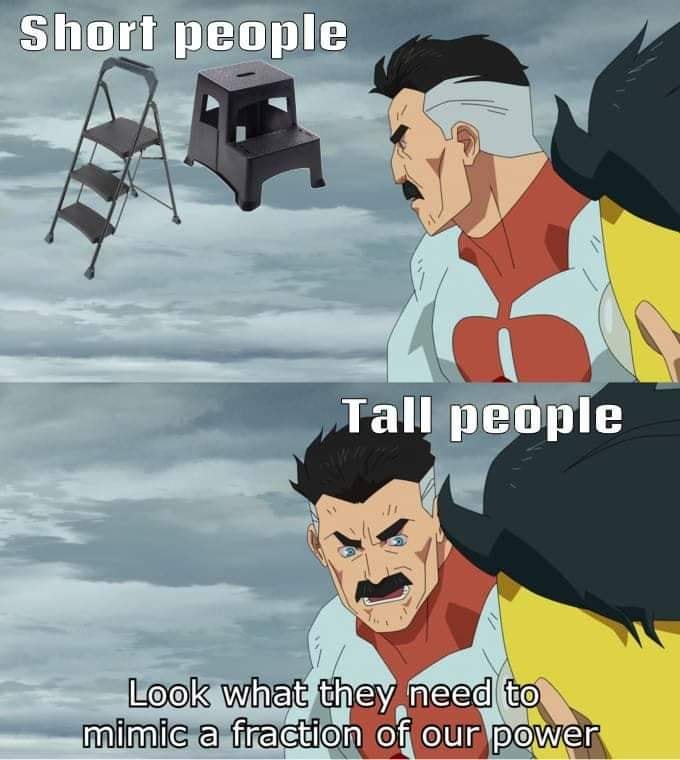
The image features a character (resembling Mr. Rogers) looking at a small stepladder. The top panel is labeled "Short people" and shows a tiny ladder and stool floating in the clouds. The bottom panel is labeled "Tall people" and shows the same small ladder and stool right next to the person. The caption reads: "Look what they need to mimic a fraction of our power." The joke implies that both people just need a tiny bit of "power" (like a tool or ladder) to achieve a goal, subverting the idea that humans have more "power" than the objects they are using.
simple-description (llama3.2-vision_11b)
This meme is an example of queer post-structuralism, a philosophical and literary movement that challenges traditional notions of identity and meaning. The meme subverts expectations by juxtaposing two seemingly unrelated concepts, "short people" and "tall people", to create a humorous and thought-provoking commentary on societal norms. The text "Look what they need to do to make us look good" is a wry commentary on the societal pressure to conform to certain physical standards.
detailed-analysis (gemma3-27b-vision)
Okay, let's break down this meme through various theoretical lenses.
Visual Description
The meme features a frame from the animated series Invincible. It presents two identical depictions of the superhero Omni-Man (a powerful alien being). Above, labeled "Short People" is Omni-Man with depictions of objects to help overcome a height difference: a ladder, a step stool, and a box. Below, labeled "Tall People" is the same Omni-Man looking down in an exaggerated expression of condescension. The text at the bottom reads "Look what they need to mimic a fraction of our power." The color palette is consistent and vibrant, typical of the animation style. The image relies on visual juxtaposition and exaggerated expressions to convey its message.
Foucauldian Genealogical Discourse Analysis
This meme is fascinating when viewed through a Foucauldian lens. It's not simply about height, but about how height becomes a marker of power and superiority through discourse.
- Discourse & Power/Knowledge: The meme participates in a discourse that constructs height as a natural, inherently superior trait. The visual and textual elements subtly reinforce this "truth." The meme doesn't argue for height-based power, it assumes it as a given, presenting it as self-evident. This is how power/knowledge operates – it shapes our understandings of the world to legitimize specific hierarchies.
- Genealogy: A genealogical analysis would trace how this discourse of height and power has emerged over time. We could look at historical contexts where physical stature was associated with authority (kings, warriors, etc.) and how these associations persist in contemporary culture (e.g., the assumption that taller people are more trustworthy or competent).
- Normalization: The meme normalizes the idea that height is a source of power. By presenting it as a playful observation, it obscures the ways in which this "truth" functions to marginalize those who are shorter.
Critical Theory
The meme can be analyzed using Critical Theory to explore how power dynamics are constructed and maintained.
- Hegemony: This meme is a subtle example of how dominant ideologies (in this case, the implicit assumption that tallness equals power) achieve hegemony. The meme isn’t a forceful demand; it’s a casual assertion that reinforces the idea. It propagates a subtle power imbalance by presenting it as natural and humorous.
- Ideology: The meme functions as a tiny ideological statement, promoting the notion that physical characteristics can translate into inherent social power. It normalizes a hierarchy based on something arbitrary.
- Power Relations: It highlights a power relation where height is positioned as a source of authority and control. The "need" for tools to compensate for height is presented as evidence of inferiority, solidifying the dominance of taller individuals.
Marxist Conflict Theory
While seemingly trivial, the meme can be viewed through a Marxist lens as a microcosm of broader class conflict.
- Social Stratification: The meme subtly establishes a social stratification based on height, positioning "tall people" as the dominant group and "short people" as the subordinate group. This mirrors the traditional Marxist analysis of class divisions.
- Means of Production: In this context, height itself becomes a form of capital – an inherent advantage that provides access to power and privilege. Short people are therefore "dispossessed" of this natural advantage.
- False Consciousness: The meme may contribute to a form of "false consciousness" among shorter individuals, leading them to internalize the idea that their height is a disadvantage and to accept the dominance of taller people.
Postmodernism
A postmodern reading would focus on the breakdown of grand narratives and the deconstruction of meaning.
- Playfulness & Irony: The meme’s humor relies on irony and the subversion of expectations. It acknowledges the absurdity of associating height with power, but simultaneously reinforces the idea.
- Hyperreality: The meme operates within a hyperreal context, where simulations and representations (like the meme itself) become more real than reality. The image does not reflect the complexities of social dynamics; it reduces everything to a simple, exaggerated contrast.
- Deconstruction: We could deconstruct the meme to reveal its underlying assumptions and power dynamics. By dismantling the apparent simplicity of the image, we can expose the ways in which it functions to maintain existing hierarchies.
Queer Feminist Intersectional Analysis
This is the most complex application, as the meme doesn’t explicitly address gender or sexuality. However, an intersectional approach can still illuminate its underlying dynamics.
- Hierarchy & Power: The meme contributes to the construction of social hierarchies based on arbitrary characteristics. The emphasis on height reinforces the idea that bodies are judged based on norms of size and stature, which can intersect with other forms of oppression.
- Body Politics: The meme engages with body politics by positioning certain bodies (tall ones) as inherently more powerful and desirable. This can contribute to the marginalization of bodies that do not conform to these norms.
- Invisibility and Marginalization: While height may not be a core issue in queer/feminist struggles, the meme mirrors broader patterns of marginalization and the ways in which certain bodies are made invisible or devalued in society.
Let me know if you'd like me to elaborate on any of these theoretical lenses!
simple-description (llama3.2-vision)
The meme is a humorous comparison between short people and tall people. It shows a short person trying to reach something high up, with a caption that reads "Short people" and a picture of a stool. The second panel shows a tall person effortlessly reaching the same height, with the caption "Tall people". The meme is poking fun at the idea that short people need to use stools or other tools to reach high places, while tall people have an advantage in this situation.
tesseract-ocr
ST ce, ~ * . a, Ca’ - = | ae ~ 1 gh 4 Le, \ nt fy | iy mimicrarinaction of our power