First Seen
2024-06-12T00:55:05.109919+00:00
simple-description (qwen3.5_2b-q8_0)
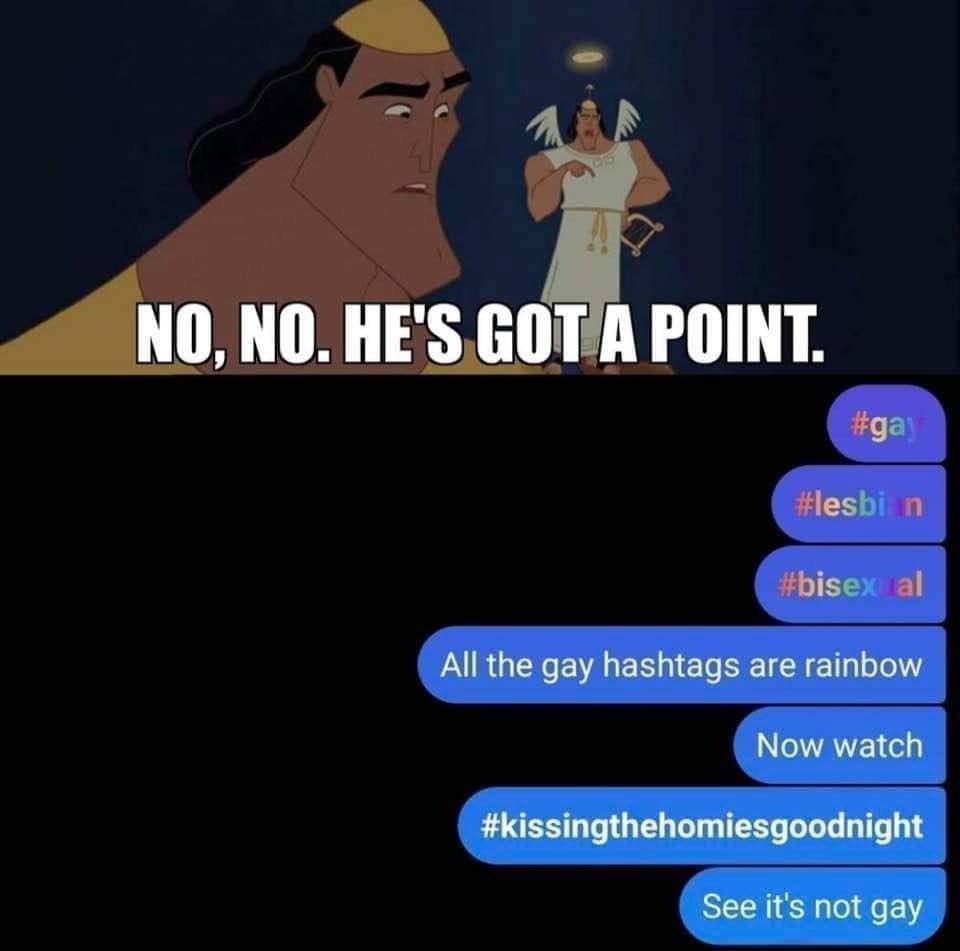
The meme uses the "No, no, no" format to make a satirical argument about movies and LGBTQ+ identity. The text mimics the Lion King scene where Scar explains why he didn't kill a lion, followed by the user's line "No, no. He's got a point," implying they agree with this perspective. The final line "See it's not gay" serves as a punchline, suggesting that the film is a generic romantic movie rather than specifically gay content.
simple-description (llama3.2-vision_11b)
The meme is a screenshot of a text conversation where a person is trying to explain the concept of post-structuralism to someone. The person is frustrated with the other person's lack of understanding and says "You're not even trying" in response to their question about what post-structuralism is. The image is captioned "When you try to explain post-structuralism to someone who's never read Foucault".
The image is a humorous take on the challenges of explaining complex ideas to people who are not familiar with them. The text conversation is a relatable example of how difficult it can be to explain abstract concepts to people who are not familiar with them.
detailed-analysis (gemma3-27b-vision)
Okay, here's an analysis of the image, broken down into relevant sections based on the provided theoretical frameworks. Note that some frameworks will be more applicable than others.
Visual Description
The image is a meme constructed from a screen capture of Disney's The Emperor's New Groove. It features Kuzco (the emperor) looking skeptical and somewhat exasperated. He's turned slightly away from a figure in the background who is rendered in a muted, ethereal white light (suggesting possibly a spiritual or angelic presence). The text overlay reads "NO, NO. HE’S GOT A POINT." Below this are a series of blue pill-shaped text bubbles resembling message notifications. These bubbles contain LGBTQ+ related hashtags (#gay, #lesbian, #bisexual) and phrases ("All the gay hashtags are rainbow," "Now watch," "#kissingthehomiesgoodnight," "See it's not gay"). The pills mimic the red-pill/blue-pill meme paradigm made famous in The Matrix, where choosing a pill offers an alternative perspective or “truth”.
Foucauldian Genealogical Discourse Analysis
This meme operates within the discourse of sexuality and the construction of “normal” and “deviant” behaviors. The meme subtly plays with the historical development of how we talk about homosexuality. Foucault would argue that the very categories of "gay," "lesbian," and "bisexual" are not natural givens, but are produced by discourses (medical, legal, religious, popular culture) over time.
The “pills” are crucial here. They represent alternative interpretations or “truths”. The meme subtly implies a skepticism towards established understandings of same-sex attraction or behavior. By presenting the hashtags as pills, the meme suggests that consuming these ideas—accepting these identities—is a deliberate choice that alters perception. The final line ("See it's not gay") is a critical point. It attempts to normalize something that may be considered outside the dominant heteronormative framework. The genealogy would examine how this attempt at normalization occurs, the power dynamics involved, and how the language itself is used to construct meaning. It’s important to note the ambiguity. Is it a sincere attempt to understand, or a form of subtle denial or erasure?
Queer Feminist Intersectional Analysis
This meme is ripe for a Queer Feminist Intersectional Analysis. The seemingly lighthearted presentation hides potentially problematic issues surrounding the construction of LGBTQ+ identities and the erasure of diverse experiences within those communities.
- Queer Theory: The meme engages with the idea that categories of sexuality are fluid and socially constructed. The presentation of hashtags as "pills" hints at the notion that identifying with these labels is a choice, which challenges the idea of innate sexual orientation.
- Feminist Analysis: The meme could be interpreted as a broader commentary on the pressures to conform to societal expectations, regardless of sexuality. The act of questioning or denying a label can be a way of asserting agency.
- Intersectionality: The meme's focus on sexual orientation overlooks other aspects of identity—race, class, gender, disability, etc.—that intersect with sexuality to create unique experiences of oppression and privilege. By presenting a single axis of identity (sexual orientation), the meme ignores the complex interplay of these forces.
- Erasure/Denial: The final statement, "See it's not gay," could be seen as a denial of LGBTQ+ experiences, potentially contributing to the erasure of queer lives.
Postmodernism
The meme exhibits characteristics of postmodern thought, specifically through its playful use of irony, parody, and intertextuality.
- Irony and Parody: The meme uses a Disney screen capture and combines it with online meme culture, creating a playful juxtaposition. The statement “He’s got a point” is ironic given the context.
- Deconstruction: It deconstructs conventional understandings of sexuality by presenting them in a fragmented, meme-ified format. It questions the "naturalness" of these labels and suggests that they are socially constructed.
- Meta-Narratives: It subtly critiques the "grand narratives" surrounding sexuality, such as the idea that there is a single, fixed definition of what it means to be gay, lesbian, or bisexual.
Important Note: The interpretation of this meme can be subjective. It's crucial to consider the broader context in which it is shared, as well as the intentions of the person sharing it. The analysis provided above is based on a critical reading of the image using the specified theoretical frameworks.
simple-description (llama3.2-vision)
This meme is a screenshot of a text conversation between two characters from the Disney movie "The Emperor's New Groove". The conversation starts with one character saying "No, no, no, no, no. He's got a point." The second character responds with a series of humorous and sarcastic tweets about the character's supposed "point". The tweets include phrases like "All the gay hashtags are rainbow" and "I can smell the desperation".
tesseract-ocr
aT TRL La) ‘oo Ea See Gag Cie Lote) aaa roe