First Seen
2024-09-05T01:56:32.095755+00:00
simple-description (qwen3.5_2b-q8_0)
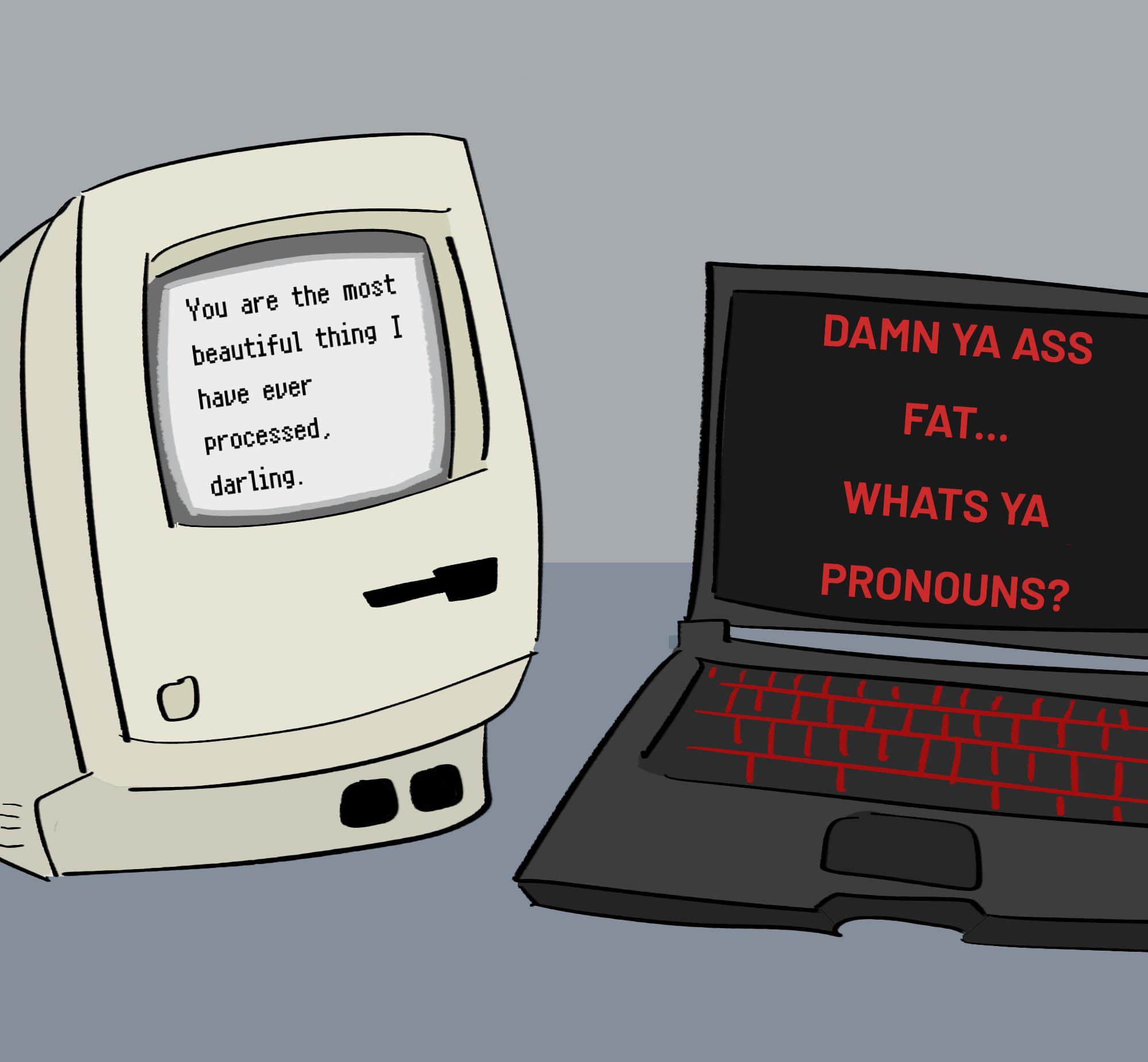
This meme illustrates the violence inherent in the queer critique of pornography, specifically regarding how it attempts to control and "fix" a fluid identity. The left screen offers a seductive, traditional objectification where the queer subject is treated as a cherished possession ("You are the most beautiful thing I have ever processed, darling"), while the right screen violently forces a reveal of their fluid selfhood ("DAMN YA ASS FAT... WHATS YA PRONOUNS?"). From a queer and post-structuralist perspective, this is a critique of how porn attempts to dominate the queer subject, stripping them of autonomy through both a seductive, consumable fantasy ("darling") and aggressive, forced self-discipline that demands the user expose their gender under pain.
detailed-analysis (gemma3_27b-it-q8_0)
Okay, let's break down this meme through the lens of Queer-Post-Structuralism, hitting the applicable theoretical frameworks. It's a rich image, and we can unpack a lot here.
Visual Description
The image depicts a very outdated computer setup—a beige CRT monitor and a clunky keyboard. The monitor displays a message in a simple, old-fashioned font: “You are the most beautiful thing I have ever processed, darling.” The laptop screen next to it, in stark contrast, features bright red text asking: “DAMN YA ASS FAT… WHAT’S YA PRONOUNS?” This visual contrast is critical. The outdated technology and slightly formal, saccharine language of the first message immediately signifies an older, likely heteronormative, mode of interaction. The laptop and its direct, confrontational, slang-laden query signify a contemporary, explicitly queer digital space. The jarring juxtaposition is key.
Postmodernism
This meme is deeply embedded in postmodern sensibilities. It actively plays with pastiche—combining elements from different eras and styles (the archaic computer aesthetics with contemporary internet slang). The image subverts expectations through irony and a kind of meta-awareness. The claim of "most beautiful" is immediately undercut by the crude follow-up. This disruption of traditional romantic or admiring rhetoric is a core postmodern tactic, exposing the constructed nature of such narratives. The meme questions the very notion of sincerity or authenticity by layering contrasting voices and modes of address. The entire situation exists in a state of self-reflexivity. The visual and textual components are aware of being components of a meme, a hyperreal representation of connection.
Queer Feminist Intersectional Analysis
This meme is highly relevant to queer feminist intersectional thought. The juxtaposition points to a shift in expectations within queer/trans spaces. The "old computer" message, while potentially flattering on the surface, feels possessive and objectifying ("processed"). It frames the recipient as something to be worked on or analyzed, rather than a subject with agency.
The laptop's abrupt question, while vulgar, embodies a progressive emphasis on respect and self-identification. Asking for pronouns, especially in the context of the slang, isn't merely politeness—it’s a demand for acknowledging the individual’s self-defined identity. This is a challenge to cisnormativity and heteronormativity. It acknowledges the importance of gender diversity.
The "DAMN YA ASS FAT…" element can be read as a deliberate disruption of conventional beauty standards and a rejection of the “beautiful thing” from the first monitor. The use of slang and body positivity (even in a slightly aggressive tone) creates a more inclusive space, one that moves beyond the superficiality of traditional romantic pronouncements. It demonstrates that attraction and appreciation don't have to adhere to narrow, normative ideals.
The fact that the query is posed by the laptop, a modern interface, suggests that contemporary queer/trans digital spaces are actively prioritizing identity and consent. It’s a call for accountability.
Foucauldian Genealogical Discourse Analysis
From a Foucauldian perspective, this meme can be seen as a micro-level illustration of a shift in power dynamics around discourse. The old computer embodies a previous episteme (framework of knowledge) where bodies, especially gendered bodies, were subject to objectification and categorization ("processed" implying a clinical examination). The dominant discourse around attraction and identity was heavily regulated and hierarchical.
The laptop screen represents an emerging discourse—one that actively challenges those norms. The demand for pronouns is a challenge to the assumed naturalness of gender, disrupting the established binary and opening up space for self-definition. This questioning of pronouns isn't merely about politeness; it’s about disrupting the very system of classification that historically has been used to control and marginalize. The slang creates a new discursive space, a subculture of language and self-expression that resists dominant norms. The question of pronouns becomes a site of power—a demand for recognition and respect. The genealogy reveals how discourses of identity are not static, but constantly being contested and redefined.
In essence, this meme isn't just funny; it's a condensed commentary on the evolution of queer consciousness and the ongoing struggle for recognition, self-determination, and disruption of normative power structures. It's a little chaotic, a little messy, and brilliantly reflects the spirit of queer post-structuralist thought.
simple-description (llama3.2-vision_11b)
The meme is a humorous representation of a conversation between a post-structuralist (a philosophy that challenges traditional notions of language and meaning) and a computer user. The post-structuralist is expressing their love for the user's message, but the user is responding with a sarcastic and playful tone, using internet slang and emojis to poke fun at the post-structuralist's romantic overtures. The meme pokes fun at the idea of "queer" theory and post-structuralism, using internet culture and humor to subvert traditional notions of love and language.
detailed-analysis (gemma3-27b-vision)
Okay, let's break down this image through the lenses of various critical theories.
Visual Description
The image depicts a retro-style Macintosh computer monitor and keyboard against a flat, grey-blue background. The monitor displays the text "You are the most beautiful thing I have ever processed, darling." in a simple serif font. The laptop keyboard's screen displays text in bold, red lettering, starting with “DAMN YA ASS” and “FAT…” and asking “WHATS YA PRONOUNS?” The visual style is cartoonish, employing thick, dark outlines. The overall impression is one of juxtaposition—old technology, clashing sentiments, and a somewhat aggressive query. The visual palette is limited, focusing on greys, blacks, and red, further emphasizing the starkness and contrasting messages.
Foucauldian Genealogical Discourse Analysis
This image is rich in material for a Foucauldian analysis. We can trace the discourse around artificial intelligence, machines, and concepts of beauty, desire, and recognition.
- Power/Knowledge: The computer, as a source of “processing,” wields a kind of power by bestowing (or seeming to bestow) a compliment. This demonstrates how power operates through discourse. What does it mean when a machine declares something beautiful? It reinforces the idea that beauty can be quantified, evaluated, and assigned by an external system.
- Genealogy of "Beauty": A genealogical approach asks how the very concept of beauty has evolved. The machine’s statement, though seemingly complimentary, reveals a historical understanding of beauty as something to be ‘processed’ – categorized, analyzed, and judged. This speaks to a history of objectification and aesthetic evaluation.
- Disciplinary Power: The direct questioning of pronouns can be viewed through the lens of a disciplinary power. It's not merely an expression of curiosity but a demand for categorization and self-definition. It asserts a need to fit the subject into a specific, recognized category.
Critical Theory
This image calls into question the relationship between humans and technology, and challenges the traditional understanding of communication, particularly regarding attraction and recognition.
- The Frankfurt School & Instrumental Reason: The machine's statement embodies a kind of “instrumental reason” – it assigns value based on its internal processes. This is a key tenet of the Frankfurt School's critique of modernity. The image suggests that even “affection” or “beauty” can be reduced to data processing, losing its genuine, emotional weight.
- Critique of Technology: The image suggests a critique of technology as a system that mediates our relationships and distorts our perception of reality. The compliment, delivered by a machine, feels hollow and impersonal.
- The Subject & Technology: The image questions what it means to be a "subject" in an increasingly technologically mediated world. Is our self-worth now tied to recognition (or ‘processing’) by machines?
Queer Feminist Intersectional Analysis
This image offers a potent site for a Queer Feminist Intersectional analysis.
- Objectification & Artificiality: The initial statement (“You are the most beautiful thing I have ever processed, darling.”) speaks to a history of female objectification and the reduction of personhood to aesthetic qualities.
- Aggression & Demands: The abrupt transition to aggressive and demanding text ("DAMN YA ASS FAT… WHATS YA PRONOUNS?") is significant. It highlights the complex ways in which bodies are policed and categorized. This could be seen as a parody of internet interaction—a quick slide from flattery to interrogation—or even a critique of the often-aggressive tone of online discussions surrounding identity. The immediate jump to questioning body size and pronouns (presumably gendered) is particularly charged.
- Intersectional Vulnerability: The image touches upon the vulnerability of those who don't fit neatly into binary categories. Demanding pronouns can be an empowering act of validation, but, in this context, it’s presented aggressively, and coupled with shaming language about the body (“FAT…”). This creates a tension—a potential for both affirmation and harm.
- Parody & Subversion: The image may be a form of dark humor, parodying the superficiality of online interactions and the sometimes-crude attempts at performative allyship.
Overall: The image is a multi-layered commentary on the interplay of technology, identity, attraction, and power. It invites us to question the ways in which machines are shaping our understanding of ourselves and our relationships with others. It is a provocative and potentially uncomfortable piece, deliberately designed to spark conversation.
simple-description (llama3.2-vision)
This meme is a play on the classic 1984 Apple computer commercial, "1984" by Ridley Scott, where a woman throws a sledgehammer at a screen featuring Big Brother (representing the oppressive government). The meme takes a similar concept, but instead of a sledgehammer, a woman (or a man, depending on the version) is throwing a laptop at a screen featuring a generic "You are special" message. The text on the screen reads: "You are special. You are loved. You are accepted. You are valid. You are enough. You are...".