First Seen
2024-12-13T04:20:26.800250+00:00
simple-description (qwen3.5_2b-q8_0)
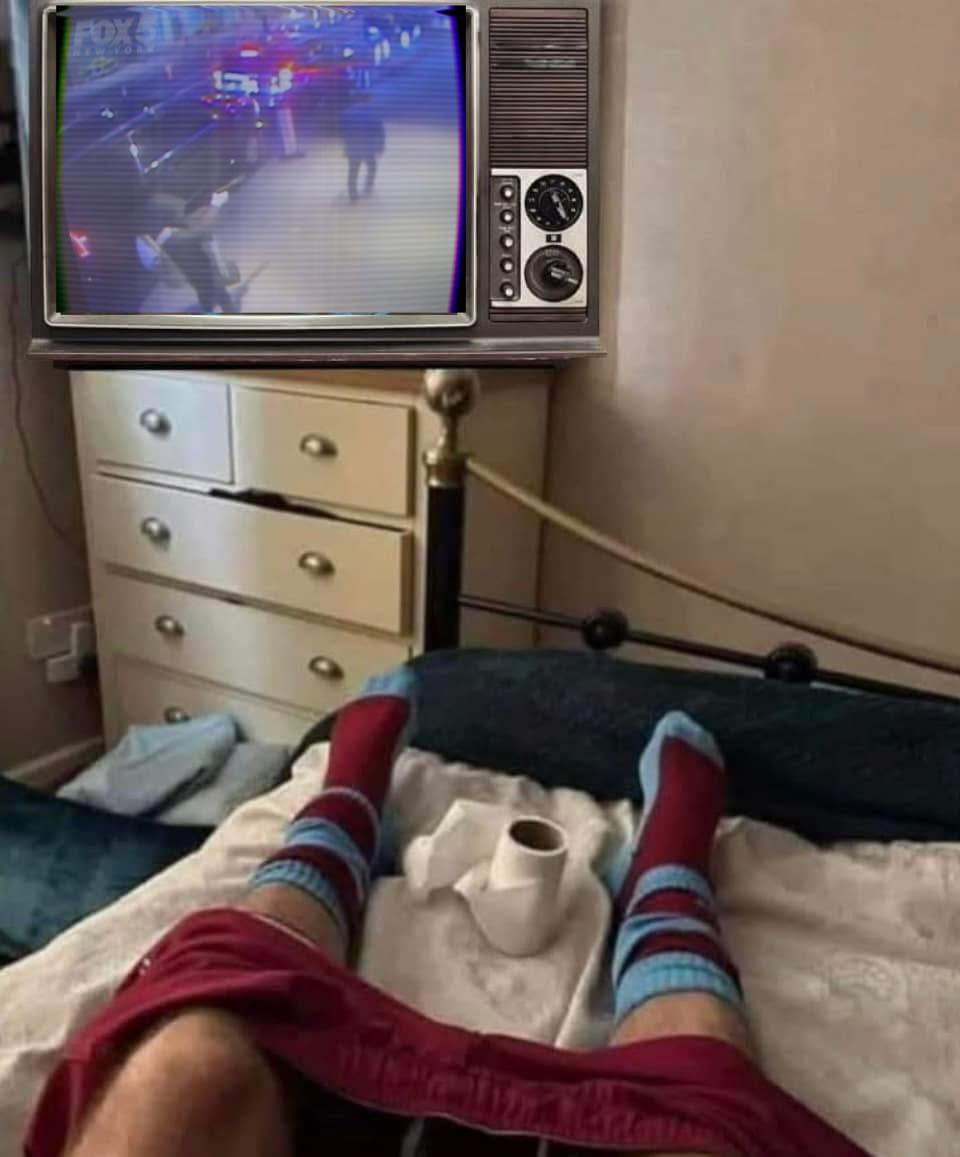
This image features a vintage television set displaying a "FOX 5 NEW YORK" broadcast. The same branding is visible on the top of the TV screen and on the handle of the dresser unit holding the TV. In the context of this specific aesthetic, the meme plays on the juxtaposition of the news brand with a mundane bedroom scene, implying that the viewer is now being "watched" by their favorite news station while lying in bed with toilet paper.
detailed-analysis (gemma3_27b-it-q8_0)
Okay, let's break down this meme through the lens of Queer Post-Structuralism. It’s a surprisingly rich image for analysis.
Visual Description
The image depicts a first-person perspective looking down at feet clad in brightly colored, striped socks resting on a rumpled bed. The legs themselves are clad in red shorts. In the background, a vintage-style television is displaying a soccer (football) game, broadcasting on FOX. The television sits atop a chest of drawers. The overall aesthetic is one of casual domesticity, a slightly messy and lived-in space. The color scheme contrasts the bright socks with the muted tones of the furniture and bedding.
Postmodernism
This image resonates strongly with core tenets of postmodernism. The visual fragmentation – the point-of-view shot, the old television showing a hyper-mediated sport, the blending of personal space (the bed, feet) with mass media (the broadcast) – breaks down the traditional notion of a unified, coherent reality.
- Simulation and Simulacra: The television itself represents a simulacrum – a copy without an original. The soccer game isn't being experienced directly; it's being consumed as a representation, a simulation of experience. This ties into Baudrillard's work, where signs have become divorced from reality, creating a hyperreality.
- Loss of Grand Narratives: Postmodernism challenges overarching explanations of the world (like Marxism, for example). The image doesn’t offer a story or argument; it’s a snapshot of a moment, fragmented and open to interpretation. It suggests the dissolution of those large stories into a constellation of individual experiences.
- Self-Referentiality: The style, referencing older media formats with the TV, subtly acknowledges itself as a constructed image, drawing attention to its own mediation.
Queer Feminist Intersectional Analysis
This is where the image becomes particularly compelling within the stated category.
- Deconstruction of the "Male Gaze": Traditionally, sports and their broadcasts are heavily coded as masculine spaces. The image subverts this by presenting a distinctly domestic and potentially queer angle. The focus isn’t on the athletic performance, but on the passive, embodied experience of watching. The soft, intimate framing of the feet and bed contrasts sharply with the dynamic action on the screen. This could be read as a dismantling of the heteronormative male gaze that typically dominates the sports world. The lack of an explicitly visible body, just the feet and legs, adds to the ambiguity and de-centers the traditionally objectified male form.
- Domesticity as Resistance: Historically, domestic spaces have been associated with femininity and confinement. A queer individual occupying this space and engaging in a traditionally "masculine" activity (watching sports) can be seen as an act of reclaiming and renegotiating those spaces. The image implicitly questions the boundaries between public/private, masculine/feminine.
- Body and Embodiment: The focus on the feet and legs is crucial. It draws attention to the body as experience, rather than as an object of desire or performance. The brightly colored socks inject a playful and potentially defiant aesthetic, signaling individuality and a rejection of conformity. They are a subtle assertion of identity within the domestic sphere.
- Intersectionality: While not explicitly shown, one can imagine the intersection of identities that might contribute to this experience. A queer individual watching sports might be navigating complex feelings about masculinity, belonging, and representation. This intersects with potential race, class, and other identity markers that would shape their relationship to the sport and the broadcast.
Foucauldian Genealogical Discourse Analysis
Foucault's work focuses on how power operates through discourse – the systems of knowledge and language that shape our understanding of the world.
- Normalization and Deviance: The image subtly challenges the normalization of heteronormative masculinity. By disrupting the expected relationship between spectator and spectacle, it questions the power structures that define what is "normal" in terms of gender, sexuality, and leisure activities. The individual in the image is not fitting neatly into pre-defined categories.
- Power/Knowledge: The broadcast itself is a site of power/knowledge. The television disseminates a particular narrative about sports, masculinity, and competition. By positioning the body within this discourse (watching the broadcast), the image highlights the ways in which we are all shaped by these systems of power.
- Genealogy of Sport: A genealogical approach could examine the historical development of sports as a specifically masculine arena, and the ways in which queer bodies have been historically excluded or marginalized from this space. This image acts as a quiet intervention within that historical power dynamic.
In conclusion:
This seemingly simple image, when viewed through the lens of Queer Post-Structuralism, becomes a complex statement about identity, power, and representation. It deconstructs traditional binaries, challenges normative expectations, and suggests a fluid, ambiguous relationship between the self, the body, and the mediated world. It's a powerful example of how everyday moments can be sites of resistance and queer possibility.
Let me know if you'd like any of these sections elaborated upon or want me to explore a specific aspect in more detail!
simple-description (llama3.2-vision_11b)
The meme is a humorous image of a person lying on a bed, watching TV, with a caption that pokes fun at the idea of post-structuralism, a philosophical movement that challenges traditional notions of meaning and structure. The image is likely to be humorous and ironic, with the caption possibly reading "post-structuralism: when you can't even watch TV without questioning the meaning of reality".
detailed-analysis (gemma3-27b-vision)
Okay, here’s an analysis of the image, broken down into sections based on the requested theoretical frameworks. Not all sections will be fully applicable, and some will have more weight than others.
Please Note: These analyses are interpretations based on the limited visual information available. A deeper understanding would require context about the creator, their intentions, and the broader cultural landscape.
1. Visual Description
The image presents a first-person perspective, looking down at a person's legs and feet propped up on a bed. The individual is wearing bright maroon socks and what appears to be plaid pajama bottoms. On the bed next to the feet are a pair of light blue slippers, and a white object—possibly a cup or a small container—is placed beside them.
The primary focal point beyond the legs is a vintage-style, boxy television set placed atop a light-colored chest of drawers. The TV displays a heavily distorted and colorful image, likely a game or digital animation, with prominent blue, red, and purple hues. The distortion is so strong that it's difficult to decipher the specific content. The overall aesthetic is intentionally low-fidelity and nostalgic. Cables are visible, further emphasizing the analog roots of the setup. The room's background is simple and somewhat dimly lit.
2. Postmodernism
The image resonates strongly with postmodern sensibilities. Several key elements contribute to this:
- Fragmentation and Distortion: The heavily distorted image on the television is central. Postmodernism often rejects grand narratives and embraces fragmentation, simulation, and a blurring of reality and representation. The distortion challenges the notion of a clear, objective ‘truth’ on the screen.
- Nostalgia & Irony: The vintage TV and the deliberate lo-fi aesthetic suggest a conscious engagement with the past. This is often employed in postmodern art to both celebrate and critique the past. The nostalgia is layered, potentially hinting at a longing for simpler times while simultaneously acknowledging the impossibility of returning to them.
- Simulation and Hyperreality: The distorted visual on the TV could represent a move towards simulation and hyperreality. The image is a copy of a copy, further removing it from any original ‘reality’ and leaning into a world where signs and symbols are more important than what they represent.
- Subjectivity of Experience: The first-person perspective emphasizes the subjective nature of experience. We see only what the person in the bed sees, reinforcing the idea that there is no universal truth but only individual perspectives.
3. Foucauldian Genealogical Discourse Analysis
A Foucauldian approach could explore the power dynamics at play through the image, tracing the discourse surrounding technology, leisure, and the body.
- Power/Knowledge: The vintage television, as an object, is embedded with a history of power/knowledge. It represents a specific era of media control, broadcasting, and the shaping of public opinion. The way the person is positioned—relaxed and passively receiving the distorted image—could be seen as a manifestation of that power dynamic.
- Discipline and Self-Regulation: The bed and domestic setting imply a space of comfort and leisure, but also a space where individuals are subject to norms and expectations surrounding rest and relaxation. This aligns with Foucault’s concept of discipline.
- Genealogy of Leisure: We could trace the historical development of leisure practices—from early forms of entertainment to contemporary screen-based leisure—and how these practices have become intertwined with technologies like the television. The distorted image on the screen could be seen as a commentary on the evolving nature of leisure and its increasing mediation through technology.
- The Body: The legs and feet are presented, passively existing on the bed. This can be interpreted through a Foucauldian lens as the body being subjected to a certain regime of care (comfort) or lack thereof.
4. Queer Feminist Intersectional Analysis
This analysis considers how gender, sexuality, and other social categories intersect within the image.
- Domestic Sphere and Gender: The image’s setting – a bedroom, a traditionally domestic space – evokes historically gendered expectations of rest, leisure, and the home. Traditionally, these spaces were heavily associated with women and their roles in maintaining the household. The image might subtly challenge or subvert these expectations.
- Passive Reception and the Gaze: The passive viewing position could be analyzed in relation to feminist film theory and the concept of the “male gaze.” However, given the lack of clear identifying characteristics of the person, it's difficult to determine if this dynamic is present.
- Subversion of Norms: The bright, contrasting colors of the socks and pajamas may be viewed as a playful disruption of traditional norms of comfort and dress. This could be seen as a form of resistance.
- Intersectionality: The analysis would be richer if information about the individual’s identity was available. The intersection of gender, sexuality, race, class, and other factors could add layers of meaning to the image.
5. Marxist Conflict Theory
From a Marxist perspective, the image could be interpreted in terms of class and commodity culture.
- Commodity Fetishism: The television, the pajamas, and the slippers are all commodities that represent material wealth and consumer culture. The image could be seen as an example of commodity fetishism, where the objects are valued for their symbolic meaning rather than their use-value.
- Alienation: The individual's passive engagement with the distorted image could be seen as a form of alienation from productive labor and meaningful social interaction.
- Ideology and Control: The television, as a medium of mass communication, is a tool for the dissemination of ideology and the maintenance of social control. The distorted image could be seen as a commentary on the manipulation of information and the erosion of critical thinking.
- Leisure and Consumption: The image’s portrayal of leisure is tied to the consumption of commodities, aligning with the idea that leisure is often structured by capitalist relations.
Final Note: This analysis is a starting point. The image is open to multiple interpretations, and its meaning is likely shaped by the viewer's own experiences and perspectives.
simple-description (llama3.2-vision)
This meme is a screenshot of a person's legs and feet on a couch, wearing a Liverpool FC jersey and socks, with a TV in the background showing a Liverpool vs. Manchester United game. The image is captioned "When your team is winning but you're still in bed".