First Seen
2025-06-03T19:16:24.731485+00:00
simple-description (qwen3.5_2b-q8_0)
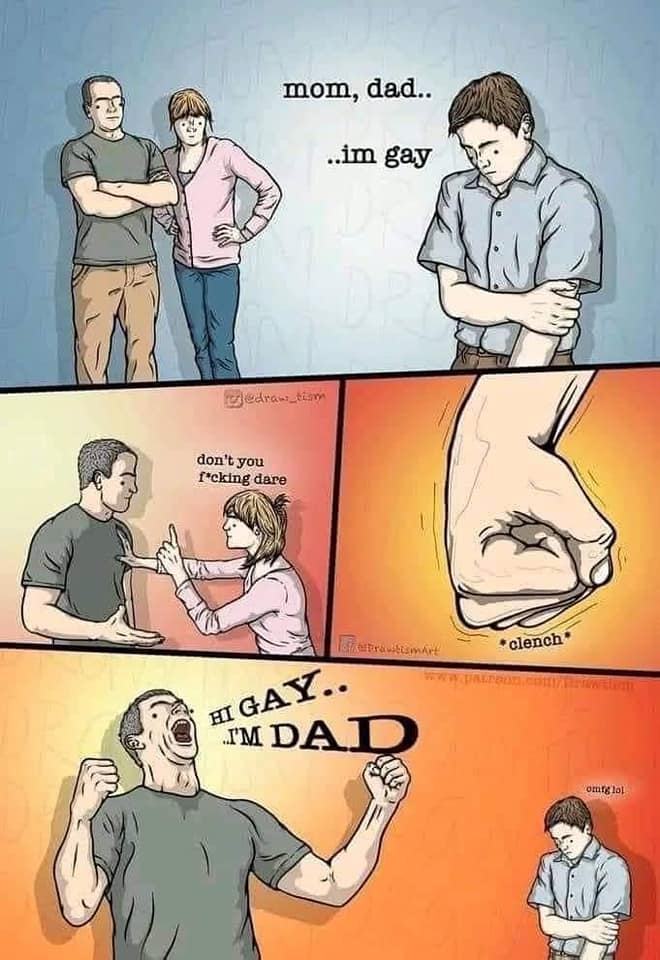
- This meme uses queer post-structuralist concepts to deconstruct the traditional nuclear family, specifically challenging the heteronormative expectation that parents should act as a barrier to the "other."
- By revealing that the son shouts "Mom, dad.. ..im gay," the text "HI GAY.. ..I'M DAD" (on the Dad) and "don't you f*cking dare" (on the Dad) reveal the father's response to the son.
- This dynamic transforms the father from an enforcer of exclusion into a "claimant" of the "homoerotic" desire, thereby breaking the strict binary opposition within the family structure.
detailed-analysis (gemma3_27b-it-q8_0)
Okay, let's break down this meme through the lens of Queer Post-Structuralism. This is a layered meme, so we'll need to unpack it carefully.
Please note: Queer Post-Structuralism is a dense theoretical framework. This breakdown will aim to be comprehensive but is still a simplification of complex ideas. Also, this meme is reliant on humour, and much of the meaning is derived from the unexpected twist.
Visual Description
The meme is formatted in a four-panel comic style, with a final small panel.
- Panel 1: A young man (presumably a son) stands tentatively before his parents, looking down.
- Panel 2: He speaks: “Mom, Dad… I’m gay.” He is depicted with a vulnerable posture.
- Panel 3: The mother aggressively denies his statement, saying “Don't you f***ing dare!” and reaches out towards him. A zoomed-in panel shows the father's foot forcefully clenching into the floor. The word “clench” is highlighted in italics.
- Panel 4: The father dramatically announces, "I'm gay. I'm Dad." with a triumphant pose, fist pumping.
- Small panel: The son, in the background, is once again in a vulnerable posture.
The visual progression moves from a conventional "coming out" scene to an utterly unexpected and subverted reveal. The focus on the father’s clenched foot is a darkly comedic detail.
Foucauldian Genealogical Discourse Analysis
Michel Foucault’s ideas are central to a Queer Post-Structuralist reading. We can analyze this meme by looking at how power operates through discourse.
- The Discourse of Heteronormativity: The first two panels set up the traditional power dynamic embedded within the discourse of heteronormativity. This discourse assumes heterosexuality as the default and places pressure on individuals to conform. The son's “coming out” is an act of resistance, but one that anticipates potential censure and control.
- Genealogy of ‘Dad’: The meme destabilizes the established understanding of the paternal figure. “Dad” is normally associated with power, authority, and the upholding of heteronormative values. By revealing the father is gay, the meme disrupts the assumed stability of this role. Foucault's genealogical approach traces the historical construction of "Dad," showing that it isn’t a fixed, natural category, but a product of social and power relations.
- Power/Knowledge: The meme plays with the relationship between power and knowledge. The father’s revelation isn't just a personal truth, but a challenge to the knowledge systems that define and categorize individuals. He upends the expectation that knowledge of one's sexuality automatically reveals one's role in the traditional family structure. His statement is an assertion of self, but it also exposes the arbitrary nature of those categorizations.
- Panopticism: The father's action, his "clenching", could be understood as a manifestation of internalized surveillance – the sense that one is always being watched and judged, a concept from Foucault's analysis of the Panopticon.
Postmodernism
This meme is intensely postmodern.
- Deconstruction: The meme actively deconstructs the traditional coming-out narrative. It takes a recognizable trope (son reveals homosexuality to parents) and dismantles it through absurdity. It highlights the constructed nature of identity and the instability of meaning.
- Irony & Parody: The humour of the meme relies on stark irony and parody. It mocks the seriousness often associated with coming-out stories by introducing an utterly illogical and over-the-top response.
- Meta-narratives: The meme rejects grand narratives (like the inevitable journey towards self-acceptance or the importance of traditional family structures). It offers no resolution, no moral lesson, only a disruption of expectations.
- Simulacra & Simulation: The meme's humour arises from a kind of "hyperreality". The father’s over-the-top announcement feels divorced from any authentic experience, becoming a simulacrum of a confession. It’s a copy of a copy, removed from any original truth.
Queer Feminist Intersectional Analysis
While not explicitly focused on gender, a Queer Feminist Intersectional reading is relevant.
- Challenging Compulsory Heterosexuality: The meme directly challenges the notion of compulsory heterosexuality—the idea that heterosexuality is assumed and enforced as the norm. The father's revelation reasserts that sexualities are diverse and can exist outside of societal expectations.
- Destabilizing Gender Roles: Though the focus is on sexuality, the meme also briefly destabilizes traditional gender roles associated with the "Dad" figure. The father’s exuberant announcement is a performance of a queer identity that rejects conventional masculinity.
- Intersectionality (Subtly): The meme's humour comes partly from the unexpected subversion of power dynamics. This subtly hints at the intersection of identity categories (sexuality, gender, family role) and how they can be simultaneously oppressive and liberating.
In conclusion:
This meme operates on multiple levels. Through a Queer Post-Structuralist lens, it’s a powerful and darkly funny commentary on the construction of identity, the operation of power, and the limitations of language. It exposes the artificiality of social norms and offers a subversive moment of liberation through absurdity. The humour lies in the sheer unexpectedness of the father’s revelation, but its lasting impact comes from its ability to unsettle deeply ingrained assumptions about sexuality, gender, and family.
simple-description (llama3.2-vision_11b)
The meme is a humorous take on the "I'm gay" joke, where a person's parents are shocked by their child's revelation, but the child responds with a playful "I'm gay" joke, implying that their parents are also gay. The meme is a commentary on the absurdity of societal norms and the expectation of conformity. The text "I'm gay" is used to subvert the expectation of a traditional "I'm gay" joke, and the meme is a playful way to poke fun at the idea of being gay.
detailed-analysis (gemma3-27b-vision)
Okay, let's break down this rather pointed and darkly humorous image through the lenses you've requested. It’s important to note this is an interpretation – these theoretical frameworks are complex, and applying them always involves a degree of subjective reading.
Visual Description
The image is a four-panel comic strip presented in a simplistic, graphic style reminiscent of webcomics. The panels depict a son coming out to his parents, but with increasingly absurd and escalating parental reactions.
- Panel 1: The son, standing between his mother and father, appears nervous and states, "mom, dad… I'm gay."
- Panel 2: Focuses on the mother and father. The father points at the mother and exclaims, “Don’t you f*cking dare.”
- Panel 3: A close-up on the father's clenched fist and the bottom of the mother's shoe, seemingly ready to strike. The word "clench" is added to the panel.
- Panel 4: The father dramatically shouts, "I'M GAY... I'M DAD!" while striking a triumphant pose, and the son stands dejectedly in the background, labeled "omg lol".
The visual style is flat, minimal, and deliberately unemotional, contrasting sharply with the violent and absurd events it depicts. The lettering is bold and emphasizes the key phrases.
Foucauldian Genealogical Discourse Analysis
This image invites a Foucauldian analysis centered on the discourse surrounding sexuality and parental authority.
- Power/Knowledge: The initial panel sets up a power dynamic where the son’s "coming out" is presented as a declaration needing parental approval or, as the comic quickly reveals, rejection. The power lies with the parents to define and control the narrative around their child's identity. The father then attempts to redefine and seize control over the discussion to "claim" the label of 'gay' as his own and assert his "dad" identity.
- Discipline and Normalization: The threat of violence in panel 3 (even if humorous) represents a disciplinary mechanism—a way to enforce societal norms and expectations around family structure and sexuality. The implication is that non-normative expressions (like homosexuality) are seen as disruptive and needing to be "corrected." The violent reaction suggests a desire to normalize the son, pushing him back into a heteronormative framework.
- Genealogy of Sexuality: The image implicitly mocks the historical construction of sexuality as something to be controlled, defined, and contained within the nuclear family. The father’s appropriation of the “gay” label disrupts the assumed order. By taking the label for himself, he attempts to defuse the son’s announcement and reassert his dominance in the narrative.
Critical Theory
Applying a Critical Theory lens, this image is a sharp critique of the patriarchal family structure and its role in perpetuating heteronormative ideals.
- Ideology: The comic highlights the ideology of the “traditional” family, where parents have the authority to dictate their children’s lives and enforce conformity. The father's reaction suggests that the son’s sexuality is perceived as a threat to this established order.
- Domination & Oppression: The parental violence (even in a comedic form) illustrates the potential for domination within family dynamics. The son is subjected to emotional (and implied physical) pressure to conform.
- False Consciousness: The father’s final shout could be seen as a manifestation of “false consciousness”—a situation where the dominant group (in this case, the patriarchal father) is unaware of or actively denies the systemic oppression that exists. His claim to being “gay” is a clumsy attempt to control the narrative and avoid acknowledging his son’s authentic identity.
Queer Feminist Intersectional Analysis
This image provides fertile ground for a Queer Feminist Intersectional analysis, focusing on how different forms of oppression intersect.
- Heteronormativity & Compulsory Heterosexuality: The comic vividly illustrates the pressure to conform to heteronormative expectations. The father's violent reaction suggests that homosexuality is seen as a deviation from the “natural” order, and the son is expected to adhere to conventional roles.
- Patriarchy & Masculinity: The father’s response is deeply rooted in patriarchal constructions of masculinity—the need to maintain control, assert dominance, and protect the family “honor.” He weaponizes his role as "dad" to suppress the son's identity.
- Intersectionality: While the primary focus is on sexuality, the image also speaks to the power dynamics within the family. The mother, though present, is largely silent and appears to support the father’s aggression, hinting at the ways in which gender roles can reinforce oppressive systems.
Important Note: This image is intentionally provocative and relies heavily on dark humor. Analyzing it through these theoretical frameworks isn't about condoning violence or dismissing the pain of coming out. It's about examining the underlying power dynamics, ideological forces, and social norms that contribute to the experiences of LGBTQ+ individuals.
simple-description (llama3.2-vision)
This meme is a humorous take on a common phrase. It shows a family situation where a son is caught by his parents, and he responds with a unexpected and ironic phrase, "I don't have gay parents, I'm gay." The text "mom, dad... I'm gay" is followed by a punchline, "In 2-3 sentences, describe this meme for someone who cannot see it. Include any text that appears in the image."