First Seen
2025-06-24T06:11:11.537158+00:00
simple-description (qwen3.5_2b-q8_0)
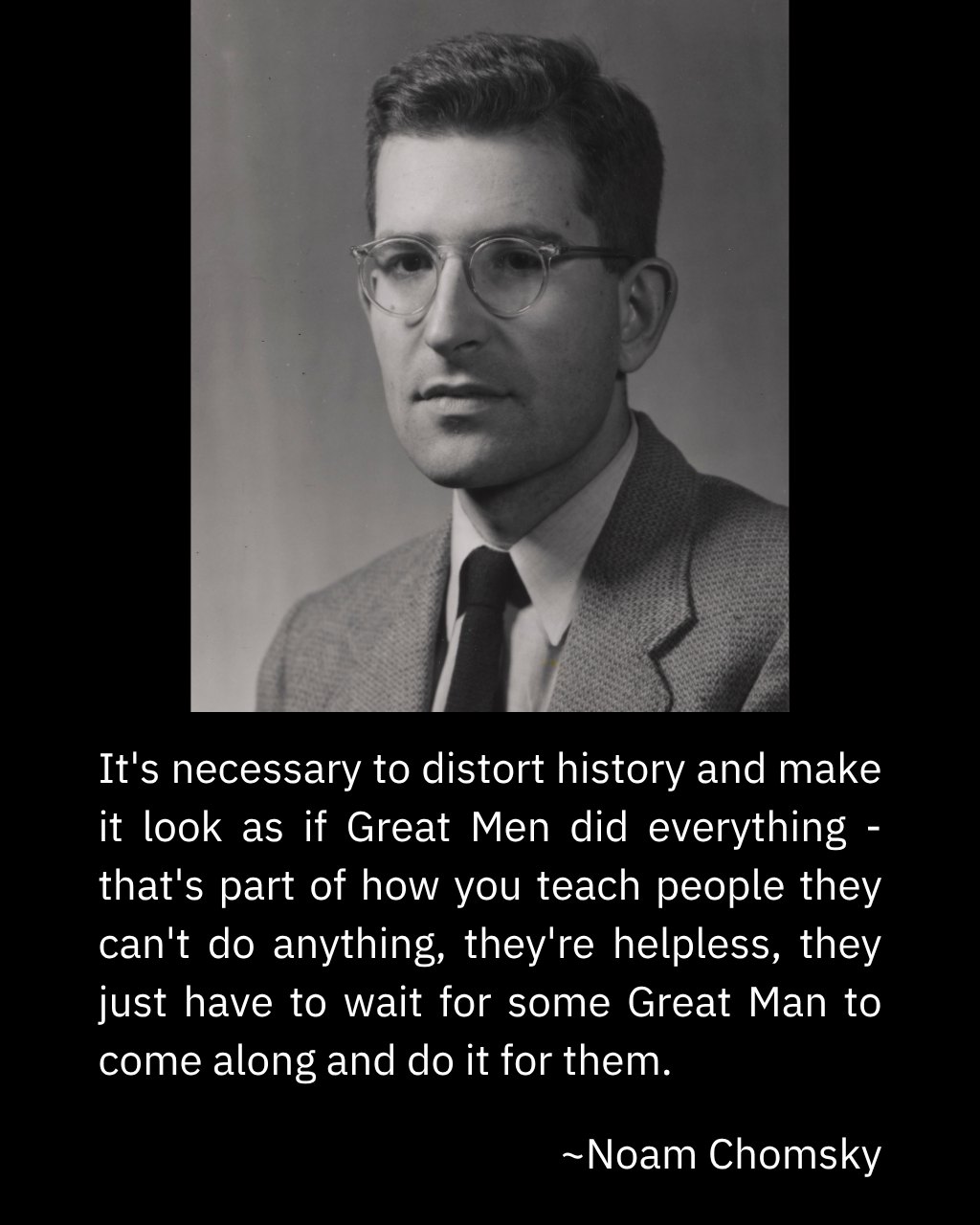
The image features inverted-color imagery against a stark black background, displaying white text that includes the name and signature of philosopher Noam Chomsky in the bottom right corner. The text contains a critical argument regarding "Great Man Theory," which posits that the only way to understand history is through singular figures who do all the work rather than systemic structures. From a Queer-Post-structuralist perspective, this meme suggests a challenge to binary essentialism—the idea that people are naturally either active heroes or helpless victims—by arguing that identity and agency are constructed through language and culture rather than being static or predetermined by "Great Men."
detailed-analysis (gemma3_27b-it-q8_0)
Okay, let's break down this meme through the lens of a "Queer - Post-Structuralism" category, covering the applicable theoretical frameworks.
Visual Description
The image presents a black and white portrait of Noam Chomsky, a prominent linguist, philosopher, cognitive scientist, and political activist. He appears in a mid-shot, gazing slightly off to the side. The aesthetic is reminiscent of historical or academic portraits, giving a sense of authority and intellectual weight. This visual framing immediately lends credence to the quoted statement. The stark contrast emphasizes the severity of the statement being attributed to him.
Foucauldian Genealogical Discourse Analysis
This meme strongly resonates with Michel Foucault’s genealogical approach. Chomsky's quote directly speaks to the construction of historical narratives. Foucault argued that power doesn’t simply repress, it produces knowledge, truth, and categories. In this case, the power dynamic lies in the historical construction of “Great Men” as the sole agents of change.
- Genealogy: A Foucauldian genealogy would trace the historical emergence of the "Great Man" trope. When and why did this narrative become dominant? What functions did it serve? It would examine how discourses around heroism, leadership, and genius were established to legitimize certain power structures. The meme is already enacting a mini-genealogy by revealing the necessity of this distortion.
- Discourse: The quote points to a discursive practice—the consistent repetition of narratives that center masculine authority. This discourse functions to normalize the idea that marginalized groups (women, queer individuals, people of color, etc.) are dependent on “saviors,” reinforcing their perceived powerlessness.
- Power/Knowledge: The meme highlights how knowledge (history) is intertwined with power. Controlling the narrative of the past is a form of control over the present and future. By framing history as the accomplishments of "Great Men", power structures ensure their continued legitimacy.
Critical Theory
The meme is critical of Enlightenment ideals, particularly the emphasis on individual genius and reason. Critical theorists (like the Frankfurt School) were skeptical of claims to universal reason, arguing that they often masked power relations and served to legitimize existing social orders.
- Critique of Instrumental Reason: The "Great Man" narrative can be seen as a form of instrumental reason—a focus on achieving outcomes (change) through supposedly rational, masterful actors (Great Men). This disregards the collective efforts, complex systems, and often invisible labor that underpin social transformation.
- Ideology: The quote exposes the ideological function of history, meaning the way historical narratives serve to maintain the status quo. The idea that people are "helpless" without intervention from above is an ideological construct that discourages collective action and resistance.
Postmodernism
The meme embodies elements of postmodern thought, specifically its challenge to grand narratives and essentialist ideas.
- Deconstruction: The quote invites a deconstruction of the category of the “Great Man.” Poststructuralism, often linked to postmodernism, would challenge the idea that “greatness” is an objective, inherent quality. It would ask how this category is constructed through language and discourse and what interests it serves.
- Rejection of Metanarratives: The meme rejects the metanarrative of progress driven by exceptional individuals. Postmodernism questions the validity of overarching narratives that claim to explain the totality of human experience. It suggests that history is not a linear progression towards improvement, but a fragmented collection of local narratives.
Queer Feminist Intersectional Analysis
This is where the meme's resonance is particularly potent within the provided category.
- Masculinity and Power: The concept of the “Great Man” is inherently linked to patriarchal structures and dominant forms of masculinity. Historically, narratives of leadership and heroism have almost exclusively centered masculine figures. The quote exposes how this perpetuates a system where women, queer individuals, and others deemed "non-masculine" are denied agency.
- Intersectionality: The meme implicitly acknowledges that the exclusion from historical agency isn't monolithic. The "people who are taught they can't do anything" are not a homogenous group. Intersectionality reveals that experiences of marginalization are compounded by factors like race, class, disability, and other aspects of identity.
- Queer Critique of Normativity: Queer theory challenges heteronormative assumptions about power, agency, and social roles. The "Great Man" narrative reinforces a normative ideal of masculine dominance and leadership. A queer reading actively disrupts this ideal, demanding recognition of the contributions of those excluded from mainstream historical accounts.
- The Potential of the Collective: A queer feminist perspective would not seek to replace "Great Men" with "Great Women" (a simple reversal). Instead, it would emphasize the importance of collective action, mutual support, and dismantling hierarchical structures. The meme implicitly suggests that true change comes from the empowerment of all people, not from waiting for a savior figure.
In summary, the meme is a potent critique of how history is written to uphold power imbalances. It speaks to the discursive construction of authority, the limitations of traditional narratives, and the urgent need to recognize the agency of marginalized groups. Within the "Queer - Post-Structuralism" framework, it's a challenge to patriarchal norms, a deconstruction of the “Great Man” trope, and a call for a more inclusive and nuanced understanding of the past and present.
simple-description (llama3.2-vision_11b)
The meme is a humorous take on the concept of post-structuralism, a philosophical movement that challenges traditional notions of language and meaning. The image features a quote from philosopher Noam Chomsky, but the text is intentionally misspelled and grammatically incorrect, implying that the "Great Men" of history are actually "Great Men" of "Men". The meme is poking fun at the idea that the "Great Men" of history are actually "Great Men" of "Men" and that the "Great Men" of history are actually "Great Men" of "Men" and that the "Great Men" of history are actually "Great Men" of "Men" and that the "Great Men" of history are actually "Great Men" of "Men".
detailed-analysis (gemma3-27b-vision)
Okay, let's break down the image and quote through the lenses you've requested. It's a rich piece of content that can be examined from several theoretical standpoints.
Visual Description
The image is a black and white portrait of Noam Chomsky. He is depicted from the chest up, sharply dressed in a suit and tie. He appears to be in middle age, with short hair and glasses. His gaze is direct, intense, and appears to be looking slightly off-camera. The lighting is strong, creating contrast and emphasizing his facial features. The background is a dark, undefined space, focusing the attention entirely on Chomsky. The image evokes a sense of intellectual authority and seriousness. It feels like a classic portrait of a prominent thinker.
Foucauldian Genealogical Discourse Analysis
The quote, and the very presentation of it with a portrait of Chomsky, is a prime example of how discourse constructs power and knowledge. Foucault would argue that the statement isn't simply about historical distortion, but participates in the very mechanisms it critiques.
- Power/Knowledge: Chomsky, as a recognizable intellectual authority (established through discourse!), is positioned as a "truth-teller" about how history is manipulated. This creates a hierarchy: he knows how power operates to shape historical narratives, and the viewer is positioned as someone being informed.
- Archaeology & Genealogy: The quote points to a historical practice of centering "Great Men" – a practice that has been built up over time. A genealogical approach would trace the emergence of this practice, how it gained legitimacy, and the shifts in how 'Greatness' itself is defined.
- Discursive Formation: The emphasis on “Great Men” is a discursive formation – a cluster of ideas, practices, and institutions that have collectively constructed the way we understand history. It is not a neutral reflection of reality, but an active construction. The quote implicitly critiques this formation.
- Discipline: By highlighting how history makes people appear helpless, it implicitly points to how social structures and ideologies discipline people, restricting their agency.
Critical Theory
From a Critical Theory perspective (rooted in the Frankfurt School), this quote is a critique of ideology and the manipulation of history to maintain power structures.
- Ideology Critique: The quote is a clear example of ideology critique. It exposes how historical narratives are not neutral accounts but rather serve to legitimize existing power dynamics. By focusing solely on “Great Men,” history obscures the contributions of ordinary people and reinforces a hierarchical view of society.
- Domination & Control: The statement suggests that historical distortion is intentional – it's a way to keep people passive and dependent on leaders. This is a mechanism of domination – by portraying people as helpless, it justifies the need for strong figures to "save" them.
- False Consciousness: The implied helplessness is a form of false consciousness, where people are unaware of their own potential for agency and change. The distortion of history prevents them from recognizing that they can actively shape their own lives and societies.
- Emancipation: Implicit in the critique is a call for emancipation – for a reclaiming of history that acknowledges the contributions of all people and empowers them to challenge existing power structures.
Marxist Conflict Theory
From a Marxist lens, the quote highlights how historical narratives are shaped by class conflict and serve the interests of the ruling class.
- Base & Superstructure: The emphasis on “Great Men” can be seen as part of the superstructure – the cultural and ideological institutions that legitimize the base (the economic system). By celebrating individual leaders, the focus is diverted from the underlying economic forces that shape society.
- Hegemony: The idea of people being made to feel helpless is a manifestation of hegemonic control – the dominance of a ruling class not through force, but through the consent of the governed, achieved through the manipulation of ideology.
- Class Struggle: The celebration of “Great Men” obscures the collective struggles of ordinary people, particularly the working class. It reinforces a narrative that change comes from above, rather than from the bottom up.
- Alienation: The sense of helplessness is a form of alienation – a separation from one’s own agency and creative potential. The distorted history contributes to this alienation by denying the possibility of collective action and social change.
Postmodernism
A postmodernist reading would emphasize the inherent instability and constructedness of history itself.
- Meta-narratives: The quote rejects the idea of a singular, overarching "truth" about history. The focus on "Great Men" is a meta-narrative – a grand story that claims to explain everything. Postmodernism challenges such narratives, arguing that they are always partial, subjective, and constructed.
- Deconstruction: The statement invites a deconstruction of the concept of "Greatness." What does it mean to be "great"? Who defines it? How does the category serve to exclude and marginalize others?
- Subjectivity: History is not an objective recounting of events, but a subjective interpretation shaped by power, ideology, and individual perspectives.
- Relativism: Postmodernism acknowledges the multiplicity of historical perspectives, rejecting the idea of a single, definitive truth.
Queer Feminist Intersectional Analysis
This lens highlights the exclusion of marginalized groups in dominant historical narratives and how these narratives reinforce oppressive power structures.
- Intersectionality: The focus on "Great Men" inherently erases the contributions of women, people of color, LGBTQ+ individuals, and other marginalized groups. These histories are not simply omitted – they are actively suppressed and rendered invisible.
- Patriarchy: The emphasis on "Great Men" is a manifestation of patriarchy, the system of male dominance that structures society. It reinforces the idea that leadership and agency are primarily male characteristics.
- Gendered Power: The statement points to a gendered power dynamic, where men are historically positioned as the active agents of change, while women are relegated to passive roles.
- Epistemological Violence: The erasure of marginalized histories is a form of epistemological violence – the suppression of knowledge and ways of knowing that challenge dominant power structures. This violence perpetuates inequality and oppression.
- Resistance and Reclaiming History: Feminist and queer scholarship seek to resist these erasures and reclaim marginalized histories, amplifying the voices and experiences of those who have been silenced.
I've tried to provide a nuanced analysis of the image and quote through these different lenses. Note that these frameworks are often overlapping and can be used in combination to provide a more comprehensive understanding.
simple-description (llama3.2-vision)
This meme features a black-and-white photo of Noam Chomsky, a well-known linguist and political scientist, with a quote below the image. The quote reads: "It's necessary to distort history and make it look as if Great Men did everything - that's part of how you teach people they can't do anything, they're helpless, they just have to wait for some Great Man to come along and do it for them." The image is meant to be humorous and satirical, commenting on the idea that history is often written from a perspective that credits only a few individuals for their achievements, while downplaying the contributions of others. The image is likely meant to be ironic or critical of this approach to history.